The Plumbers of Power: The Architecture Africa Is Building Today Cannot Wait Until Tomorrow
Africa's financial systems, digital infrastructure and fintech architecture are being designed today. The question nobody is asking loudly enough: are Africans designing these systems, or just building them for someone else?
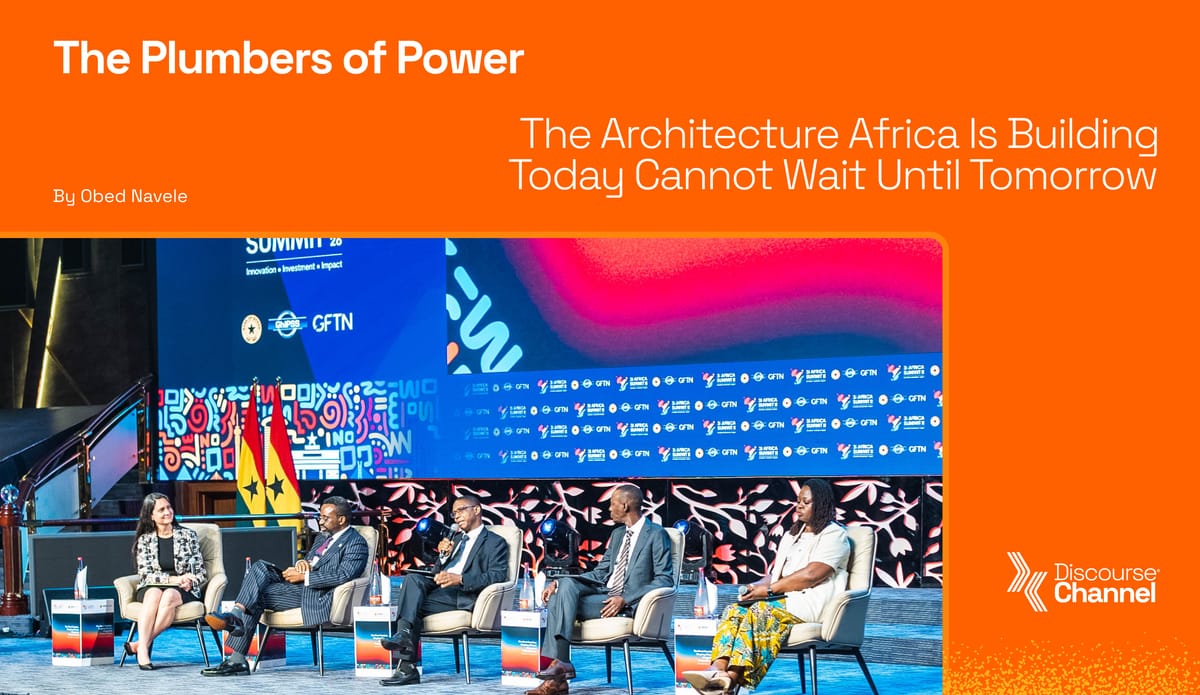
Ghana, Rwanda, Zambia and several other African states have now moved closer toward implementing a cross-border fintech passporting framework alongside a continental digital trade corridor built around interoperable payment systems and mutual recognition of digital identity frameworks. In practical terms, it means African fintech companies may soon be able to operate across multiple African markets without restarting the entire licensing process country by country.
For decades, Africa’s digital economy has expanded faster than Africa’s systems could integrate. African startups have repeatedly been forced to rebuild themselves every time they crossed a border: new licenses, new compliance systems, new regulations, new payment integrations, new settlement structures. What should have been a continental market often operated like dozens of disconnected economies sharing the same map.
The first three articles in this series traced a particular arc. The first asked why Africa's economic revolution will not be built on apps alone, and argued that coordination not invention is the continent's most urgent challenge. The second made the case that digital infrastructure is a political emergency, not a development project to be scheduled at leisure. The third confronted the harder question of power: who controls the rails, who owns the data, and who gets to write the terms under which Africa participates in its own digital future.
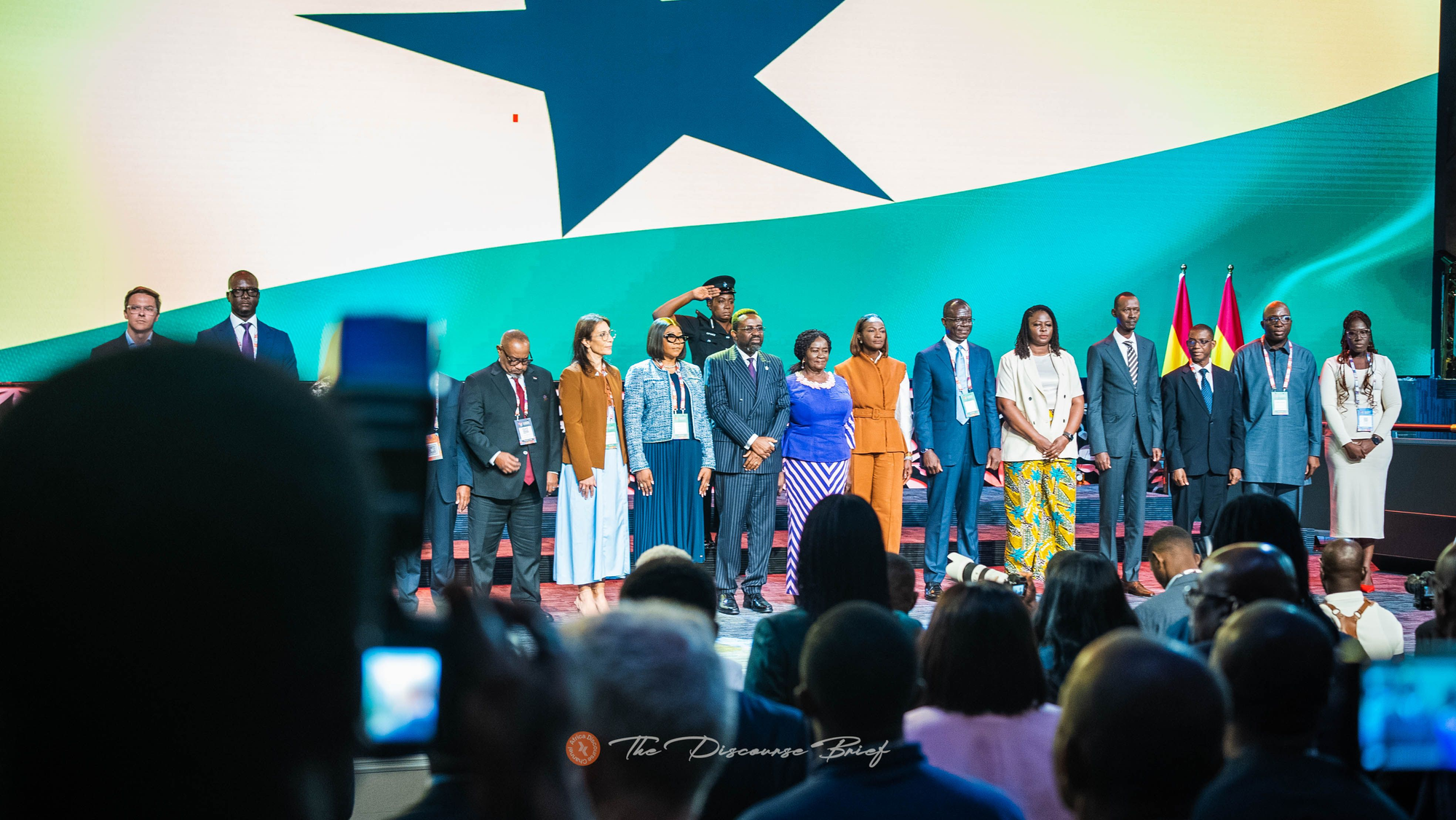
What the 3i Africa Summit ultimately revealed in the spaces between the keynote addresses, in the back-and-forth of panel rooms, in the frank admissions of governors and founders alike was something more unsettling than any of those three articles captured. It was this: Africa now knows what to build. This has been discussed for years. The real question that hung over every session was not what but how fast, for whom, and on whose terms.
The Fourth "I" — and Why It Changes Everything
Africa has already proven its capacity to innovate in ways the world has studied and adopted. Mobile banking that enabled financial inclusion, agent banking that reached remote communities, a continent that leapfrogged past legacy systems that took other regions decades to build. These are not small achievements. "Sixty-six percent of global mobile money transaction value comes from Africa," Sub-Saharan Africa has the highest number of adults with mobile money accounts. The statistics are real but what comes next?. innovation, investment and impact cannot deliver alone. It requires the hard, unglamorous, politically demanding work of implementation regulatory cooperation, institutional continuity, cross-border agreements, financing structures that survive changes in government, infrastructure investment that outlasts any single summit.
The summit's organizing frame was simple: three I's — innovation, investment, impact. Throughout the official language of the conference, another word kept quietly emerging from panel discussions, policy debates, investor conversations, and regulatory exchanges. Everyone, in one way or another, seemed to be pointing toward the same conclusion: implementation.
When Pipes Become Plumbing.
The highest ambition for infrastructure is invisibility and ‘’ at what point do pipes become plumbing?" . Professor Chris Brahma of the Fintech Foundation, asked this question: Daré Okoudjou, founder of Onafri, answered by pointing to what Africa actually built over twenty years with mobile money: a foundation more widely spread and more deeply understood than anything that came before it. "Mobile money is the most common form of current account in Africa. Over a billion people use it. For many, it was the first time they formed a formal relationship with a financial institution."
Our bank accounts did not just become interoperable until there were some sort of schemes put on them. Visa, Mastercard, Swift. What is the equivalent for mobile money?" The foundation exists. The next layer, the interoperability layer, the scheme layer, the equivalent of a Swift for mobile money, does not yet exist at scale.
From Olubemi Agboola of Flutterwave, to offer a merchant a single platform to receive payments across Africa, Flutterwave must individually integrate with every mobile money network on the continent, obtain a separate license in every country, negotiate commercial terms in each jurisdiction, and maintain infrastructure in markets that may not justify it on volume alone. One API, one pricing, one license, that is what an European fintech gets by default and that is what an African fintech has to earn, country by country, spanning years. The technology is available. The gap is regulation and policy. And until it closes, every African startup pays a fragmentation tax in time, capital, and attention that its counterparts in more integrated markets do not.
The Inclusion Gap That Access Numbers Cannot Hide
Internet use in sub-Saharan Africa grew by over 115% between 2016 and 2021 and more than 191 million additional people made or received digital payments in that period. These numbers are real. But, they are also misleading if read in isolation. Only about 22% of people actually use mobile internet, despite much wider coverage. Over 60% of people live within broadband reach but remain unconnected. African firms pay up to 35% more for digital tools than their peers in other regions. And while 86% of firms have access to digital tools, only a small fraction uses them intensively enough to drive productivity gains.
This is the usage gap, the affordability gap, and the productivity gap. Without addressing these, we risk digital access without economic transformation.
The distinction between access and use, between connection and empowerment is one the sector does not ponder on long enough. Coverage statistics and account-opening statistics measure inputs, not outcomes. The question is if the systems being built are reaching the people who most need them, and whether those people are gaining real economic agency, or simply gaining the ability to participate in systems whose value flows elsewhere.
The Data Question Behind Every Other Question
Data, its ownership, its quality, its use, and its strategic implications is not a technical issue or an economic issue but rather a governance issue.
The US institutional capital does not flow into African markets at the scale the continent warrants. Africa is perceived in the US as a data desert. Not because the data does not exist, it does, but because of data translation problems. African fintechs that have successfully attracted large-scale western investment, were not necessarily the most innovative, they were the most effective translators. They knew how to take behavioral insights and market dynamics from contexts that western investors did not understand, and reframe them in language that investment committees could evaluate.
This matters beyond capital markets. If African data whether on mobile money transactions, agricultural yields, health outcomes, or financial behavior cannot be structured and communicated in ways that attract the investment and policy responses it warrants, then Africa will continue to be described by others rather than narrated on its own terms.
The inverse problem also exists: the risk that African data flows outward to foreign platforms and data centers, generating value elsewhere. From the Vice President Jane Naana Opoku-Agyemang "If our data is stored and processed elsewhere, then even when we participate, we lack control." The practical implication is that Africa's digital participation, without deliberate data governance architecture, may deepen the very dependencies it is trying to escape.
Having more data does not automatically translate into better understanding. What separates mature AI companies from low-level companies, is the feedback loop, the structured intent behind data collection, the analytical tools applied to it, and the connection between data and decision-making. You can have a lot of data and still have unusable noise.
Sovereignty Is Designed, Not Declared
The quote "Sovereignty is not decided. It is not declared. It is designed. And whoever owns or controls the rails of money does not only facilitate trade but holds power." was spoken by Dominic Owusu, the Director and Head of the Currency Management Department at the Bank of Ghana.
This is the frame through which Africa's digital financial architecture must be evaluated, not whether it is technically sophisticated, but whether its design concentrates or distributes power, and whether that power stays on the continent or migrates to the infrastructure providers who build the rails.
Stablecoins for example are real and growing. Flutterwave is deploying them across multiple African markets with regulatory support. The Stellar Development Foundation's Jose Fernandez noted that euro-denominated stablecoins grew 154% in volume year-on-year, and that local-currency instruments are beginning to emerge and the Bank of Ghana has issued a gold coin and is working on its tokenization.
The vast majority of stablecoins currently circulating in Africa are denominated in US dollars. Which means that when Africans use them, they are, in effect, deepening the dollar's reserve currency status and contributing to the US Treasury not to any African sovereign. Are we opening up our stable currency infrastructure?, Because if stable currencies are backed by treasuries and Ghana has stable currencies that someone sitting in Hong Kong can purchase into, it is a show of confidence in the economy. The opportunity, in other words, is not just to adopt stablecoins. It is to issue them backed by gold, by oil, by the natural resources Africa produces, so that the value captured from their use flows into African economies, not out of them. Whether African governments, central banks, and private sector actors can coordinate quickly enough to seize that opportunity is an open question.
The Capital Problem Is Structural, Not Sentimental
Africa is not short of capital, it is home to some of the world's fastest-growing economies, it has the youngest population in the world, and the most strategic mineral assets. Yet African capital markets account for a small share of global portfolio allocation.
Why?
For institutional investors, the barriers are concrete issuer sizes below benchmark thresholds, wide bid-offer spreads, currency risk that cannot be hedged at sufficient depth, uneven default resolution processes, and the operational friction of markets where even routine transactions can create unexpected complications.
In late 2025, despite the Cedi's significant appreciation, the Bank of Ghana implemented a new Foreign Exchange Operations Framework to manage volatility and rebuild reserves. While intended to stabilize the macroeconomy, the framework introduced "structured discretion" that prioritized specific sectors such as Bulk Oil Distribution Companies (BDCs) over general market liquidity
This is the gap between a country being perceived as a good investment destination and being structured as one. The former is about narrative. The latter is about plumbing settlement cycles, FX hedging depth, KYC standardization, and disclosure frameworks. Ghana's pension industry is sitting on substantial capital that has very limited eligible investment destinations under current regulations. The capital exists. The pipeline of companies to absorb it does not. The Ghana Stock Exchange is attempting to address this through what it is calling a GSE Academy, a deliberate effort to nurture companies toward capital market readiness, so that pension fund managers have domestic options beyond government bonds.
Africa's Young Population: The Question Behind the Demographic Opportunity
The continent is the youngest in the world and technology adoption is accelerating. The African Development Bank estimates that AI could represent a $1 trillion GDP opportunity by 2035 and has the potential to create 40 million jobs. These numbers are cited so frequently they have begun to lose their force. The Oxford Government AI Readiness Index suggests that sub-Saharan Africa had the lowest average digital skills score in 2025. This does not mean the continent is incapable of AI development; there are excellent initiatives across multiple countries. But it does mean that many parts of the continent still grapple with infrastructure gaps, governance gaps, and skills gaps that will determine whether young Africans build the AI systems that shape their lives, or simply consume them. The choice is determined by investment decisions being made right now in digital education, in data center infrastructure, in regulatory frameworks that either encourage or discourage domestic AI development. It is determined by whether African governments treat AI governance as a sovereign priority or outsource it to frameworks designed elsewhere for different contexts.
Trust Is Not a Soft Variable
As fintechs scale, it is important to recognize that trust is the most important infrastructure. This statement applies equally to central banks, to governments, to the architects of continental integration frameworks, to development finance institutions, and to every platform that asks citizens or businesses to hand over data, money, or identity in exchange for services. Trust, in a digital financial ecosystem, is not a sentiment, It is a design specification. Citizens adopt systems when they believe their money is safe, their identity is protected, and the institutions behind the system are accountable. Investors commit capital when they believe the rules are predictable and the safeguards are real. Businesses cross borders when they trust that a contract enforced in one jurisdiction will be honored in another.
Identifying what the most underrated barrier to trust, we may consider : limited access to data, and a deep cultural mistrust between innovators and institutions. Fintech founders applying to test their products sometimes cannot obtain data from companies they approach, because those companies fear irrationally or not that the innovator will exploit it. University students pursuing ICT degrees cannot get internship placements at financial institutions because those institutions worry they will "steal the data." The human and institutional dimensions of trust run far deeper than any technical standard can fix.
Who Is This For?
The answer, is that it is being built for everyone, for the market woman who wants to receive mobile money without thinking about the infrastructure behind it, for the small business owner who wants to sell across Africa without rebuilding her compliance framework from scratch for every country, for the diaspora investor who wants to put capital into Africa and receive it back without FX complications, for the institutional fund manager who wants a liquid, transparent, predictable market. These are not incompatible beneficiaries. But they have different timelines, different power relationships, and different levels of leverage over the decisions that shape the systems they will use.
In the end, Africa is entering a systems era of pilot projects, startup ecosystems, and leapfrogging narratives giving way to something harder and more consequential: the era of institutional architecture. Who owns the rails? Who governs the data? Who sets the standards? Who captures the surplus.
The Systems Africa Builds Today
The conclusion of this series is not a call to optimism, nor a counsel of despair. It is something more demanding than either. Africa has already proven it can innovate. That argument has been settled. The harder arguments are about coordination, about sovereignty, about who captures value, about whether the systems being built, serve the people who need them most are currently operational.
The conversations, partnerships formed and impact from 3i Africa Summit will be measured, over time, by whether the MOUs between Rwanda and Ghana on fintech passporting become a model that spreads across the continent, or a footnote. By whether Ghana's virtual assets law becomes a template for regulatory clarity, or a local experiment. By whether the young engineer at the Bank of Ghana who is working on tokenizing gold goes on to design financial infrastructure that captures value for African people, or finds himself watching that value flow elsewhere through systems he helped build.
The systems being constructed right now, the payment rails, the data governance frameworks, the AI infrastructure, the capital market architectures will not announce their significance. They will simply become the invisible plumbing through which Africa's economic life flows and thus, how we design is the real concern.