What Senegal’s Constitutional Reforms Mean for Democracy in West Africa
In late June, Senegal’s National Assembly approved a package of constitutional amendments designed to rebalance power within government. Among the most significant changes are proposals to prevent the President from serving as the leader of a political party while in office...
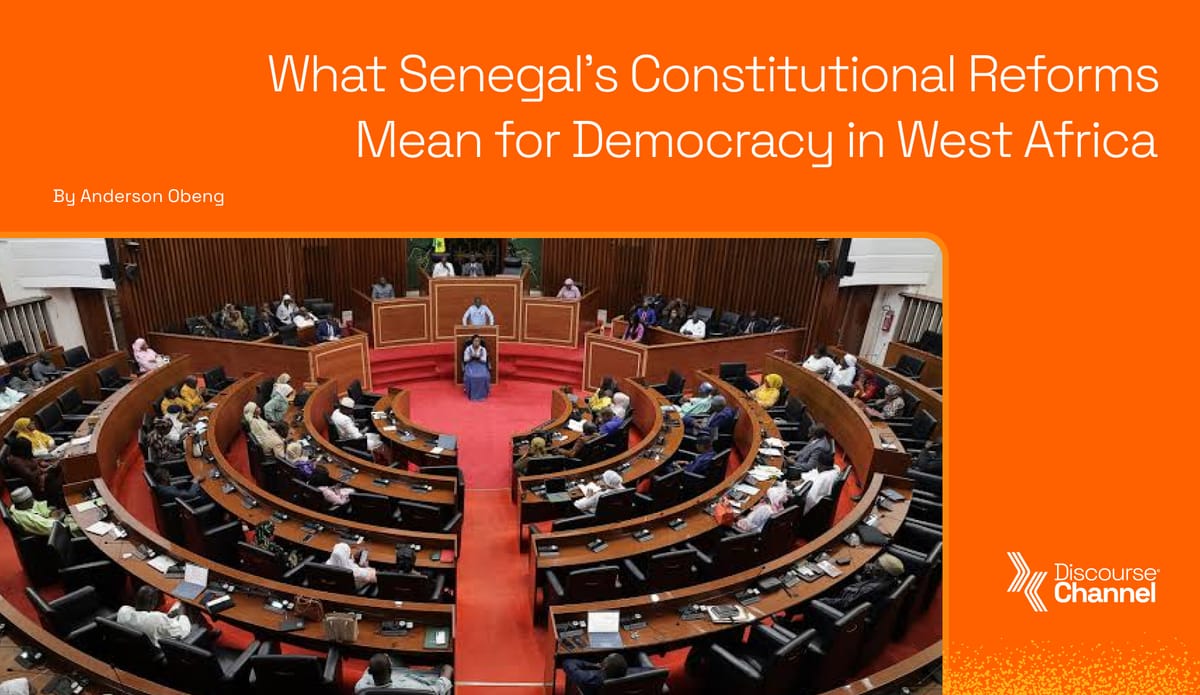
Democracies are often judged by the leaders they produce. Yet history repeatedly shows that the strength of a democracy depends less on who occupies the presidency and more on the institutions that limit, balance and oversee political power. That idea sits at the heart of Senegal’s recent constitutional reforms.
In late June, Senegal’s National Assembly approved a package of constitutional amendments designed to rebalance power within government. Among the most significant changes are proposals to prevent the President from serving as the leader of a political party while in office, establish a new Constitutional Court to replace the existing Constitutional Council, strengthen Parliament’s oversight role, and place tighter limits on certain presidential powers. Supporters argue that these reforms will reinforce democratic accountability by ensuring that no single institution dominates the political system. Critics, however, question both the political context in which the reforms emerged and whether constitutional amendments alone can deliver stronger governance.
The debate extends well beyond Senegal. It raises one of the most important questions confronting African democracies today. Can changing constitutional rules change the quality of governance?
Why Democracies Keep Returning to Constitutional Reform
Constitutions are designed to prevent excessive concentration of power. They define how governments operate, how leaders are held accountable and how different institutions interact with one another.
When constitutional reforms seek to reduce presidential authority, they usually aim to strengthen checks and balances by giving legislatures, courts and independent institutions greater influence over public decision-making.
In theory, this creates healthier democracies. Power becomes more evenly distributed. Institutions become stronger. Accountability improves. For many supporters, this is precisely what Senegal’s reforms attempt to achieve.
Rather than concentrating authority within the presidency, the reforms seek to create a system in which government decisions face greater institutional oversight.
Rules Alone Do Not Create Democracy
Yet constitutional reform has limits. Around the world, many countries possess constitutions that guarantee accountability, judicial independence and democratic participation. Some nevertheless continue to struggle with corruption, political polarization, weak institutions and declining public trust. The challenge is rarely the absence of constitutional rules.
The challenge is whether those rules are respected. A constitution cannot enforce itself. Courts require independence. Parliaments require genuine oversight powers. Public institutions require transparency. Political leaders must be willing to operate within the limits established by law. Without those conditions, constitutional reform risks becoming symbolic rather than transformative.
Senegal Matters Because Others Are Watching
Senegal has long been regarded as one of West Africa’s most stable democracies. Unlike several neighbouring countries that have experienced coups or prolonged constitutional crises in recent years, Senegal has maintained a reputation for constitutional continuity and competitive elections.
This makes its reforms particularly significant. Developments in Senegal often shape wider regional conversations about governance. When one of West Africa’s strongest democracies revises its constitution, policymakers, civil society organisations and governments across the region inevitably pay attention.
The reforms therefore represent more than domestic political change. They become part of a broader African conversation about how democracies should manage executive power.
The Real Test Begins After the Reform
Passing constitutional amendments is often the easiest part of institutional reform. Implementing them consistently is considerably more difficult. The effectiveness of Senegal’s reforms will ultimately depend on whether institutions exercise their new responsibilities independently and whether future governments respect both the letter and the spirit of the revised constitution.
This is where many reform efforts succeed or fail. Strong constitutions matter. But stronger democratic culture matters just as much. Public trust is built not only through constitutional design but through consistent application of constitutional principles.
Why This Matters
The significance of Senegal’s reforms extends beyond a single country. Across Africa, governments continue to debate executive authority, judicial independence, parliamentary oversight and constitutional change. Senegal now offers an opportunity to observe whether reducing presidential powers can strengthen democratic institutions in practice. Its experience may influence future governance debates far beyond Dakar.
Ultimately, constitutions establish the rules of democracy. Institutions protect those rules. People give those institutions legitimacy. Changing a constitution can reshape political structures. Whether it reshapes governance itself depends on everything that follows. That is the question Senegal’s reforms now place before the country and before the wider region.