West Africa’s Flood Crisis Is More Than a Climate Concern
In recent weeks, torrential rains have swept across several West African countries, leaving behind a familiar trail of destruction. The more difficult question is not why it rained. It is why the same cities continue to flood.
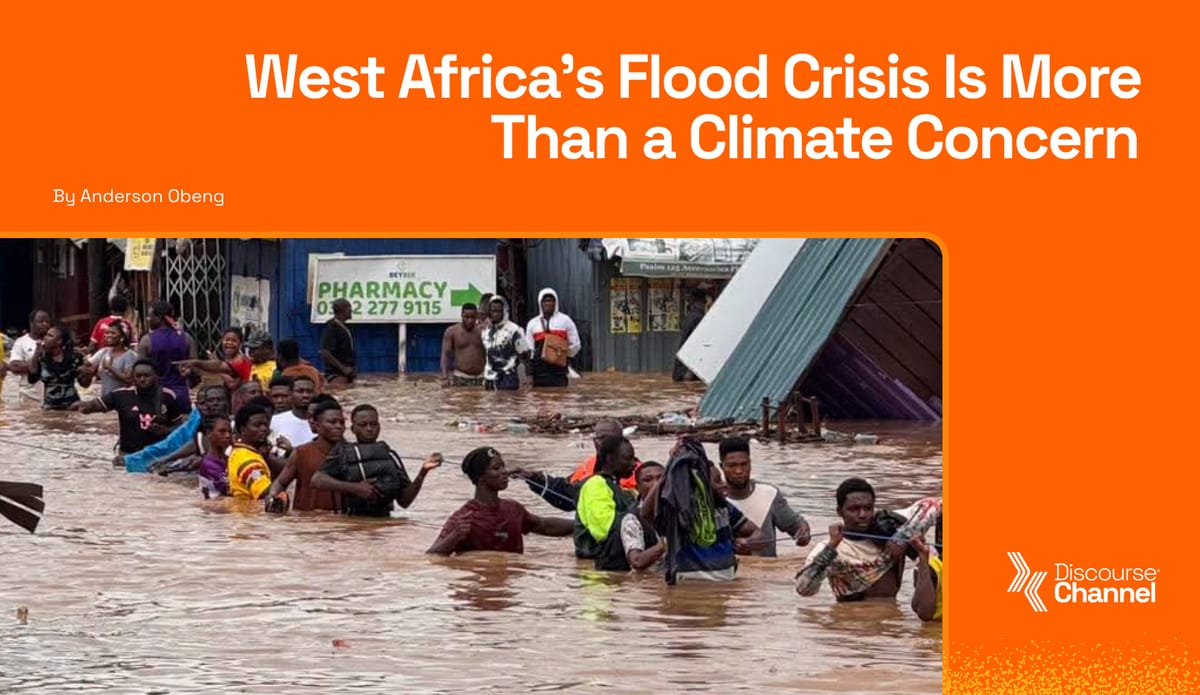
In recent weeks, torrential rains have swept across several West African countries, leaving behind a familiar trail of destruction. Floodwaters have inundated communities in Ghana, Nigeria, Sierra Leone, Liberia, Côte d’Ivoire and Guinea, claiming lives, displacing thousands of people, destroying homes and businesses, and disrupting transport and economic activity. In Ghana alone, flooding in Accra resulted in at least twelve deaths, prompting the government to release GH¢350 million for emergency relief and recovery.
For many residents, the scenes have become painfully familiar. Roads disappear beneath muddy water. Vehicles are stranded. Homes are submerged. Businesses lose stock overnight. Families are forced to begin again. Each year, the explanation seems straightforward: unusually heavy rainfall.
Climate change has undoubtedly increased the frequency and intensity of extreme weather events across many parts of the world, including West Africa. Scientists continue to warn that rising temperatures are making rainfall patterns less predictable and storms more intense. Yet climate alone does not explain why seasonal rains repeatedly become humanitarian disasters across the region.
The more difficult question is not why it rained. It is why the same cities continue to flood.
Urban Growth Is Outpacing Urban Planning
West Africa is one of the world’s fastest urbanising regions. Cities such as Accra, Lagos, Abidjan, Freetown and Monrovia continue to expand as populations grow and demand for housing, roads, shopping centres and commercial developments increases.
Urban growth itself is not a problem. In many respects, it reflects economic opportunity and national development. The challenge arises when cities expand faster than the systems designed to manage them.
In many urban centres, new residential estates, office complexes and commercial buildings continue to emerge, while drainage infrastructure, flood management systems and environmental planning struggle to keep pace. Roads are widened, buildings rise, and neighbourhoods expand, yet investments in storm-water drainage, flood retention systems and climate-resilient infrastructure often lag behind.
The result is a city that grows physically without becoming proportionately more resilient. Rainfall that might once have been absorbed or redirected instead overwhelms drainage channels, floods major roads and enters homes and businesses. In this sense, flooding is no longer simply a weather event. It has become a planning challenge.
Developing Without Resilience
The rapid transformation of many West African cities also raises important questions about how development decisions are made.
Every major construction project, whether an apartment complex, shopping centre, housing estate or commercial building, passes through planning and regulatory institutions before construction begins. Local authorities issue permits. Planning agencies approve land use. Environmental assessments are often required for larger developments. This raises an important question.
If governments are responsible for approving where development takes place, how do flood-prone areas continue to experience uncontrolled construction?
Across the region, wetlands have been reclaimed for housing, waterways narrowed by development and natural drainage channels obstructed by expanding settlements. These decisions may create valuable land for immediate development, but they also reduce the landscape’s natural ability to absorb excess rainfall.
Concrete replaces soil. Buildings replace wetlands. Water that once spread naturally across open land is forced into increasingly limited channels until those channels can no longer hold them. The consequence is not just flooding. It is a city whose own development is inversely proportional to its vulnerability.
Climate Change Is Raising the Risk, however Governance Determines the Impact.
Climate change cannot be excluded from the conversation around flooding. More intense rainfall means that governments must now plan for extreme weather conditions. Infrastructure designed for yesterday’s climate may no longer be sufficient for today’s reality.
But climate change does not automatically determine the scale of disaster. Cities with effective drainage systems, protected wetlands, strict enforcement of planning regulations and investments in climate adaptation are generally better positioned to withstand extreme rainfall than cities where these systems are weak or poorly maintained.
This is why climate adaptation has become as important as climate mitigation. West Africa cannot prevent every storm. But it can reduce the damage those storms cause.
The Cycle of Reactive Governance
Another pattern has become increasingly visible across the region. After every major flood, governments mobilise emergency responders, announce relief packages, visit affected communities and promise longer-term interventions.
These responses save lives and provide critical support to affected families. Yet they also reveal a deeper problem. The same emergency conversations return every rainy season. Relief funds are released after disaster strikes. Drainage systems are cleared after communities have already flooded. Planning reviews are announced after lives have already been lost. The region has become increasingly effective at responding to floods. The more difficult challenge is preventing them.
This distinction matters because disaster management is not only about emergency response. It is also about reducing future risk through proactive planning, stronger regulation, climate-resilient infrastructure and long-term investment.
Why This Matters
Urban Flooding is no longer simply an environmental issue.
It has become an economic issue, a housing issue, a public health issue and, increasingly, a governance issue. Every flooded market impacts livelihoods. Every damaged road slows economic activity. Every displaced family places additional pressure on already stretched public resources. As West Africa continues to urbanise, the question facing governments is becoming increasingly urgent.
Cities will continue to grow. Rainfall may continue to intensify. The real question is whether urban planning, infrastructure investment and governance will evolve quickly enough to meet this new reality. West Africa cannot stop the rain. But it can decide whether rain continues to become a disaster.