Citizenship as a Weapon: Niger’s Crackdown and the Future of Political Dissent
Niger’s ruling military junta, has taken a step that is raising difficult questions across the Sahel. The government has provisionally stripped exiled opposition figure Mariama Djibrine of her nationality, accusing her of inciting revolt and collaborating with foreign powers.
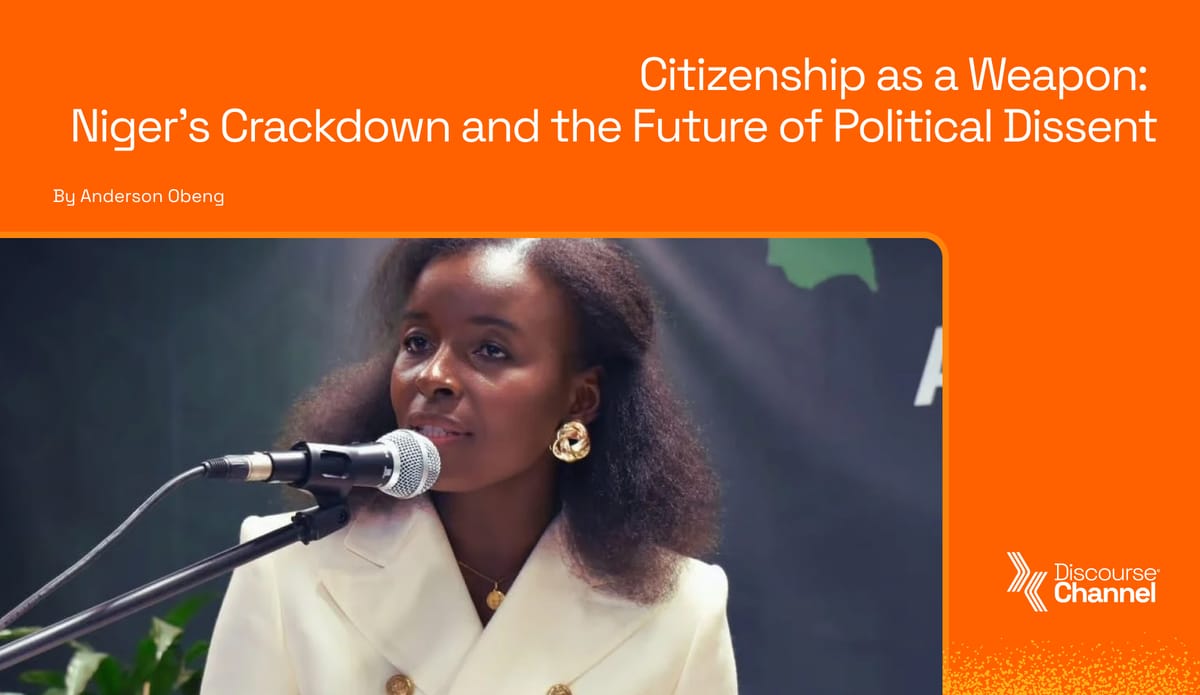
Niger’s ruling military junta, has taken a step that is raising difficult questions across the Sahel. The government has provisionally stripped exiled opposition figure Mariama Djibrine of her nationality, accusing her of inciting revolt and collaborating with foreign powers. The decision, framed by authorities as a matter of national security, marks one of the most severe political actions taken against an opposition figure since the military took power.
At the heart of the move is not just a legal dispute over one individual. It is a broader question about what citizenship means when it becomes entangled with political conflict, and whether states under military rule are expanding their authority into areas that were once considered protected from political interference.
A country under military consolidation
Since Niger’s most recent military takeover, the political environment has shifted significantly. The transitional authorities have positioned themselves as stabilisers in a period of insecurity, particularly in response to armed insurgencies and regional instability in the Sahel. In this context, the state has increasingly framed dissent not simply as political disagreement, but as a potential threat to national survival.
It is within this climate that the decision against Djibrine has emerged. She has been living in exile and remains a vocal critic of the military government. Officials have accused her of encouraging unrest and aligning with external interests hostile to Niger’s sovereignty.
While governments have a legitimate responsibility to protect national security, the way that responsibility is exercised becomes critical in moments of political transition. The stripping of nationality represents a particularly serious escalation because it does not only restrict political activity, it removes the legal foundation of belonging to the state itself.
Citizenship as identity and protection
Citizenship is not only a legal status. It defines the relationship between an individual and the state. It guarantees access to rights, protection under the law, and a sense of political and social belonging.
What makes the Niger case significant is not only the accusation against Djibrine, but the political context in which the decision has been made. When opposition figures are stripped of nationality, the effect goes beyond punishment. It raises questions about whether citizenship itself is becoming conditional on political loyalty.
This shift matters because it changes the nature of dissent. Opposition is no longer just disagreement within a political system. It becomes a factor that can determine whether an individual continues to belong to the political community at all.
Security concerns and expanding state authority
The justification offered by authorities centres on national security. Like several governments across the Sahel, Niger faces ongoing threats from armed groups, cross-border militancy, and internal instability. In such environments, governments often expand their security powers in response to genuine threats.
However, security measures taken in periods of crisis can also reshape the boundaries of state authority. The line between protecting national stability and restricting political freedoms can become increasingly blurred, particularly when opposition figures are framed as collaborators with foreign forces.
This tension raises a difficult question: when security becomes the primary lens through which political activity is judged, what safeguards remain for political dissent?
The concern is not limited to Niger alone. Across the Sahel region, military governments have increasingly consolidated power following coups and transitions away from civilian rule. In several cases, political space has narrowed, with opposition activity subjected to heightened scrutiny and legal restrictions.
A wider regional pattern
The Niger case is part of a broader regional context in which questions about governance, legitimacy, and political competition are becoming more acute. Military-led governments in parts of West Africa and the Sahel have justified their role as necessary responses to insecurity and governance failures under previous administrations.
When citizenship becomes a tool that can be withdrawn in response to political opposition, it signals a shift in the balance between state authority and individual rights. It also raises the possibility that political disagreement may increasingly be treated as disqualification from national belonging.
This is not only a legal issue. It is political. It speaks to how states define loyalty, and what space remains for disagreement within systems under pressure.
The limits of security-driven governance
Governments facing instability often operate under intense pressure to demonstrate control. In such environments, actions taken in the name of security can expand quickly, especially when institutions designed to check executive power are weakened or undergoing transition.
The challenge is that while security threats are real, responses that weaken political rights can create long-term consequences. When opposition is criminalised or stripped of legal standing, it can reduce the space for peaceful political engagement and increase mistrust between citizens and the state.
At the same time, governments argue that strong measures are necessary to prevent destabilisation. This creates a difficult balance between maintaining order and preserving political freedoms.
The Niger case sits directly within this tension.
A question of precedent
One of the most important implications of the decision is the precedent it may set. If citizenship can be revoked for political activity deemed hostile to the state, it raises questions about where the limits lie.
Could similar measures be applied to other opposition figures? Could criticism of government policy be interpreted as grounds for questioning national allegiance? And what safeguards exist to prevent such powers from being used more broadly?
These are not abstract concerns. They go to the heart of how political systems define belonging and dissent.
Where the line is drawn
The decision to strip Mariama Djibrine of her nationality forces a broader reflection on the relationship between the state and its citizens in times of political transition.
When governments face threats to stability, the temptation to expand state power is significant. But the way that power is used determines whether political systems remain open or become increasingly restrictive.
The central question raised by the Niger case is not only about an opposition figure. It is about whether citizenship remains a protected right, or whether it becomes conditional on political alignment.
When governments face opposition, the challenge is not simply to maintain security. It is to decide where the line is drawn between protecting the state and preserving the rights of those who belong to it.