Whose Africa Is It Anyway? The Fight for Capital, Sovereignty, and the Right to Build on Your Own Terms
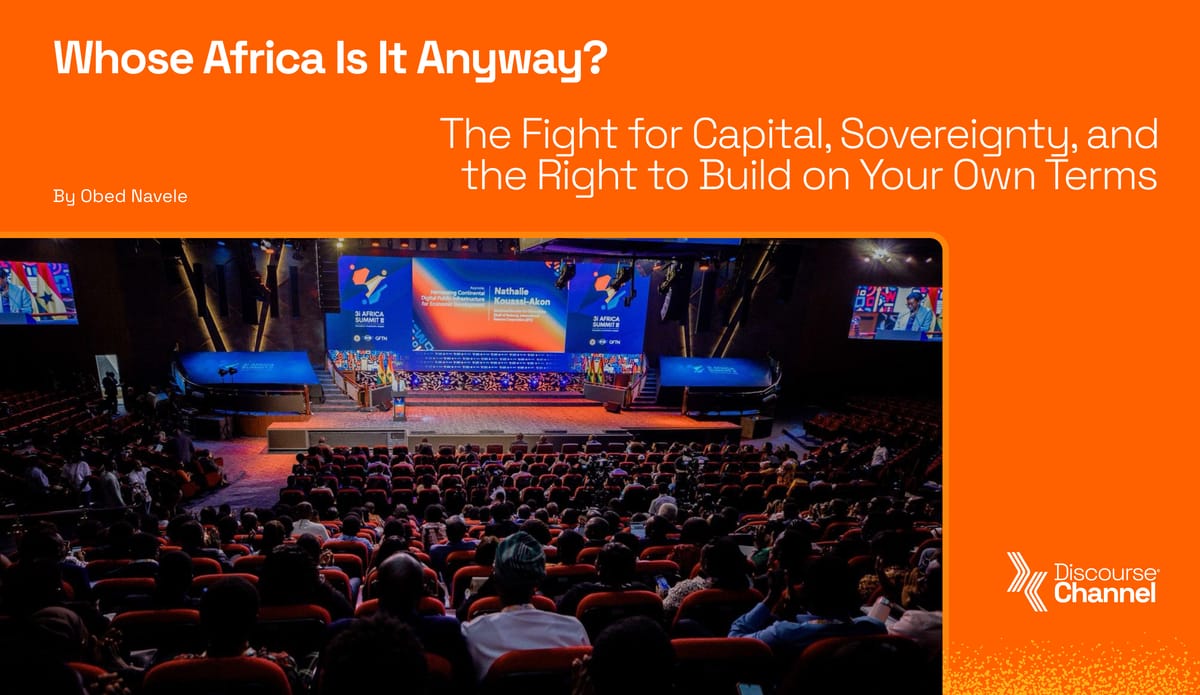
By the third day of the 3i Africa Summit 2026, the conversation had evolved in a way that felt almost inevitable. The summit had arrived at the question that had always been lurking, the one that nobody in a convening of this kind wants to ask: whose Africa is it anyway?
Africa raised a record $3.42 billion in startup funding in 2025. That number is a more unsettling story about who controls the capital, who owns the data, and whether Africa is building a future it actually owns.
By the third day of the 3i Africa Summit 2026, the conversation had evolved in a way that felt almost inevitable. The first day had laid the diagnostic: the infrastructure, governance, and institutional alignment that determines whether a continent grows for itself or for Africa's next economic transformation would not be built on applications alone, but on the deeper logic of coordination. The second day had sharpened the argument into a political one, framing continental digital infrastructure not as a technical aspiration but as an emergency. By day three, the summit had arrived at the question that had always been lurking beneath the surface, the one that nobody in a convening of this kind wants to ask too directly but that everything eventually leads back to: whose Africa is it anyway?
It is a question that carries weight precisely because it has no comfortable answer. Africa's digital economy is growing. Mobile money transactions are scaling. Fintech valuations are rising. Startup ecosystems in Africa are producing founders who can compete on global stages. And yet, the deeper you look at the architecture of this growth who owns the data, who sets the rules, who captures the value, who defines the terms the more you begin to suspect that the continent is in danger of reproducing, at digital speed, the same structural inequalities that have defined its economic history.
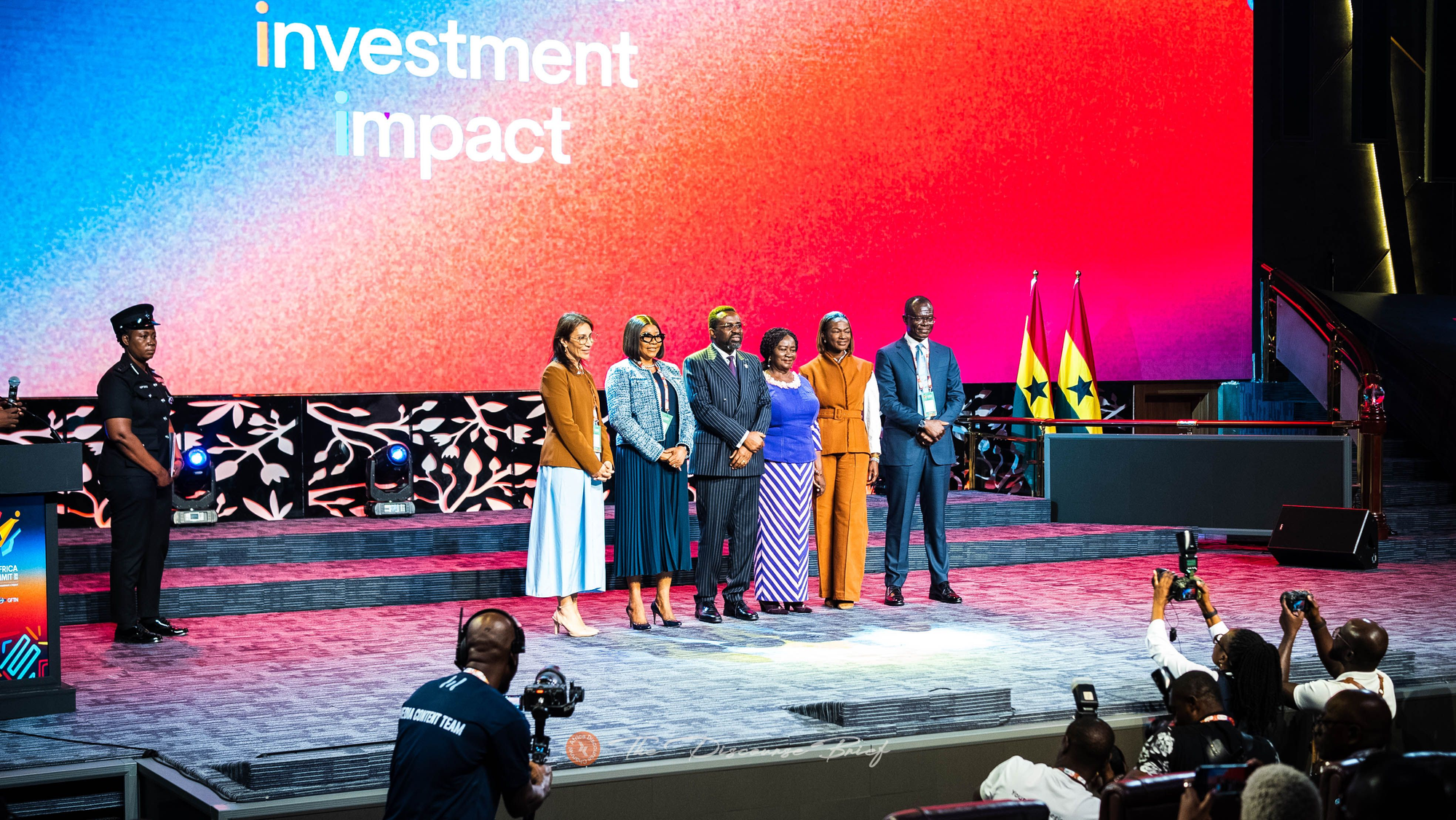
"If digital progress only serves those who are already visible and easy to serve, then we are simply digitizing advantage." This observation was made by the Deputy Governor of the Bank of Ghana, Mrs. Elsie Addo Awadzi. The line was clear and striking because it named what polite summitry usually avoids naming. Technology is not neutral. Every platform encodes assumptions. Every payment system carries a governance logic. Every data architecture decides, implicitly or explicitly, who counts and who does not. The real question we are compelled to ask is if digitization will expand participation or merely accelerate it for the already included.
This is why the summit's most revealing conversation was not about venture capital returns or startup unicorns, but about the regular individual, informal workers, market traders, rural users, and the hundreds of millions of Africans whose economic lives happen outside the formal systems that technology typically serves first. These are not edge cases, they are at the centre. They represent the majority of African commerce, African labour, and African ingenuity. And yet, for most of the continent's celebrated digital infrastructure from mobile money rails to credit scoring systems these demographics remain an afterthought, a secondary market to be converted once the primary architecture is established for high-value users.
The danger, as several voices at the summit made clear, is that Africa builds systems that are technically sophisticated but institutionally exclusive. A payment interoperability framework that connects banks but not informal savings groups. A digital identity system that functions for urban professionals but not for rural smallholders. A credit infrastructure that reads transaction histories on smartphones but ignores the vibrant commerce that has always existed beyond those screens. "Innovation without infrastructure cannot scale," one investor noted but the inverse is equally true: infrastructure without inclusion is not transformation. It is simply a more efficient version of what already exists.
Beneath this lies a political economic question that the summit did not shy away from, it circled it carefully. Africa's digital transformation is being built largely on foreign capital, foreign platforms, and foreign regulatory models. This is not inherently corrupt, capital has no ideology, and good infrastructure serves people regardless of who financed it. But it is not without consequence. Capital flows where systems work, and systems are designed by those who build them. When the infrastructure of an economy, its payment rails, its data architecture, its connectivity backbone is owned and operated outside the continent, the question of sovereignty is not abstract. It is the most concrete political question of the digital age.
The world is changing and everybody is looking within for strength. In an era of splintering global trade, strategic reshoring, and intensifying competition over digital standards, Africa's dependence on external capital and external platforms is not an economic risk but a sovereignty risk. A continent that does not control its own data infrastructure does not fully control its own economic decisions. A continent whose AI systems are trained on foreign data with foreign assumptions will produce an artificial intelligence that serves foreign interests first.
The African capital was one of the summit's most candid conversations. Africa has wealth. The continent's pension funds, sovereign wealth vehicles, insurance assets, and diaspora remittances represent pools of capital that, if mobilised purposefully, could reshape the funding landscape for African technology. And yet, as speaker after speaker acknowledged, African capital consistently underweights African innovation. The reasons are structural regulatory barriers, liquidity concerns, governance deficits but unfortunately these barriers stem from cultural perceptions. There exists, still, a persistent scepticism among African institutional investors about African risk, a preference for the safety of external assets over the uncertainty of continental ones. "Africa must learn to invest in itself," one venture capital leader said plainly. It was not a new argument. But the fact that it still needed making, in 2026, at a summit dedicated to Africa's technological acceleration, was its own diagnosis.
This risk-appetite problem goes way beyond financial cases, It is also political. When African capital does not flow into African technology, African technology flows toward foreign capital and with foreign capital come foreign terms, foreign board compositions, foreign exit timelines, and foreign definitions of what counts as a successful business. The result is a startup ecosystem that looks African from the outside but is often governed by incentive structures that point elsewhere. Founders optimize for global venture returns rather than continental impact. Investors optimize for dollar exits rather than infrastructure durability. And the systems that get built reflect these priorities, serving the users and use cases that make financial sense to the people holding the money.
Africa's terms is a design principle, and it is worth pausing on what that means in practice. To build on Africa's terms is to design payment systems around how Africans actually transact, not how they are supposed to transact according to imported models. It is to build identity systems that account for the informality and mobility that characterise most African lives. It is to build AI on African languages, African datasets, and African priorities. It is to structure regulation that protects African data, builds African institutional capacity, and ensures that the value created by African users does not immediately exit the continent through the financial architecture of foreign platforms. It is, at root, a refusal to allow the continent's digital future to be designed by people who are not accountable to it.
Interoperability, a word that appeared repeatedly across all three days of the summit is, when understood properly, a political concept. The push for harmonised payment rails, aligned regulatory frameworks, and integrated digital identity infrastructure across African markets is not primarily a technical exercise, It is a sovereignty exercise. It is the recognition that a continent fragmented into fifty-four separate digital markets cannot negotiate on equal terms with global platforms, cannot attract the kind of patient capital that builds durable systems, and cannot develop the institutional depth to govern its own digital transformation. Harmonisation is how Africa gets to have leverage. And leverage, in the digital economy, is what determines who sets the rules.
The summit's third day ultimately surfaced what the previous two had been building toward: a recognition that Africa's biggest challenge is not innovation. The continent has demonstrated, repeatedly, that it can innovate under constraint. The challenge is institutional architecture. It is the system of rules, incentives, capacities, and relationships that determines whether innovation accumulates into durable transformation or dissipates into a series of celebrated but isolated experiments. Mobile money worked in Kenya. It did not automatically work everywhere else. That is not a technology failure. It is an institutional failure: a gap in the regulatory environment, the trust infrastructure, the interoperability frameworks that would allow what works in one context to scale across a continent.
There is, underlying all of this, a genuine cause for strategic hope. Africa's very lateness to formalised digital infrastructure is, paradoxically, its most significant asset. The continent is not locked into the legacy architectures that constrain more developed economies. It does not have to digitise old systems. It can build new ones. And in an era where artificial intelligence, distributed ledgers, and next-generation connectivity are rewriting the rules of what digital infrastructure can do, Africa has a once-in-a-generation opportunity to design systems that are not merely as good as the global standard but structurally better because they were built for the real complexity of African life rather than retrofitted to it.
But windows close. The global technology order is consolidating. Standards are being set. Data governance regimes are being embedded. AI systems are being trained. The infrastructure decisions being made right now by African governments, African regulators, African investors, and African founders will determine not just the shape of the continent's digital economy for the next decade, but the degree of sovereignty it retains over its own future. That is what the 3i Africa Summit 2026 was, at its most serious level, about.
Not technology, Power. Not connectivity, Governance. Not startups, but Ownership. And the final question it leaves behind, the one this series will attempt to answer fully in an extended synthesis to follow. Whether Africa's leaders, in all their forms, have the institutional courage to build for the continent's majority rather than its minority, on Africa's terms, at the speed the moment demands.