Africa Cannot Afford to Build Slowly: The Case for Continental Digital Infrastructure as a Political Emergency
Forty-six percent, that is the share of African adults who remain entirely outside the formal financial system. Set it alongside the headline numbers the $2 trillion in mobile money transactions, the 66% share of global mobile money value and what you get is not a success story.
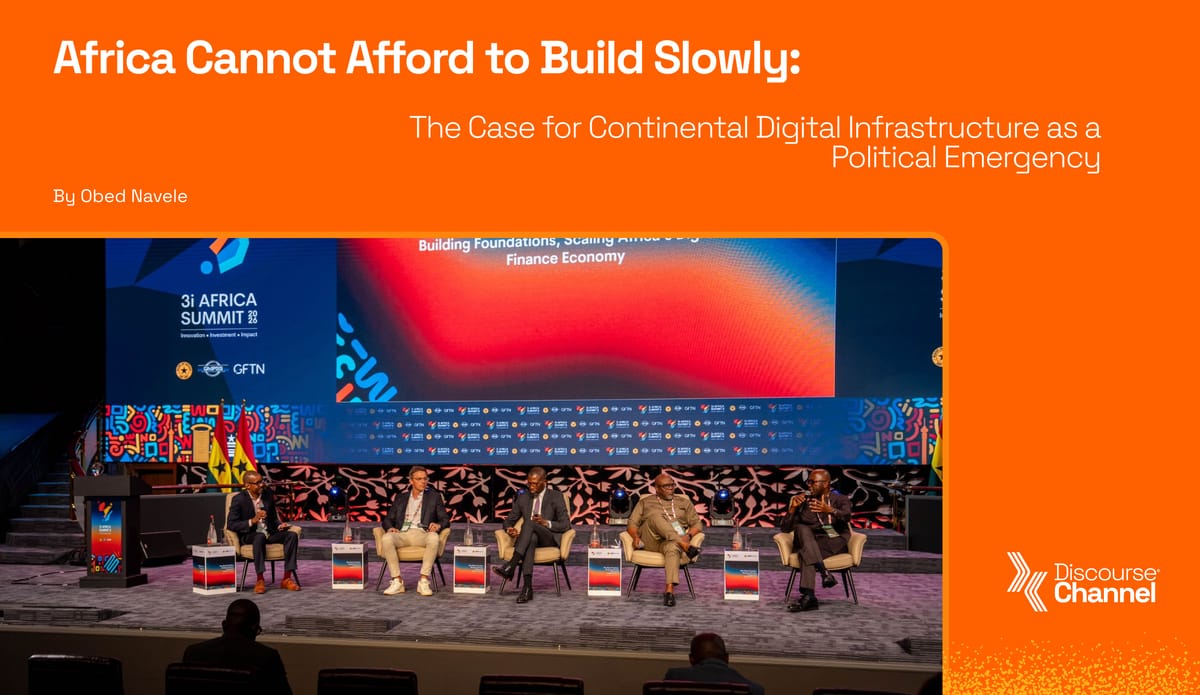
Africa has proven it can innovate in digital finance and Day Two of the 3i Africa Summit raised a harder, quieter question: can it build the infrastructure that makes that innovation matter to everyone?
Forty-six percent, that is the share of African adults who remain entirely outside the formal financial system. Set it alongside the headline numbers the $2 trillion in mobile money transactions, the 66% share of global mobile money value and what you get is not a success story. You get a paradox, a continent that has simultaneously demonstrated extraordinary capacity for digital financial innovation and extraordinary failure to extend that innovation to the majority of its people. You can refer to the first article for deeper analysis: The Coordination Imperative: Why Africa's Next Economic Revolution Won't Be Built on Apps.
This contradiction sat at the centre of Day Two of the 3i Africa Summit 2026 in Accra. The moment became an unavoidable structural challenge behind every conversation about platforms, systems, interoperability, and digital public infrastructure. Day One asked what Africa was building, Day Two is asking who, exactly, is it being built for?
Nathalie Kouassi-Akon, Divisional Director for West Africa at the International Finance Corporation, came to the summit's Day Two keynote with a diagnosis that dispensed with diplomatic softening. Africa's digital ecosystems, she argued, have reached a critical turning point; the continent no longer needs more applications or more platforms. What it needs are connected systems that allow its digital economy to grow as one. That distinction between platforms and systems carries more weight than it might appear.
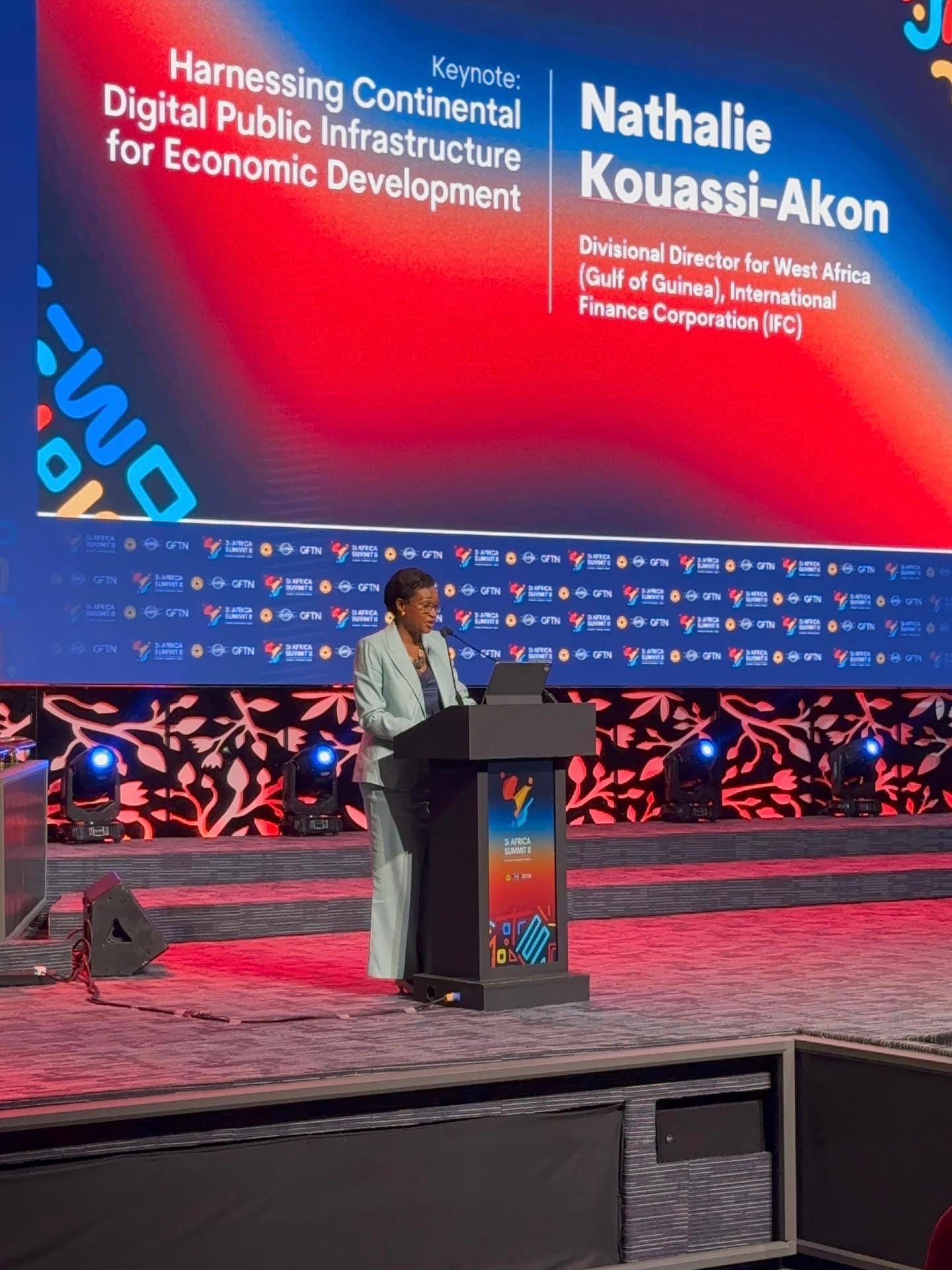
A platform is a product, a system is infrastructure. Products compete and Infrastructure coordinates. Africa has spent the last decade building extraordinary products and has not yet built the infrastructure that connects them into an integrated continental economy. The consequence of that gap, as Kouassi-Akon made clear, is not merely inefficiency, It is unfair. More than 40.6 million informal businesses across Africa stand to benefit from digital transformation but only if they are able to formalise, scale, and cross borders. Without connected systems, those businesses remain trapped in local markets, invisible to continental capital and disconnected from the trade corridors that the AfCFTA was designed to open.
There is something important in that figure: 40.6 million informal businesses. It forces a recalibration of the entire narrative around digital finance in Africa. The conversation has too often centred on individuals: the unbanked farmer, the mobile money user, the first-time digital wallet holder. But the real engine of economic transformation is not individual access, it is enterprise. It is the small trader in Kumasi whose digital footprint could qualify her for a loan, the artisan cooperative in Cotonou whose payment records could unlock supply chain financing, the logistics company in Mali whose cross-border transactions are currently denominated in dollars because no African interoperable corridor exists to handle them otherwise.
Digital public infrastructure, done right, is what bridges that gap. But to be direct about what stands in the way, infrastructure deficits, unreliable electricity, limited digital skills, and regulatory fragmentation across African markets remain fundamental obstacles that must be addressed alongside, not after, digital investment. Africa's policy community is sometimes reluctant to state plainly: the digital transformation agenda cannot succeed if it is designed only for the parts of the continent that already have reliable power, urban connectivity, and technically literate populations. If the system is not built for the margins, it is not really a system, it is just a better-looking silo.
The question of who finances this infrastructure exposed the most serious structural tension of the day. African countries currently finance approximately 90% of infrastructure projects from domestic resources, placing enormous pressure on government budgets that are already stretched by debt servicing, climate adaptation, and social spending. At the same time, the private sector has historically been reluctant to commit capital to long-gestation infrastructure without clear regulatory certainty and credible risk-sharing arrangements.
Kouassi-Akon's proposed model positions governments as enablers of policy rather than primary financiers, with development finance institutions like the IFC de-risking investments and providing first-loss capital, while the private sector contributes operational expertise and long-term funding. It is a sensible architecture. It is also one that has been proposed at many African summits before this one, without always generating the institutional momentum to execute it.
The gap between the model and its execution is where the hard questions are asked. Development finance institutions operate on timelines and risk appetites that do not always match the speed at which digital markets evolve. Governments that set enabling policies do not always maintain them consistently through electoral cycles. And private capital, however eager it may be in principle, ultimately follows returns which means the digital infrastructure investments most likely to attract it are the ones serving already-connected, already-profitable markets. The 40.6 million informal businesses do not automatically follow from the investment model being proposed. Getting to them requires deliberate design choices, cross-subsidisation mechanisms, and regulatory commitments that outlast individual administrations.
"Without integration, Africa risks scaling silos rather than scaling growth," That is a sentence worth sitting with. Because the risk identifying is not hypothetical it is already visible. Across the continent, well-funded digital payment ecosystems exist in parallel, unable to communicate with each other. Identity systems are duplicated across sectors and borders, data moves slowly and expensively, and the informal businesses that represent the backbone of African economies continue to operate on the margins of a digital transformation that was supposedly built for them.
Building connected systems is not only a technical challenge, It is political .
- Who controls the data that flows through a shared digital infrastructure?
- Who sets the standards that determine interoperability?
- Who adjudicates when national regulatory frameworks conflict with continental integration requirements?
These are questions that require institutional agreements, legal frameworks, and sustained political will, the precise commodities that are hardest to produce at continental scale and not questions that technology resolves
The AfCFTA Digital Trade Protocol, adopted in 2024, provides a foundation. But the work of translating that framework into operational reality is vast, uneven, and in many countries, barely begun. Some nations have built agile regulatory environments capable of hosting digital infrastructure at scale. Others are still negotiating the basic terms of data sovereignty within their own borders. A continental system cannot be stronger than its weakest national node.
What gave Day Two its particular texture was the insistence from multiple voices in the room that these are not reasons to wait. They are reasons to move faster, with more deliberate coordination. The continent's demographic window is open now. The 1.4 billion Africans who will join the workforce by 2050 will need economic infrastructure that exists, not economic infrastructure that is still being debated.
There is a version of this story that ends in frustration: grand frameworks, persuasive keynotes, unimplemented pilots, and another summit two years hence covering the same ground. That version is not inevitable. But it requires something beyond technical capability and development finance.
It requires the continent to treat digital public infrastructure as a political priority not a development project, not a technology initiative, but as the foundational layer of a continental economy. The same urgency that African governments applied to building roads and ports in the 20th century must now be applied to building interoperable payment corridors, shared digital identity systems, and harmonised data governance frameworks in the 21st.
"The next step is not about building more apps or more platforms. It's about building connected systems that allow Africa's digital economy to grow as one," but the more important question, as always, is what it does next.
This is Part Two of a three-part series covering the 3i Africa Summit 2026. In our Day One piece, we examined the coordination imperative of how Africa has moved past the access milestone into the harder challenge of building the connective tissue between its national digital ecosystems. Day Two deepened that argument, bringing the informal economy, infrastructure financing, and governance into sharper focus.
Day Three will bring another interesting finding and after, we will conclude with a critical analysis of the full three-day conversation: what the summit collectively revealed, what it avoided, and what its outcomes mean for the trajectory of Africa's integrated digital economy. The most important question of this summit is not what was said in any single session. It is whether the sum of three days of deliberation produces something more durable than the deliberations themselves.