Threads of Africa – Episode 3: Mali's Bogolan and the Future It Holds
This is Bògòlanfini — Bogolan — the mudcloth of Mali. It is one of the most quietly powerful stories Africa has never fully told the world. In a continent where so much of the conversation about progress centers on what lies underground, minerals, oil, gold.
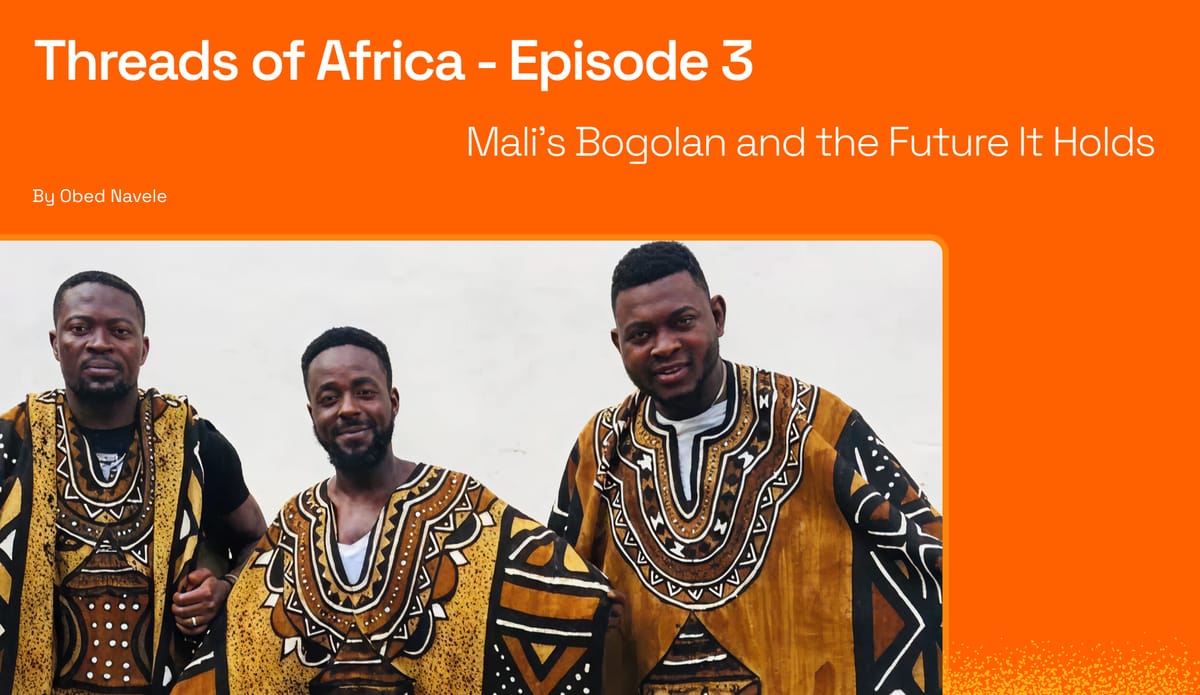
Africa has always known how to make beautiful things, the world just isn't paying attention. “They say that Bogolan is made of the earth, the river, the forests, and the sun of Mali. It is literally true, but it is even more than that.” A Malian weaver’s proverb.
This is Bògòlanfini — Bogolan — the mudcloth of Mali. It is one of the most quietly powerful stories Africa has never fully told the world. In a continent where so much of the conversation about progress centers on what lies underground, minerals, oil, gold. Bogolan makes us look at what lies before us: the hands of an artisan, the patterns dyed into cotton by fermented earth, the knowledge passed from a mother to her daughter across generations that no school curriculum, no development report, no economic indicator has ever adequately captured.
This is the third episode in our journey through the fabric traditions of West Africa. We have explored Ghana's Fugu and Togo’s Kete,. Now we arrive in Mali, a nation that is, by almost every economic indicator, counted among the poorest in the world, and yet sits upon one of the most extraordinary cultural and creative inheritances on the planet. Mali is Africa’s largest cotton producer. The cotton is cultivated along the banks of the Niger, watered by one of the continent’s most storied rivers. And yet, as we will see, cotton leaves the country mostly as a raw material traveling to factories abroad, transformed into garments, and sold back to Africans at a price only a few can afford. Looking at this, we can say this is not merely a poor economic decision, but a story about a country that has not been allowed or allowed itself to finish what it starts.
Bogolan, in all its quiet, mud-brown beauty, represents the existence of potential. It is a fabric made entirely from Mali’s own land, shaped by Mali’s own hands, and carrying the history of the Mali people. It asks a simple but urgent question: What if Mali stopped exporting its raw materials and started finishing its own cloth? What if the value added stayed here in the hands of the farmer, the dyer, the weaver, the mother teaching her daughter by firelight?
This episode is about that question. About the alchemy of mud. About the artisans, the economics, the dangers, and the dreams. About what Bogolan can teach us not just about Mali, but about Africa’s future as a whole.
Mali: Its People and Their Traditional Garments
Before we can understand the cloth, we must understand the land that made it. Mali is a vast country, the eighth-largest in Africa, stretching from the dry Sahara of Northern Africa down to the fertile savannas and river valleys in the south. It is a land of enormous geographical contrast, the same country that contains Timbuktu, the legendary city of salt and learning, also holds the Office du Niger, one of West Africa’s most productive agricultural zones.
Mali is a home to more than twenty recognized ethnic groups, each with their own traditions of fabrics, craft, and identity. The Bambara people of the central and southern regions are the most numerous and culturally dominant, and from their tradition that Bogolan directly springs. But the Dogon, the Peul, the Tuareg, the Malinke, and the Songhai all contribute to a textile culture of enormous depth and variety. Cotton has been grown here for centuries. Today, Mali produces more cotton than any other country in Africa, with the crop intersecting the lives of roughly four million people and contributing an estimated fifteen percent of the country’s GDP. Nearly forty percent of Mali’s rural population depends on cotton farming, and for many of these families, the annual cotton harvest is the primary moment of financial stability in a year otherwise defined by subsistence and uncertainty. This is precisely why SDG 2, Zero Hunger is not an abstract development target in Mali. It is a lived reality, kept into the same seasons that determine whether a cotton crop succeeds or fails. Food security and agricultural stability here are not separate from the textile economy. They are the same question, asked by the same families, in the same fields.
And yet, something is deeply wrong in the arithmetic of this abundance. Despite being Africa’s cotton giant, Mali barely refines two percent of its raw cotton into finished products before export. They leave the country as raw fiber to be spun, woven, dyed, cut, and sold by someone else, somewhere else. The local value chain that should lift Malian farmers and artisans is, for the most part, does not exist in Mali. This is the paradox at the heart of Mali’s story. A country rich in raw material but poor in the systems needed to translate that material into lasting wealth. A country whose children know how to grow cotton but do not have the means to turn them into a finished product capable of becoming a global fashion phenomenon.
Bogolan — mudcloth — is not a solution in isolation. But it is a proof of concept. It is evidence, cotton dyed with fermented mud, that Mali is capable of making something extraordinary from already available resources.
Bogolan is not Mali’s only textile tradition. Mali has many traditional fabrics, including the Bazin cloth, the Khasa wool, the Hunter’s Tunic, among others. Like every African country, Mali carries a wardrobe of cultural expression that reflects the diversity of its people.
The Hunter's Tunic — Donsodonkili
Of all the garments in Mali's rich textile catalogue, none carries a heavier spiritual charge than the Hunter's Tunic also known as the Donsodonkili, cloth of the Donso. Here, the tunic is not clothing in any ordinary sense but an armor and a biography. It is a living record of everything a man has survived, learned, and earned in his lifetime, in civilization and in the wild. To look at a Donsodonkili is to experience legacy. The tunic is covered in talismans animal horns and teeth, small mirrors meant to deflect evil, and secret leather pouches called basis, each is filled with protective verses known only to their maker. Every charm marks a moment when a hunt survives, a spirit is confronted, a lesson learned deep in the bush where ordinary rules no longer apply.
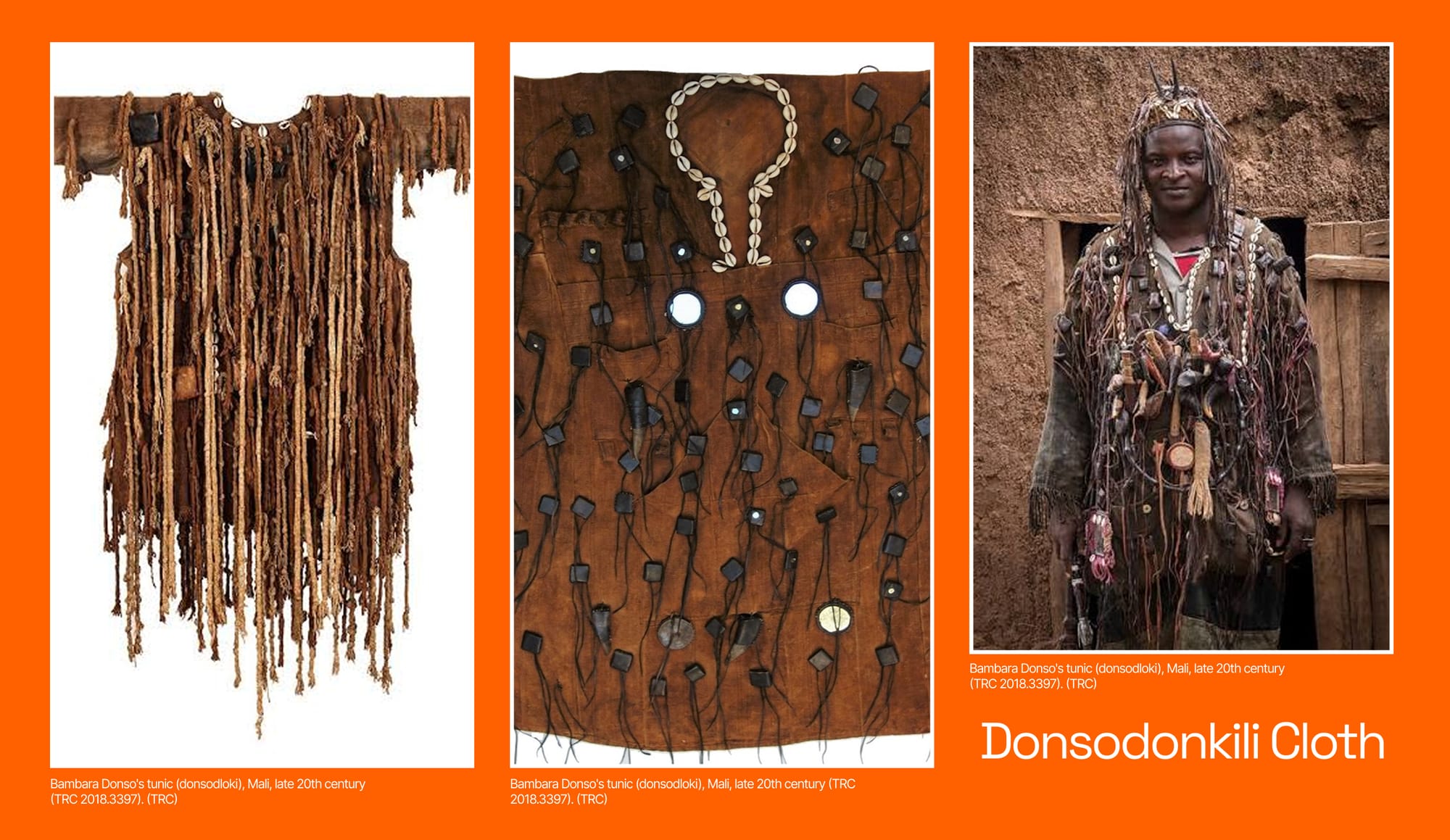
In Malian culture, Donso hunters are regarded as cultural heroes who navigate both the physical wilderness and the spirit world within it. Their tunic is their credential, worn on their body. The symbols are understood to bring strength, sharpen instinct, and connect the wearer to his ancestors and to every hunter who carried this knowledge before him. Even today, some Donso still wear these tunics during rituals and important hunts, a quiet reminder that in Mali, the sacred and the practical have never really been two different things. They were always the same cloth.
Bazin Cloth
If Bogolan speaks in the language of earth and symbols, Bazin speaks in the language of Panache and Drama. Smooth, shiny, and dyed in deep saturated colors, indigo blue, rich burgundy, forest green, royal purple. Bazin cloth announces whoever it clothes even before they speak. It is Mali's fabric of celebration, of status, of occasions that mark a life of significance.
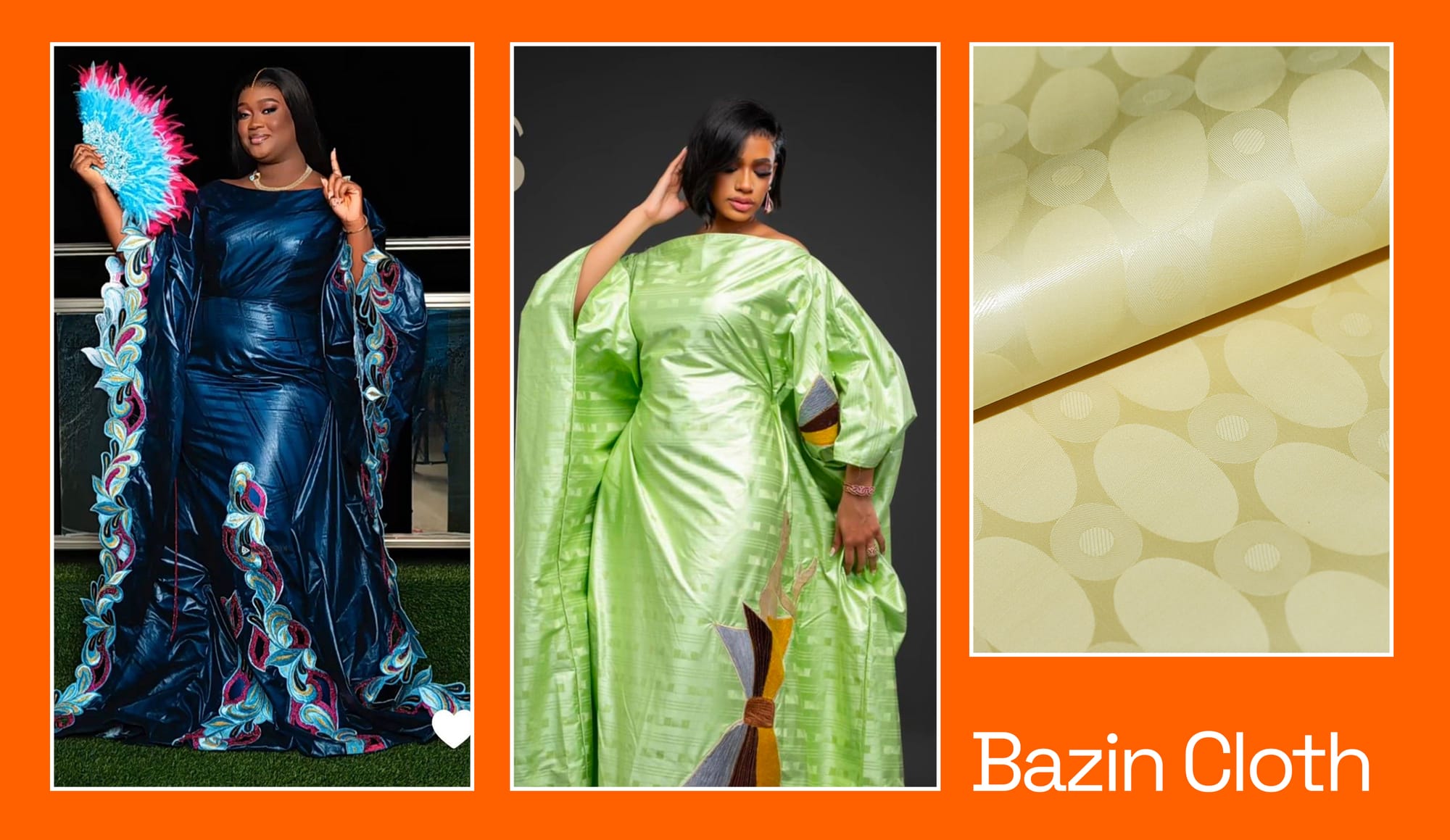
Bazin is a cotton damask, its surface carrying a subtle sheen that catches light in a way that an ordinary cotton fabric cannot. The finest grade, Bazin Riche, is embroidered with delicate golden or colored thread along the neckline, sleeves, and chest. work so precise and time-consuming that a master tailor may spend weeks on a single garment. Brides are adorned in it. Grooms are wrapped in it. Elders embellish themselves in it so everyone knows, in every sense, they have arrived. The simpler grade, regular Bazin, is more accessible but no less meaningful and worn for everyday celebrations, naming ceremonies, and the kind of Friday mosque visits that are themselves a quiet act of dignity. The cut of the outfit, the depth of the color, the fineness of the embroidery all of it is readable to those who know the language. A person's Bazin can tell you their region, their occasion, their standing in the community. In Mali, getting dressed has never been a private act. It is a statement, woven in fabric, offered to the world.
Khasa
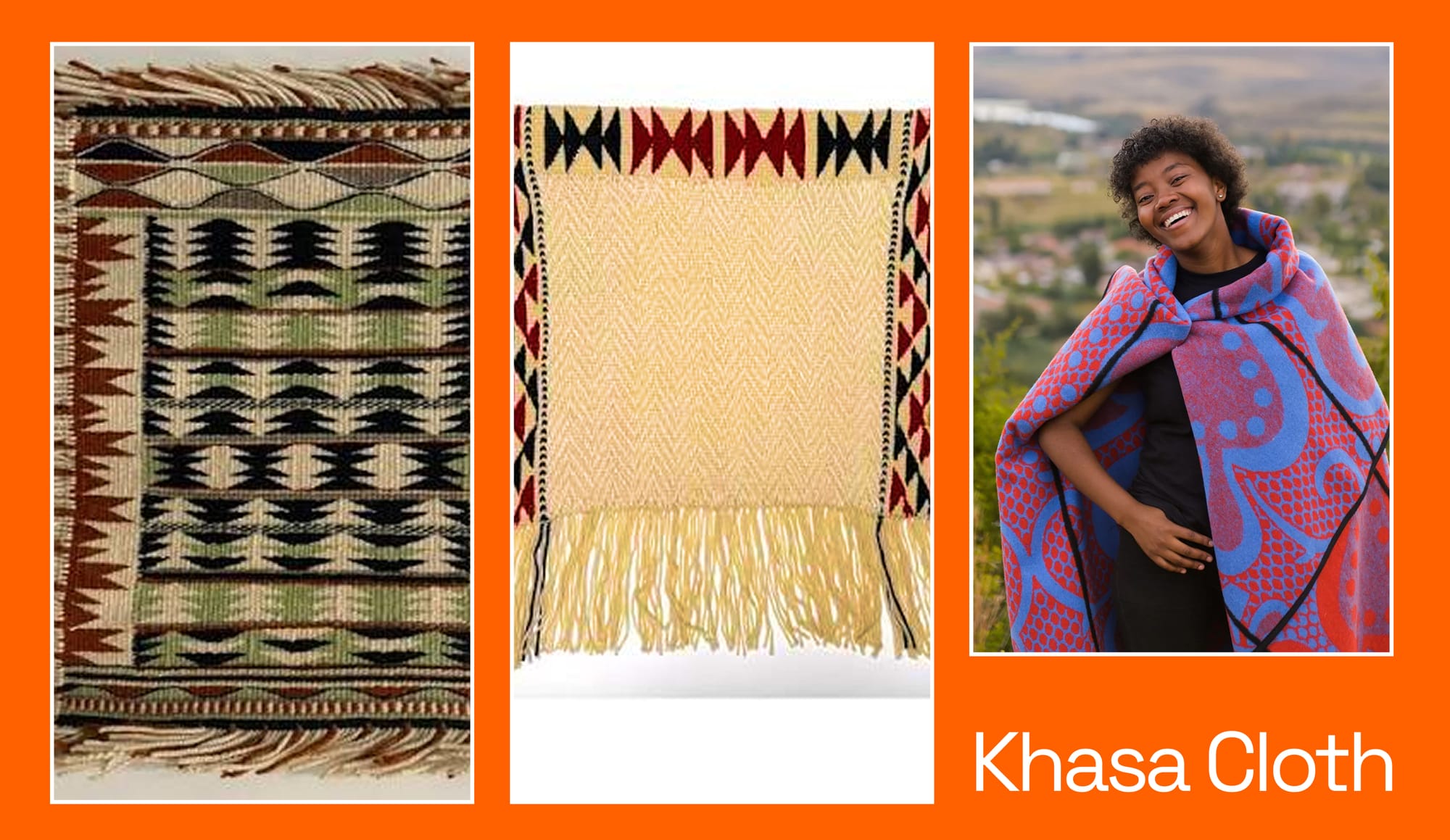
Khasa is Mali's northern cloth. It is woven by hand from sheep's wool into heavy blankets and tunics. Khasa exists because the Sahel demands, the desert nights in the north of Mali can be brutally cold, and the people who live there figured it out with their ingenuity and craft. The designs are simple and strong, characterized by stripes, geometric shapes, patterns that carry enough authority. Some Khasa cloaks pass down from parent to child, then to grandchild, becoming family heirlooms worn at the gatherings that matter most. Khasa may not travel to Paris Fashion Week or hang in galleries abroad. However it portrays something the most celebrated fabrics sometimes cannot embody, the quiet resilience of a people who looked at a harsh environment and found in it, everything they needed to make something functional, lasting and beautiful.
Bogolan: The Art of Its Making
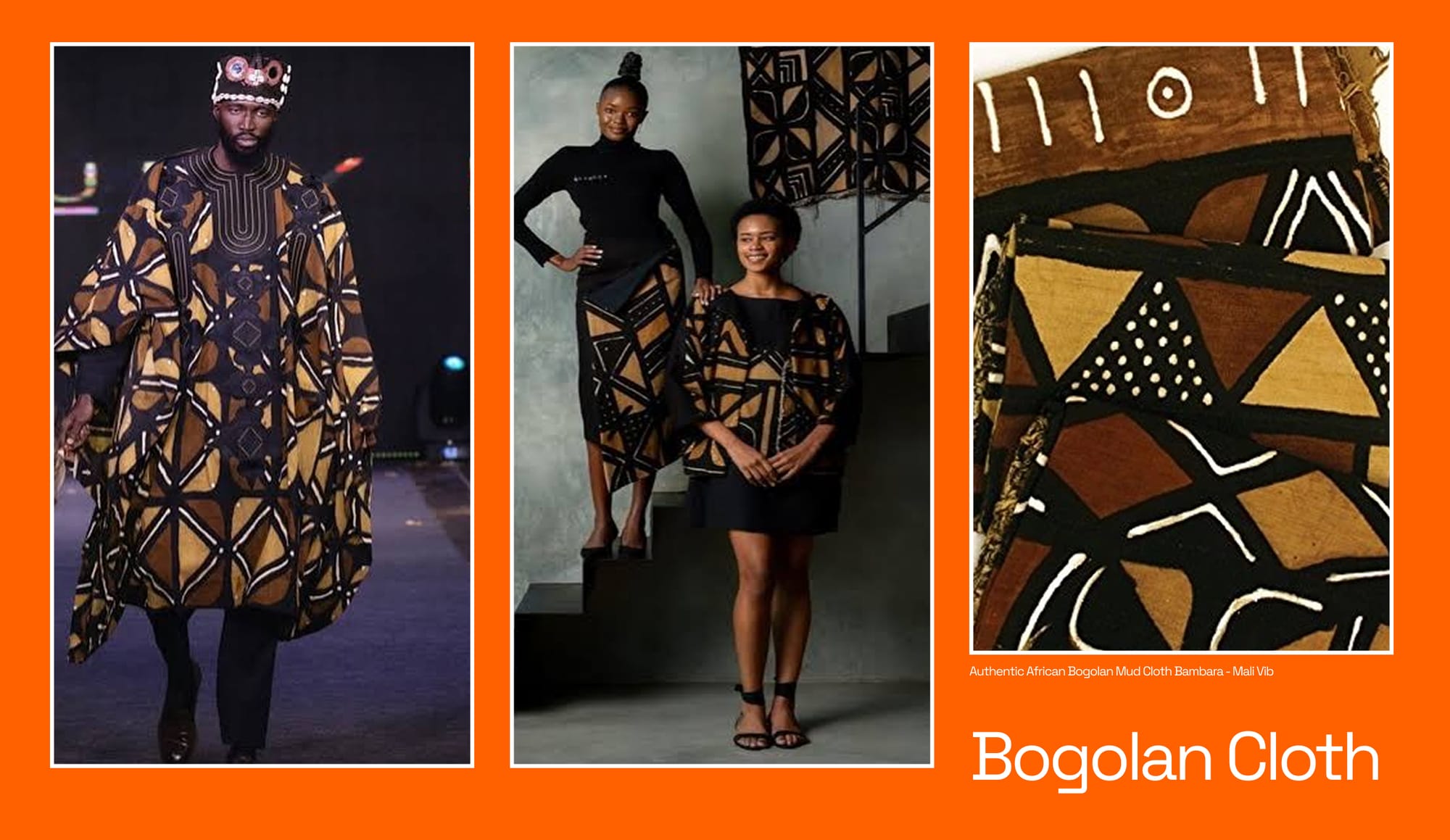
The word Bògòlanfini is Bambara, the language of the Bambara people of Mali. Break it apart and you find three smaller words: bogo, meaning earth or mud; lan, meaning with or by means of; and fini, meaning cloth. Cloth made by means of mud. This is precisely what it is and the literal truth of that name barely scratches the surface of what the making process actually involves. It is chemistry, ecology, and art working together in a language that mother earth taught the Bambara people.
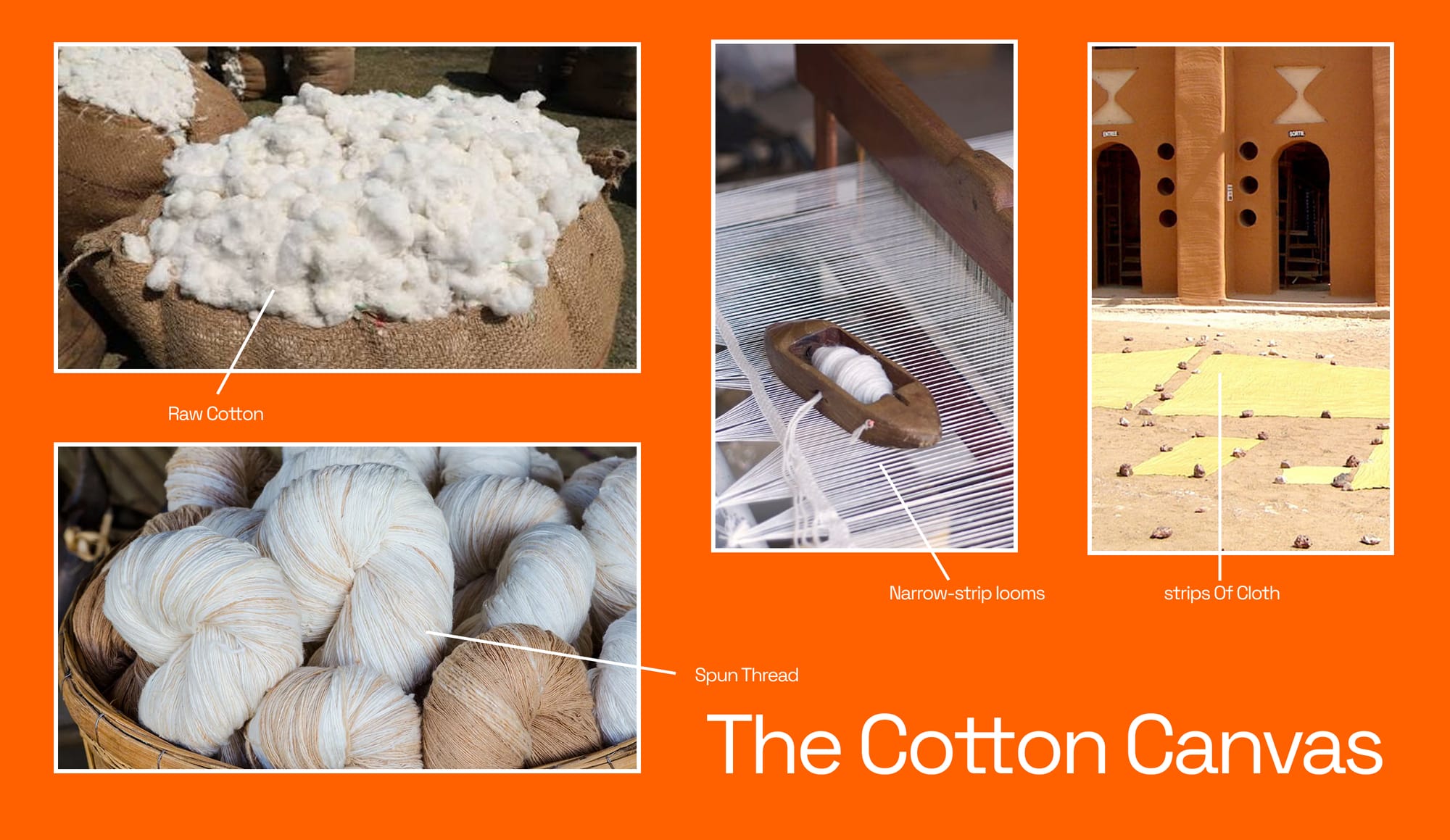
The Cotton Canvas; Everything begins with cotton, grown by hand and harvested at the end of the agricultural year. Both men and women weave it on narrow-strip looms into strips roughly fifteen centimetres wide, which are then stitched together by hand into larger cloths. At this stage the fabric is cream-colored, slightly rough carrying in its texture the weight of a slow growing season under the Malian sun.
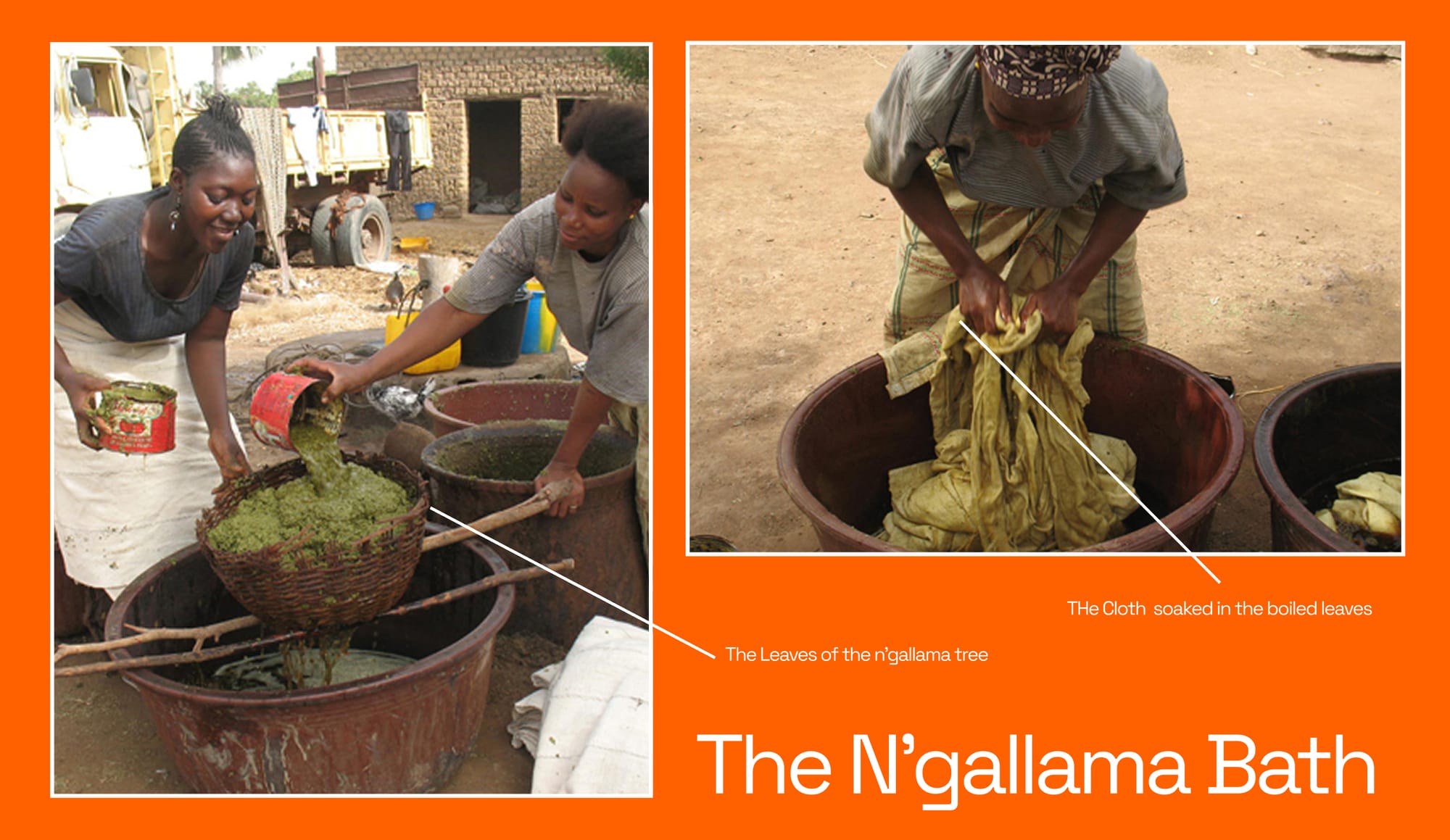
The First Bath; Before any mud touches the cloth, it is soaked in a bath made from the boiled leaves of the n'gallama tree. This tannin-rich extract binds to the cotton fibers and prepares them chemically to hold the mud dye. Without it, everything washes away. The n'gallama bath is what makes Bogolan permanent and the knowledge of how to prepare it, which leaves, what season, what quantity, is the kind of knowledge not contained in any book. It lives in the people.
The Mud; Not just any mud. The mud for Bogolan is gathered from the banks of the Niger River and fermented in clay pots sometimes for over a year until its iron content darkens and the chemistry of the mud transforms. The deep black color of Bògòlanfini (mudcloth) is the result of a complex iron-tannin complexation reaction. When the iron-rich fermented mud is painted onto fabric previously soaked in plant tannins, the iron ions bond with the tannin molecules to form a permanent, insoluble dark pigment. Aged Bogolan mud smells dark, mineral-rich, and alive. The dyer applies it slowly, deliberately painting around the pattern. This is one of Bogolan's most distinctive qualities: the negative space is dyed, not the actual design. The pattern emerges from what the mud did not touch. The meaning exists in what is left behind.
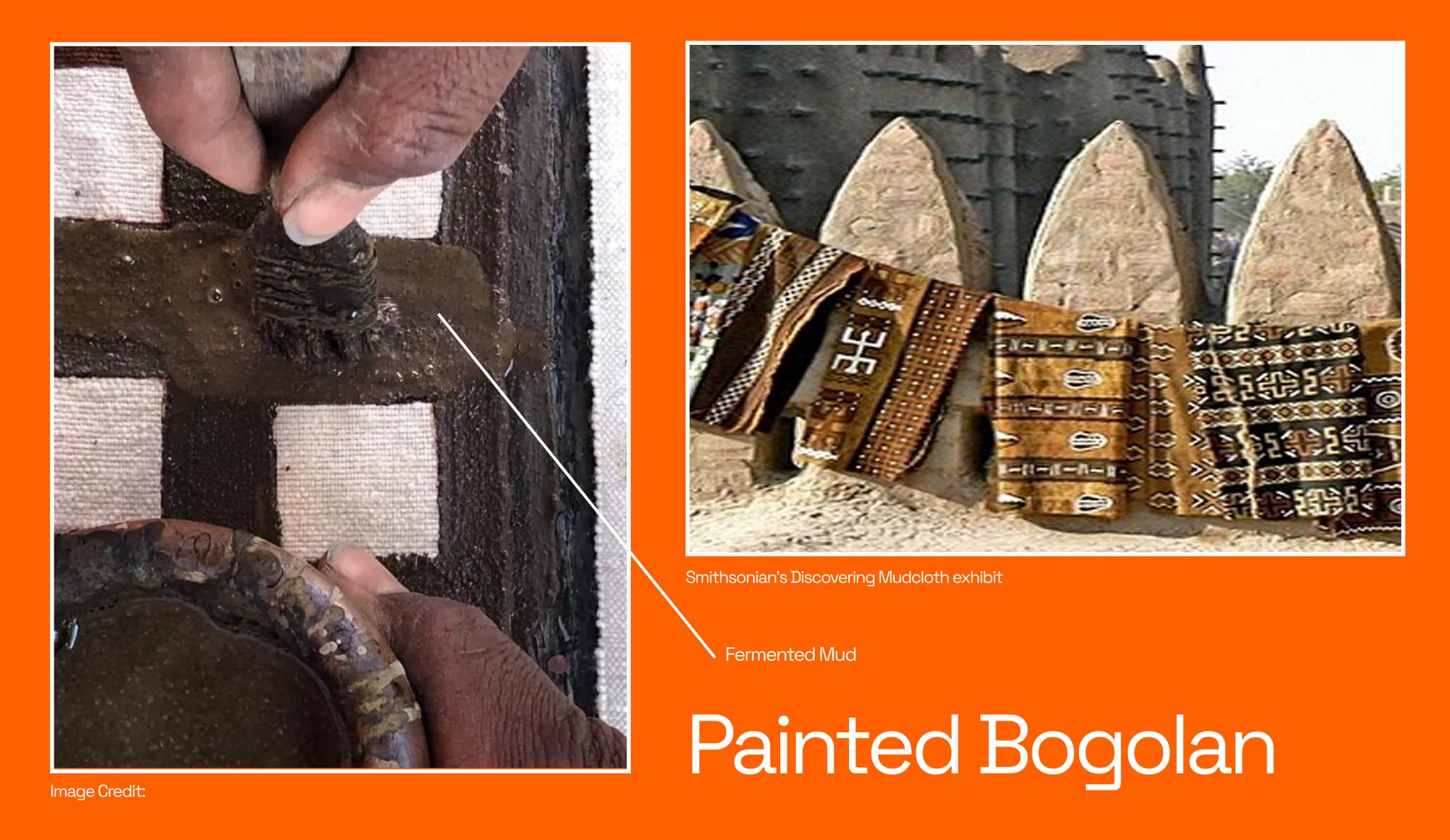
Finishing; After drying in the sun repeatedly to deepen the color, a bleaching solution is applied to the unpainted areas, making the geometric forms crisp and contrasting sharply against the dark ground. The result is visually powerful: cream and ochre against deep brown or black, it is bold and precise.
The Global Rise and Local Struggle of Bogolan
Since around 1980, Bogolan has been steadily reclaimed as a symbol of Malian national identity. Musicians wear it. Filmmakers frame it. Young people in Bamako have made it a fashion statement, cutting the ancient fabric into contemporary silhouettes: jackets, miniskirts, tote bags that blend tradition and modernity in ways that feel both natural and electric. The key figure in Bogolan’s international breakthrough was Chris Seydou, the Malian designer sometimes called the father of African fashion, who in 1979 brought Bogolan wraps to a Paris fashion show and introduced the fabric to an audience that had never seen anything like it. In the decades since, the cloth has appeared in collections by Givenchy and Oscar de la Renta, been featured on American television, and sold in boutiques from New York to Tokyo. The Groupe Bogolan Kasobané, a collective of six Malian artists working together since 1978, elevated the cloth into fine art, producing large-format works that hang in galleries and museums around the world.
And yet, for all this international glamour, the majority of people who actually make Bogolan in the craft villages of southern Mali remain economically vulnerable. The cloth travels the world. The wealth, for the most part, does not travel back. And so, the question remains: why has this potential remained dormant?
Barrier One: The Counterfeit Crisis
Walk through many African markets today or browse certain international retailers online and you will find Bogolan cloth that was never touched by Malian mud, never soaked in n’gallama, never made by a Bambara artisan. Cheap screen-printed imitations, factory-produced from the east, flooding markets at prices no hand-made cloth can compete with. And here is the deeper damage. When a fake Bogolan circulates without context, the meaning dies with it. The crocodile that carried a Bambara myth becomes just a print. The pattern that encoded a proverb becomes just a shape. The cloth that was a text becomes wallpaper. That is not just economic loss. That is cultural strip-mining.
We have seen this same crisis in Ghana and Togo. If you missed those episodes, check them out here: Episode 1; The Fugu Mandate: How Ghana is Stitching Culture into National Credit and Episode 2: Ewe Kente and the Fabric of Togo’s Creative Economy . But what makes Mali's situation urgent right now is this. In 2025, Ghana secured Geographical Indication status for Asante Kente. Legal protection that says only the real thing, made in the right place by the right hands, can carry that name. Mali has not done this for Bogolan yet. Every year that window stays closed, more value drains away from the very communities that created it.
Barrier Two: The Infrastructure Gap
A Bogolan dyer cannot work after dark without electricity. A workshop without power cannot use the digital tools modern marketing requires. A cloth made outside Ségou cannot reach Bamako without roads that hold up in the rainy season. And then there is water. The entire dyeing process depends on a reliable water supply. In communities where water scarcity forces artisans to choose between production and basic survival, a creative economy simply cannot grow. We have talked about infrastructure before. But here is what is specific to Mali. Rural connectivity remains patchy and expensive. And yet several Malian workshops have already proved that a smartphone and reliable internet can connect an artisan directly to an international buyer, cutting out the middlemen entirely. The technology works. The access is just not there yet.
Barrier Three: Trade Friction and the Cost of Crossing Borders
The African Continental Free Trade Area (AfCFTA) promises, in principle, to create a single continental market of 1.4 billion people. For Bogolan artisans, this should mean that a cloth made in Ségou can reach buyers in Accra or Lomé as easily as a business in Texas sells to California. In practice, the gap between that promise and the reality on the ground remains wide and painful. Research has shown that up to 80% percent of small-scale traders in West Africa have encountered demands for informal payments at border crossings bribes, essentially, that function as a hidden tax on the artisans least able to afford them. In some trade corridors, these informal costs alone can absorb the majority of a small producer’s potential profit. Poor roads, high fuel costs, and long travel times add further burden. Moving goods across West Africa remains, in some corridors, five times more expensive than equivalent distances in the United States.
When the 2012 political crisis struck Mali, revenues from Bogolan production reportedly dropped by over seventy percent, as trade routes collapsed and buyers retreated. The fragility that the crisis exposed was not new. It was the structural vulnerability of a creative economy with no shock absorbers, no legal protections, no digital alternatives, no diversified market access. A Bogolan artisan whose entire income depends on a single physical market, accessible only by road, through a border post that demands informal payments, is one bad season away from financial collapse. The AfCFTA’s own Secretary General has publicly identified porous borders and inconsistent customs enforcement as the number one implementation challenge. Until that challenge is addressed with real political will and real infrastructure investment, the free trade area will remain, for Mali’s artisans, a promise written in a language they cannot yet afford to speak.
Barrier Four: A Young Nation Without Enough Pathways
Mali’s population is among the youngest in the world, with a median age of approximately sixteen years. By 2043, projections suggest that Mali’s GDP could be more than triple, but only if its growing young population finds productive, dignified work. If it does not, the social cost will be paid in ways that no economic figure can fully capture.
The textile and craft economy speaks directly to this challenge. When a young person completes a three-year apprenticeship as a Bogolan dyer or weaver, they do not simply acquire a technical skill. They acquire a professional identity, a sense of mastery and a place in a community of practice that has existed for centuries. In the workshops of San and Ségou, in the ateliers of Bamako, young men and women have found in the craft not only an income but a structure for their days, a community of peers, and a form of self-expression that the formal economy has failed to offer. But this pathway is not as accessible as it could be. Training centres are scarce and unevenly distributed. Formal certification systems that would allow young artisans to build verifiable credentials and access loan programmes are limited. Young women, in particular, face additional structural barriers restricted mobility, limited access to finance, and social expectations that can make it difficult to build a business independently, even when the skills are there. Communities built around a shared craft tend to have lower rates of social disintegration not because craft is magical, but because it creates the conditions under which dignity, income, and belonging can coexist.
Barrier Five: The Branding Gap and the Battle for Market Access
The global market for authentic, sustainably produced, culturally grounded fashion is growing. International consumers in the early twenty-first century are increasingly drawn to products with traceable supply chains and genuine cultural stories. Bogolan, a cloth whose every element can be traced to a specific river, a specific tree, a specific pair of hands should be ideally positioned for this market. In practice, most Bogolan artisans have no access to it.
The intermediary problem is structural. Between the artisan in Ségou and the boutique buyer in Berlin sits a long chain of traders, exporters, importers, and retailers, each taking a margin that reduces what returns to the maker. Digital platforms offer a partial solution: artisans who can sell directly to global buyers through well-managed online shops can capture far more of the value their work generates. Several Malian workshops have already demonstrated this model, maintaining international client relationships through geopolitical crises that would have severed traditional supply chains entirely.
But digital sales require skills that most artisans have not been trained in: photography, copywriting, pricing for international markets, logistics, and customer communication in multiple languages. The gap between producing extraordinary cloth and successfully marketing it to a global buyer is real, and without structured support training programmes, shared digital platforms, cooperative marketing budgets most individual artisans cannot bridge it alone. Technology also offers tools for authentication that earlier generations could not have imagined. Blockchain-based certification systems can trace a cloth from the cotton field to the final customer. QR codes woven into authentic pieces can tell the full story of who made them, where, and how. These tools are not hypothetical; they are in use today in other craft sectors.
The Vision of African Textile Unity
Stand back far enough from the map of West Africa and something remarkable becomes visible. Within a few hundred kilometres of each other, three of the world’s most extraordinary handwoven textile traditions have their homes: Bogolan in Mali, Fugu in Ghana, and Kete in Togo. Each is distinct in its aesthetic language and ecological grounding. Together, they offer something none of them can offer alone: the sheer creative abundance of West African textile culture, presented as a unified statement.
Imagine a West African fashion house based perhaps in Accra, Bamako, or Lomé working simultaneously with Bogolan artisans in Mali, Kete weavers in Togo, and Fugu makers in Ghana. A collection that brings these three traditions into dialogue. Each piece bearing a label that names the artisan who made it, the village it came from, the pattern that inspired it. This is not a fantasy but a business model and the market for it is ready. Cross-border collaboration would also create structural economic benefits: shared trade fairs, joint digital platforms, coordinated lobbying for geographical indication protections at the African Union level, and skills exchange programmes that deepen the craft knowledge of artisans across borders. African Textile Unity is not an abstraction. It is a practical programme with concrete deliverables and measurable outcomes.
What All of Us Can Do
The barriers facing Bogolan will not be dismantled by any single actor working alone. Every industry, every institution, and every individual has a part to play.
Governments have a clear role: pushing for geographical indication protections at the African Union level, enforcing trade agreements that actually reduce border friction, investing in rural roads, electricity, and digital connectivity, and creating training certification systems that give young artisans verifiable credentials they can build a financial life around.
The private sector's contribution is equally concrete: financial institutions extending credit to artisan cooperatives; technology companies adapting existing authentication tools for the craft economy; fashion brands committing to sourcing partnerships with named, traceable Malian producers rather than anonymous intermediaries; and tourism operators building artisan access into the experiences they sell.
Civil society and cultural institutions, museums, universities, documentary makers, writers all carry a responsibility too: to tell these stories accurately, to name the communities behind the cloth, and to actively resist the circulation of decontextualised "African print" narratives that strip the meaning from the pattern.
And then there is the rest of us. The person who pauses before buying a cheap imitation and asks where it came from. The diaspora professional who uses their networks to connect an artisan in Ségou to a buyer in London. The young Malian designer who decides to build on this tradition rather than import one from abroad. The teacher who includes the story of Bogolan in a lesson not about art, but about economics. None of these acts are small. Cultures survive because ordinary people, in ordinary moments, make choices that say: this matters. This is worth keeping. This is worth passing on.
The Fabric Is Already There
Bogolan does not ask us to imagine something that does not yet exist. It asks us to recognize something that has always been here. The craft is not waiting to be invented. It is waiting to be seen properly, fully, with the economic seriousness and cultural respect it has always deserved. What Bogolan demonstrates stubbornly and beautifully is that Africa does not need to borrow its creative identity from elsewhere. It does not need to wait for foreign investment to conjure an artisan economy from nothing. The economy is already here, already making extraordinary things, already carrying meaning that the global market has shown it is willing to pay for, when it can find it, when it can trust it, when it can trace it back to a human hand.
The barriers are real but they are not permanent. Legal protection can be built, roads can be paved, borders can be made easier to cross, young people can be trained and certified, artisans can be connected to buyers who will pay what the work is worth. Every single one of these problems has a solution that already exists somewhere in the world. The question is not whether it can be done. The question is whether enough people will decide that it should be. And perhaps that is what a piece of cloth, this particular piece, made of mud and cotton and three thousand years of knowing is quietly asking each of us.
The Bigger Picture
This story is not only about Mali, but a pattern that repeats, with local variation across almost every creative economy on the African continent. Raw materials leave and finished goods return, priced beyond reach and the cultural knowledge is circulated without attribution or compensation. Young people in places rich with tradition find themselves with no formal pathway into the livelihoods that tradition could sustain. The intermediary captures the light while the maker does not. This is not a story about failure. It is a story about an interrupted process and one that is already being interrupted back. In Ghana, legal protection for Kente has been secured. In Ethiopia, coffee cooperatives have shown the world that origin branding and direct trade can fundamentally restructure a commodity's value chain. In Rwanda and Kenya, creative economy policies have begun to treat artisanal and cultural production as a serious pillar of national economic strategy, not a footnote.
These are not isolated experiments. They are proof points. They demonstrate that when the political will is present, when the legal architecture is in place, when the infrastructure investments are made, and when artisans are connected to each other, to markets, to digital tools, to financing, the creative economy does not just survive. It grows. Sustainability, traceability, and cultural meaning are becoming the new premium and Africa, which has been making extraordinary things in exactly these ways for centuries, is extraordinarily well positioned to meet that demand.
What Bogolan gives us, in the end, is not just a beautiful cloth. It is a complete argument in economic, cultural, ecological, and human lifestyle for a different kind of development. One that does not begin by asking what Africa lacks, but by asking what Africa already has and what it would take to let it fully flourish. The mud is ready, the cotton is growing, the hands are skilled, the stories are old and alive and the world is looking. What happens next is a choice.