Women Leading Africa's Tech
A major shift is currently underway as women tech builders pivot away from elite software ecosystems to intentionally design products for this informal consumer base.
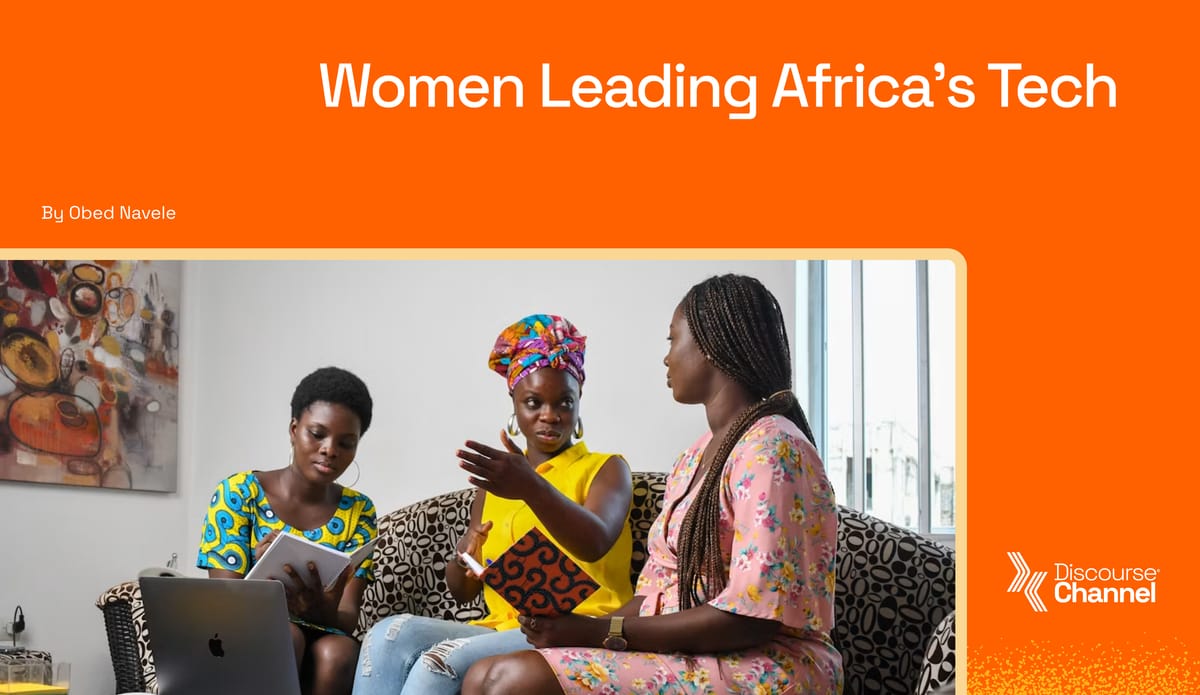
African women drive a critical share of the continent's informal economy and household management, demonstrating an established capacity for resource optimization and operational problem-solving. Historically, however, the narrative surrounding Africa’s technology sector has focused on high-capital tech hubs and complex software architecture designed primarily for formal markets. This approach creates a design mismatch that excludes the informal sector such as market women and small-scale traders who form the actual backbone of local commerce. A major shift is currently underway as women tech builders pivot away from elite software ecosystems to intentionally design products for this informal consumer base. By aligning digital infrastructure with the existing, real-world workflows of neighbourhood commerce, these innovators are translating grassroots economic activity into scalable digital utility.
After looking at how women are driving our general economy and transforming agriculture, this third article brings us to the digital space. This third article looks at how they are changing the digital world. We talked to female tech leaders across East and West Africa like Wendy (founder of StockMate), Amina (a digital designer), and Joyce (a tech mentor). Their work shows a clear shift in how tech is made. When these women build technology, they don't just build fancy apps for smartphones. Instead, they design simple tools that fit perfectly into the daily lives and businesses of regular market traders.
Building Technology For Existing Systems
"I think fundamentally it's an educational gap," Wendy, founder of StockMate, told us during our conversation. "Not just educating the people we are trying to get into tech, but also the decision-makers of those people." Her observation goes beyond the conversation about women in technology. It speaks to a much larger issue facing innovation across Africa: many transformative ideas struggle not because they are ineffective, but because the people expected to support or adopt them often do not fully understand them.
For Wendy, technology is not about building sophisticated platforms for people who are already connected to the formal financial system. It is about solving everyday problems for the millions of informal traders who keep African economies running. She explained it in the simplest way possible. Every day, neighbourhood shop owners travel to different markets to buy products from different wholesalers. They restock their shelves, sell to customers, and repeat the process. Yet almost none of these transactions leave a digital record. Without purchase histories or financial data, many of these hardworking business owners remain invisible to banks and cannot qualify for credit, despite operating profitable businesses for years.
StockMate is changing that reality. Rather than asking traders to fit into an unfamiliar banking system, the platform records their purchasing patterns through a single distribution network. Over time, that information becomes an alternative financial identity, allowing lenders to assess the consistency of a trader's business even without a traditional bank account.
That is what meaningful innovation looks like. It begins with understanding how people already live and work before introducing technology that fits naturally into those routines.
Across Africa, a growing number of women are embracing this human-centred approach to innovation. Instead of designing products that only serve urban professionals with the latest smartphones, they are building solutions around existing community systems, local languages, and everyday realities.
One example is SusuPaa, a Ghanaian fintech platform inspired by the traditional susu system that has helped communities save collectively for generations. In Twi, susu means "little by little." More than a savings method, it represents trust, accountability, and community support. SusuPaa digitises these rotating savings groups, enabling members to organise contributions, automate collections, and manage payouts transparently without losing the cultural values that made the system successful in the first place.
The same philosophy is reshaping healthcare. Female health-tech founders are creating services that work directly through familiar platforms like WhatsApp instead of requiring users to download large applications or navigate complicated interfaces. A mother in a remote village can simply send a message and receive reliable maternal health information, making digital healthcare far more accessible.
These innovations share a common principle: technology should adapt to people, not force people to adapt to technology. Wendy's own journey also reflects another important lesson. Working in a field that remains largely male-dominated has presented challenges, but she believes those barriers should never discourage young women from pursuing careers in technology. Her advice is simple: "Don't give up. Be resilient in the vision that you have for yourself. If you fail, you get up and try again."
Breaking the "Tech Elite" Barrier
Too much technology is built by tech experts, for other tech experts. Women in tech are shattering this elite bubble by forcing builders to design for the informal sector and adapt tools to how local traders actually operate.
During our interviews, we spoke with a digital designer named Amina, who actually spends her days sitting in local markets, watching how vendors interact with their phones.
"If a tomato seller can’t use your wholesale app with one hand while handling cash and talking to a customer with the other, your app isn't useful to her," Amina smiled.
Because of this down-to-earth approach, women-led startups are designing platforms with simple visual icons, local voice notes, and straightforward steps. They are making sure that the digital world doesn't leave small traders behind, but instead gives them easy tools to track their stock, get micro-loans, and protect their hard-earned profits.
Beating Everyday Hurdles (Data and Power Cuts)
To build tech that actually works in Africa, you have to design for reality. And the reality includes expensive internet data, patchy network coverage, and unexpected power cuts. While some developers treat these things like annoying interruptions, female tech leaders treat them as a starting point.
The founders we spoke with are getting incredibly creative with resource-light engineering. They are building "offline-first" apps that save all your data locally, waiting to sync up with the internet only when you finally get a stable connection. Others are tweaking their platforms to consume only kilobytes of mobile data, ensuring that checking a price or making a payment doesn't swallow a trader's daily profit. They are turning tech from a luxury item into an everyday tool that fits with little friction.
The Multiplier Effect: Pulling Others Up
A consistent pattern among our interview participants was the emphasis on ecosystem support; the women we interviewed actively leverage their positions to mentor and create pathways for others entering the tech sector.
Historically, women in corporate spaces have often been steered toward administrative roles like Human Resources rather than technical positions like Chief Technology Officers (CTOs). Female tech leaders are actively changing that.
"When you open a door for a woman in tech, she doesn’t slide through and shut it," Joyce, an ecosystem mentor in Nairobi, told us. "She reaches right back out, grabs three younger girls, and pulls them into the room with her."
This is what people call the multiplier effect. It’s woven into the DNA of women-led tech businesses. These founders aren't just running companies; they are hosting weekend coding bootcamps for young girls, setting up mentorship circles, and creating direct internship pathways. They know that to truly change African tech, they have to build a whole new generation of female talent in science and technology.
The Big Bump in the Road: The Funding and Trust Gap
Even though these women are incredibly resourceful and running businesses in a region that actually leads the world in female entrepreneurship, they face a massive, unfair hurdle when it comes to getting investment money.
According to a recent report by Disrupt Africa, the funding gap for women is actually getting worse. In 2024, female tech CEOs received a tiny 2% of the total tech funding across Africa, which totals just $48 million. Meanwhile, male-led startups locked in a massive $2.2 billion. Experts pointed out that the 8.2% we saw in 2023 was an exception to the rule because just three female-led healthcare companies managed to secure $50 million through unique grants. Without those specific grants in 2024, funding for women took a massive dive, dropping by nearly 2,000% compared to where it should have been.
The founders we interviewed didn't hold back when explaining why this happens. Women are much more likely to bootstrap meaning they fund their businesses out of their own pockets or personal savings because they don't always have access to the same old-boys' business networks or mentors that men do. And when they do get into investor meetings, they face a lot of skepticism. Investors often ask women defensive questions about risks and how they plan to avoid losing money, while male founders get asked exciting questions about their big visions and how fast they want to grow.
There is also a big push needed to help more women move past simple personal savings and gain access to advanced financial tools like mutual funds and venture networks. Interestingly, this isn’t just an African problem, it's a global one. In fact, Africa is actually doing better than many places; 3.2% of our fintech companies are women-led, which is double the global average of 1.6% (in the US and UK, women get 2% or less of venture funding).
Looking Forward: The Smartest Bet We Can Make
The fact that female tech leaders are being underfunded isn't just unfair, it’s bad business for the entire continent. A famous study by the Boston Consulting Group (BCG) found that startups founded by women are actually much better at managing money. For every single dollar of funding they receive, women-led startups generate 78 cents in revenue, while male-led teams only generate 31 cents.
Fixing this gap could change the world economy. The World Bank estimates that matching the number of female and male entrepreneurs could add $5 trillion to $6 trillion to the global economy. Groups like First Check Africa and ShEquity are working hard on the ground to give women their first financial breaks, but the rest of the investment world needs to wake up. At the current pace, the World Economic Forum warns it will take five whole generations until the year 2158 to reach true gender balance.
African women aren't waiting around for the system to fix itself. From small neighborhoods to big cities, they are quietly building data-smart, offline-ready technology that respects human dignity and keeps local trade alive. If we want a digital future that genuinely transforms everyday lives, backing these women isn't just a nice idea, it's the absolute smartest investment Africa can make.