Dangote's IPO: Africa's Leap or Capital Market Charade?
Dangote's ₦2.15 trillion refinery IPO is either proof African capital can finance African industry, or a $50 billion bet built on a tenth of the company. ADC unpacks what naira exposure, thin margins and diaspora access reveal about who actually builds Africa's next industrial era.

The Facts
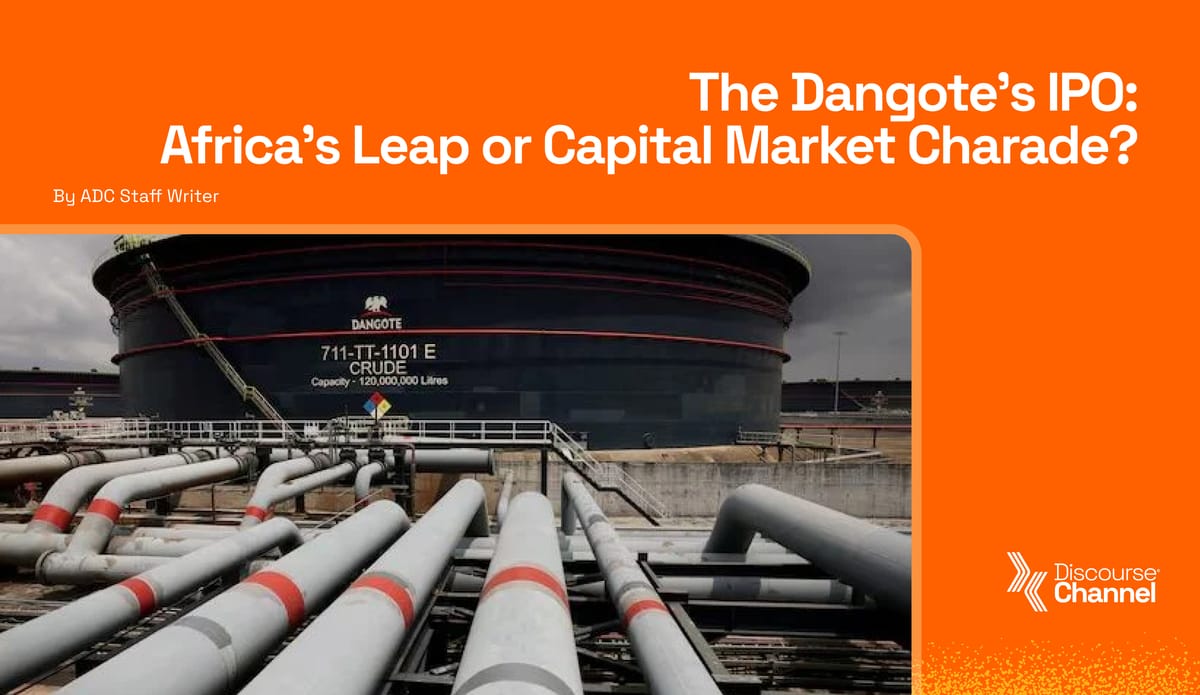
On September 14, Dangote Petroleum Refinery and Petrochemicals FZE opened a public offer targeting N2.15 trillion, roughly $1.6 billion, pricing 4.1 billion new ordinary shares at N525 each. The largest single-train refinery on earth, built by Africa's richest man, is asking ordinary Nigerians, diaspora investors and institutional capital across the continent to become part owners of a facility that has quietly rewired West Africa's fuel economy in under two years. The minimum subscription is ten shares, N5,250, and the window closes October 13. More than fifty distribution channels are carrying the offer, from the Nigerian Exchange's own NGX Invest platform to commercial banks and a wide field of fintech apps including Bamboo, Cowrywise, PiggyVest, Trove, GetEquity, and Flutterwave. Early reporting from the opening days described billions of naira in subscriptions within hours.
Proceeds are earmarked partly to fund an expansion of refining capacity from roughly 650,000 to 700,000 barrels a day currently, to 1.4 million barrels a day. Renaissance Capital Africa figures, cited across recent market coverage, put the refinery's first half 2026 earnings before interest, tax, depreciation and amortisation near $2.6 billion, with net income around $1.82 billion. Reuters has reported an indicative timetable for listing on the Nigerian Exchange Main Board sometime between early and late November. By Condia's reporting, only about a tenth of the refinery's total equity is being floated in this offer, with the remainder staying under existing ownership. A separate figure, Aliko Dangote's personal wealth reported near $54 billion in filings tied to the offer, has circulated in Nigerian business press; ADC has not independently verified that figure against the prospectus itself, and flags it here as reported, not confirmed.

Our View
We believe this offer is best read as a live test of whether African capital markets can finance African industrial ambition on their own terms, rather than as a purely Nigerian corporate story. The numbers support genuine investor appetite independent of hype. Margins in the range Renaissance Capital describes justify interest on fundamentals, and a capacity expansion to 1.4 million barrels a day, if it holds, would turn the refinery from a domestic supply fix into a regional export platform, the kind of infrastructure the continent has more often imported than built.
The access side of the offer also differs substantively from past African listings. A four-dollar entry point, distributed across more than fifty digital channels, is a genuine attempt to widen who can own a piece of the businesses reshaping their economies. Nigerian Exchange Group's chief executive, Temi Popoola, has framed the transaction as evidence that the market can deliver on that promise, and the infrastructure now visibly exists to try.
But we believe the ownership structure undercuts the inclusion narrative more than the marketing admits. Floating roughly a tenth of a company while its founder's fortune remains largely untouched is not the same as broadly distributing control. It is a partial opening, useful and possibly a template, but not yet the structural shift some of the coverage implies. Aliko Dangote's own prediction that shares could run from N525 to N10,000 is the kind of claim that deserves scrutiny precisely because it comes from the seller, not confirmation because it comes from a credible businessman.
Room for Disagreement
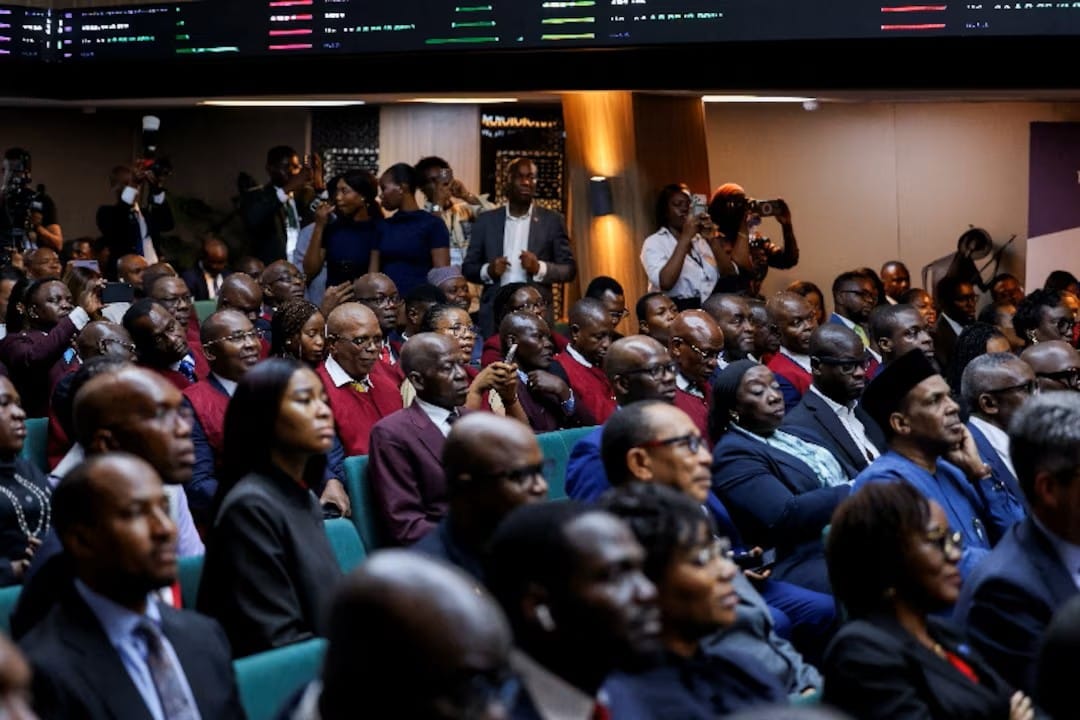
Investors closer to the deal would push back on parts of this reading. A ten per cent float is not unusual for a founder-led conglomerate's first listing anywhere, and Renaissance Capital's own coverage treats the IPO as a credible entry point. NGX executives would argue that judging inclusion by float size alone ignores the question of whether ordinary Nigerians who could never previously access this kind of asset now can, and by that measure the offer succeeds regardless of how much the Dangote Group retains. There is also a fair critique of ADC's own caution here: withholding judgment on the $54 billion wealth figure until it can be checked against the prospectus is the correct call editorially, but readers should understand that even an unverified figure of that scale says something about how concentrated the upside likely remains.
What Else Matters
Africa's history with founder-controlled conglomerates going public is mixed. Kenya's Safaricom listing in 2008 is often cited as a comparatively broad-based African IPO, though the comparison is imperfect and worth treating with care rather than as a clean precedent. What is clearer is that Nigerian retail investors have historically had thin access to public markets, which is the gap NGX Invest and the fintech distribution layer are explicitly built to close. Worth watching alongside the October 13 close: whether the dollar-denominated dividend Dangote has signalled, still pending regulatory approval, actually materialises, since that would matter more to hard currency-starved investors than the naira share price itself.
Solutions in Action
The clearest attempt at genuinely broadening access sits with platforms like GetEquity and Daba, which use nominee structures so investors without a Nigerian CSCS account, including diaspora investors, can hold shares without navigating local brokerage infrastructure. That is a real innovation on the distribution side, and it is being tested at scale for the first time with an offer this size. Its obstacles are currency conversion friction for non-naira investors, payment systems visibly straining under IPO day demand, and a float small enough that oversubscription could crowd out exactly the retail investors the campaign is built for. Whether this model scales to the next African industrial listing depends less on whether this offer closes successfully and more on whether the structure, not just the marketing, gets copied.