Rural Jobs Are Everywhere in Africa however Nobody Wants Them.
Africa's rural infrastructures sit unstaffed while qualified graduates stay unemployed in the cities, choosing to wait rather than take posts that offer no housing, no power, and no path forward. The real gap isn't jobs or workers, it's the infrastructure that would make rural postings worth taking.
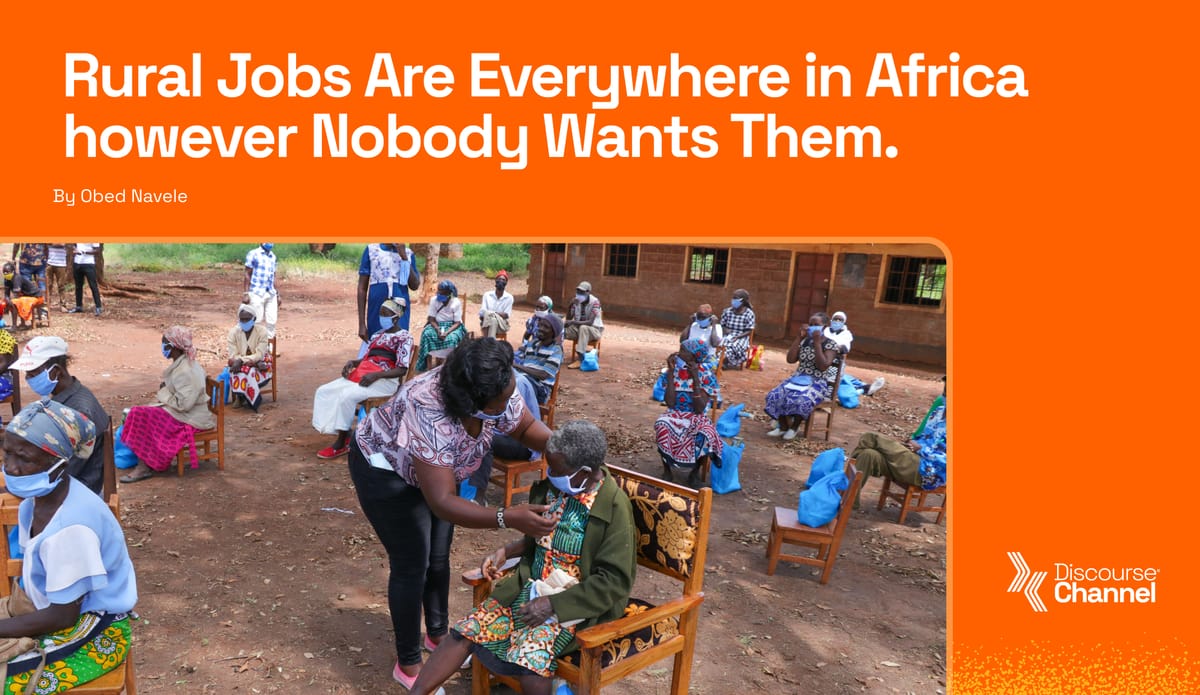
Africa's youth unemployment rate sits above the global average even as its public health and education systems report chronic staff shortages in districts that need them most. The World Health Organization estimates the continent carries roughly a quarter of the world's disease burden while employing under 3 percent of its health workforce, and much of that thin workforce clusters in capital cities rather than the rural clinics where the shortage is sharpest. Meanwhile, thousands of newly qualified nurses, teachers, and engineers leave university each year and cannot find their first job posting. Two labor-market failures are occurring at once, in the same countries, often among the same graduating class and neither is being solved by treating it as the other's mirror image. The Ghanaian government recently launched an initiative to directly bridge this paradox by opening clearances to recruit 16,000 newly qualified nurses to clear the graduate backlog. However, the program carries a strict mandate: most of these newly employed nurses will be directly deployed to rural and underserved villages.
Two Crises, One Labour Market
The instinct is to describe this as a matching problem: unemployed graduates on one side, vacant posts on the other, and a policy nudge in between. That framing understates the difficulty. A vacancy in an underserved district is not equivalent to a vacancy in a city hospital or an urban school. It carries a different cost structure: commute, housing, safety, electricity reliability, access to further training that a graduate weighs against the alternative of remaining unemployed in a city where none of those costs apply. Unemployment in an urban Centre, with its networks, amenities, and proximity to future opportunities, is in many cases the economically rational choice over employment in a district that offers none of those things. The paradox is not that young professionals are unwilling to work. It is that the terms on offer make waiting a better bet than serving.

In this episode, we discuss the rationale behind social obligations and where they actually come from — using a real story where a man told our guest he couldn't marry her because she was "too opinionated," then sent her his wedding invitation months later.
What a Job Offer Does Not Include
A teaching or health posting in an underserved community is typically advertised as a salary line, sometimes with a modest rural allowance attached. What it rarely specifies is what that salary must be spent surviving: a shortage of formal housing that pushes new staff into informal rentals, electricity supply that is intermittent or absent, water that must be fetched or bought, and a transport network too weak to allow a reasonable commute or a weekend visit home. For a graduate weighing where to build a career, the job offer is only one line item in a much larger calculation that includes whether the posting has functioning equipment to work with, whether professional development or promotion is possible from that location, and whether personal safety is assured. Where any of these are unresolved, the salary figure becomes close to irrelevant. Employment, in this sector, has never been separable from the conditions surrounding it. Governments that treat it as separable will keep advertising posts that qualified graduates decline to fill.
The Structural Urban Pull
It is tempting to read graduates' preference for cities as a values problem, a generation less willing to sacrifice than the one before it. The pattern is better explained by infrastructure than by attitude. Urban centers concentrate not just amenities but the professional ecosystem that makes a career legible: mentors, specialist referral networks, further-training institutions, and the visibility that leads to promotion. A doctor posted to a district hospital with no functioning referral system or continuing-education access is not merely inconvenienced; she is professionally isolated in a way that a doctor in a city hospital is not. Underserved communities remain underserved for the same reason they are hard to staff decades of underinvestment in roads, power grids, housing stock, and institutional infrastructure that would make a posting there comparable, rather than punitive, relative to an urban one. Recruitment campaigns aimed at graduates cannot compensate for infrastructure gaps that recruitment does not touch.
Recruitment Without Retention Is a Revolving Door
Several African governments have run mandatory or incentivised rural-posting schemes, national service placements, bonded scholarships that require a term of rural service, rotational deployment for newly qualified health workers. These schemes have proven reasonably effective at getting professionals into underserved posts in the first year. They have proven far less effective at keeping them there once the mandatory term expires. Where the underlying conditions, housing, infrastructure, career pathway have not changed by the end of a bonded period, professionals leave for the city at the earliest legal opportunity, and the district returns to vacancy. The recurring pattern across these schemes suggests that mandatory deployment solves a placement problem but not a retention problem, and a system that must re-recruit for the same post every two to three years is not building workforce capacity; it is running a treadmill.
Reversing the phenomenon
Retention improves where the incentive structure changes the underlying comparison rather than the salary alone. Rwanda's health-sector allowances tied to remoteness, combined with staff housing built alongside new district facilities, have been credited with narrowing though not closing the rural-urban staffing gap in health. Ghana's rural incentive package for health workers, which bundles a salary premium with accelerated study-leave eligibility, has had a similar partial effect: it moves the calculation but does not fully invert it, because the accompanying infrastructure reliable power, housing stock, transport links has not scaled at the same pace as the financial incentive. The lesson from both is that allowances alone shift behavior marginally; allowances combined with genuinely functional infrastructure and a visible career pathway shift it substantially. A posting that offers a graduate a plausible next promotion, not just a higher stipend, is a fundamentally different proposition than one that offers a bonus for hardship with no route out of it.
Evolving from Emergency Deployment to Workforce Planning
Most African governments still approach underserved area staffing as an emergency measure: a vacancy is identified, an incentive is attached, a professional is deployed, and the cycle repeats when those professional leaves. Workforce planning of the kind that would resolve this durably requires treating employment creation, regional infrastructure investment, and service access as a single planning exercise rather than three separate ministries working in isolation. A ministry of health cannot solve a staffing shortage that is, at its root, a ministry of works and ministry of energy problem. Until national planning connects the deployment of professionals to the parallel deployment of the infrastructure that makes deployment sustainable, governments will continue producing skilled graduates on one end and vacant posts on the other, and calling the distance between them a paradox rather than what it is: a policy design that has not yet matched its ambitions to its investment.
Digital Assets Summit Africa
Theme: From Policy to Prosperity: Scaling Digital Assets for Investment, Jobs & Economic Growth
16th - 17th Sept, 2026 | Kempinski Hotel, Accra, Ghana