Is the Africa's Free Movement Agenda Progress or Another Policy on Paper?
Africa has a protocol for free movement. It has had one since 2018. What it does not yet have is a border that behaves as if that protocol exists. The distance between signature and practice is where continental ambition goes to wait.
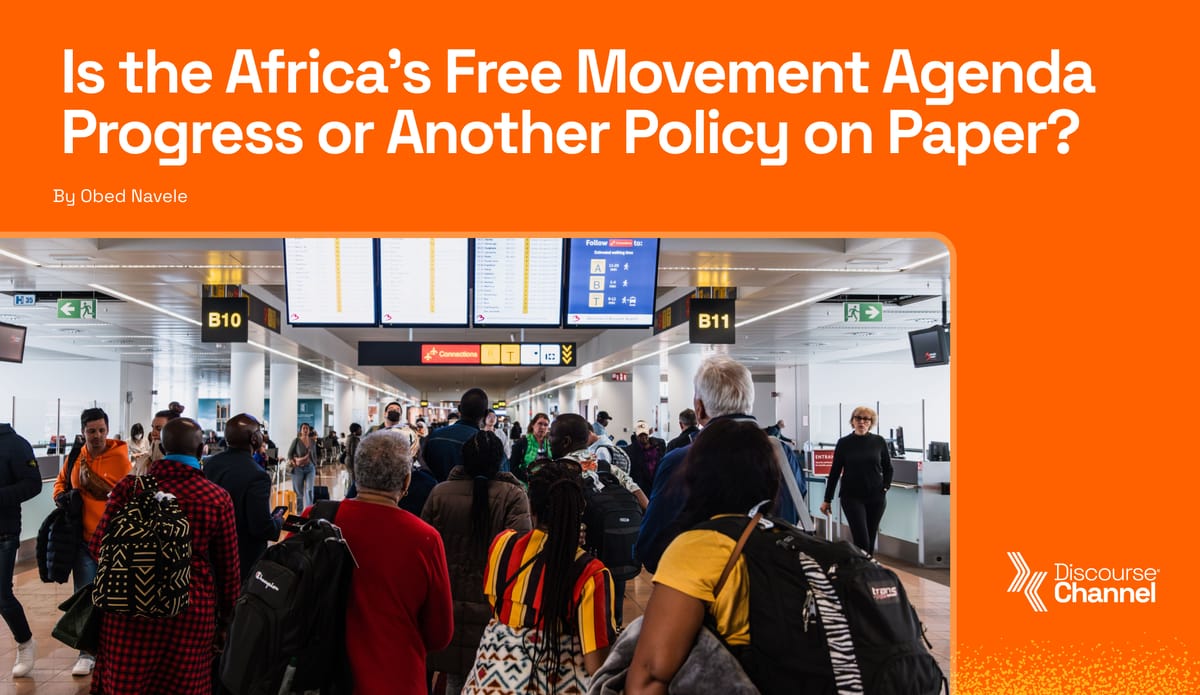
The African Union's Protocol on Free Movement of Persons was adopted in 2018. As of the most recent reporting, 32 countries have signed the Protocol, but only four have ratified it (Mali, Niger, Rwanda, and São Tomé and Príncipe). That's roughly 7% of the AU's 55 member states, and the gap between what has been signed and what is actually experienced at a border crossing remains wide. A trader moving goods from Lagos to Accra still encounters a patchwork of national rules that a continental agreement was supposed to dissolve. We examine African institutions' ability to deliver the agenda.
The Distance Between Signature and Practice
A framework becomes official policy only when it is formally ratified and implemented. It translates into real-world reality only when strictly enforced at actual points of contact, the immigration desk, the customs post, and the visa office. For regional initiatives like the African Union's free movement framework, the initial legislative hurdles have been cleared in name, but not yet in substance. The Protocol requires 15 ratifications to enter into force, about 27% of the 55 member states (less than two-thirds majority of member states). However, recent AU reporting shows that the number of nations that have both signed and legally ratified the agreement remains a small fraction of that threshold.
This gap between political promises and actual enforcement is highly visible in recent national updates. While nations like Chad and the Republic of Congo, among others, have announced ambitious visa-free movement policies scheduled to begin in 2027, the path from announcement to execution remains complex. Merely signing a diplomatic protocol costs a government very little. In contrast, full ratification requires rewriting domestic immigration laws, retraining border officials, and restructuring customs databases. Furthermore, it often forces states to surrender a tight measure of border control that finance and security ministries are historically reluctant to give up.
Ghana, Rwanda, Kenya, Benin, among some other African countries, have each introduced unilateral visa-free or visa-on-arrival access for African nationals, and each has been cited as a continental success story. However, unilateral openness is not the same as reciprocal integration. A Ghanaian visitor can enter Rwanda without a visa; a Rwandan wishing to do business in a country that has not reciprocated still queues for documentation, proof of funds, and a return ticket. The result is a continent of asymmetric doors open in one direction, guarded in the other, which does little to build the kind of predictable, bloc-wide mobility that trade and labour markets require.

In this episode, we discuss the rationale behind social obligations and where they actually come from — using a real story where a man told our guest he couldn't marry her because she was "too opinionated," then sent her his wedding invitation months later.
Why Policy Struggles After Launch
The implementation gap is rarely a failure of drafting; AU legal instruments are, on paper, comprehensive. The failure sits downstream, in the machinery that is supposed to carry policy from headline to execution. Immigration systems across the continent operate on isolated national databases; a security flag raised in one country is invisible to the next. Customs and immigration staff are trained under national curricula, not continental ones, so the interpretation of "free movement" varies from one crossing to the next even when the underlying law is identical. And coordination between the ministries that must move together (foreign affairs, interior, trade, security) is frequently absent, leaving each to implement its slice of the protocol on its own timeline.
Security concerns compound the delay. Governments citing terrorism, trafficking, and irregular migration have used border discretion as a political safety valve, and that discretion does not disappear because a continental protocol exists. Opening a border does expand the surface area a state must monitor. But the AU framework has offered few operational tools: shared watchlists, harmonised biometric standards, joint border-management structures that would let states open movement without opening themselves to the risks they cite as justification. Absent those tools, caution wins by default, and the protocol sits ratified but unimplemented on a shelf.
Lessons From the Regional Blocs
The continent already has working models, even if they are imperfect ones. The Economic Community of West African States has operated a free movement protocol since 1979, and ECOWAS citizens can generally cross member-state borders without a visa. In practice, the free movement of goods and long-term residence rights under that same protocol have lagged years behind the free movement of persons, and traders still report harassment and informal levies at land borders that the protocol was meant to eliminate. The East African Community's single tourist visa, shared by Kenya, Uganda, and Rwanda, has measurably simplified regional travel for visitors but it remains a tourism instrument, not a labour-mobility one, and citizens of the bloc still face separate work-permit regimes.
The lesson from both is consistent: free movement frameworks succeed where they are narrow, monitored, and backed by an enforcement body with teeth, and stall where they are broad, aspirational, and left to voluntary national compliance. The AU's continental protocol is the broadest and least enforced version of the model to date.
What a Moving Africa Would Actually Unlock
The economic case for solving this is not speculative. Intra-African trade remains a fraction of the continent's total trade volume, and the African Continental Free Trade Area cannot deliver on its promise if the people who trade, service, and staff that market cannot move to reach it. A trader who cannot cross a border without a visa cannot participate in a free trade area built to lower tariffs on the goods she is prevented from carrying. Labour mobility, similarly, is the mechanism by which Africa's demographic weight, a median age near 19, and the largest working-age population entering any labour market globally by mid-century converts into productivity rather than pressure. A young workforce concentrated behind national borders is a stranded asset; the same workforce able to move toward opportunity is a regional economic engine.
An Open Question, Not a Resolved One
Africa does not lack the legal architecture for free movement. It lacks the institutional plumbing, interoperable border systems, reciprocal enforcement, and joint security infrastructure to make that architecture function past the level of a press release. Until ratification numbers close the gap with signature numbers, and until national immigration bureaucracies are given the tools and incentives to implement rather than merely acknowledge continental commitments, the Free Movement Protocol will remain what it has largely been since 2018: a document that describes the Africa its authors want, rather than the one that exists at its borders. Whether the next decade closes that distance, or simply produces a second generation of protocols nobody ratifies, is still an open question.
West Africa Agri Show & 3rd National Annual Livestock Day
Theme: Empowering Agriculture. Driving Innovation. Connecting West Africa.
29th - 30th Sept, 2026 | The Palms Convention Centre, Accra, Ghana