What Depression Really Is And Isn’t: Dispelling Myths and Embracing Clinical Truths
Depression is a difficult emotional illness that affects more than 280 million people throughout the world, according to the World Health Organization (WHO), 2023. In countries that are not Western, there is a lack of understanding of depression despite the fact that it is prevalent.

A significant number of individuals all around the world, particularly those who come from religious and African cultures, have an inaccurate concept of depression. The purpose of this article is to investigate the clinical definition of depression, to explain how it is distinct from usual emotional swings, to dispel myths that are spread by a variety of religions and cultures, and to emphasize the necessity of empathy and therapy that is based on evidence, wherever possible.
Depression is a difficult emotional illness that affects more than 280 million people throughout the world, according to the World Health Organization (WHO), 2023. In non-Western countries, there is a lack of understanding of depression despite the fact it is prevalent. This is due to the fact that mental health education is sparse, stigmatization is widespread, and religious misconceptions add to this lack of knowledge. By describing depression and the many ways in which it manifests itself, the objective of this article is to promote therapies that are respectful to cultural norms and to raise awareness about mental health.
Depression, according to a clinical definition: Gaining a deeper comprehension
According to the Diagnostic and Statistical Manual of Mental Disorders, Fifth Edition (DSM-5), Major Depressive Disorder (MDD) is characterized by experiencing a depressed mood or a lack of interest in daily activities for a period of at least two weeks, in addition to a combination of symptoms that cause significant functional impairment. In 2013, according to the American Psychiatric Association (APA). The following are some of the symptoms that may be present: persistent feelings of melancholy or low mood; sleep abnormalities (insomnia or hypersomnia); fatigue or loss of energy; changes in appetite and variations in weight; feelings of worthlessness or guilt; difficulty focusing; thoughts of death or suicide.
The condition known as depression, which has an effect on both physiological and psychological processes, is not the same as situational melancholy or momentary emotional distress.
The Unseen Illness That Is Depression
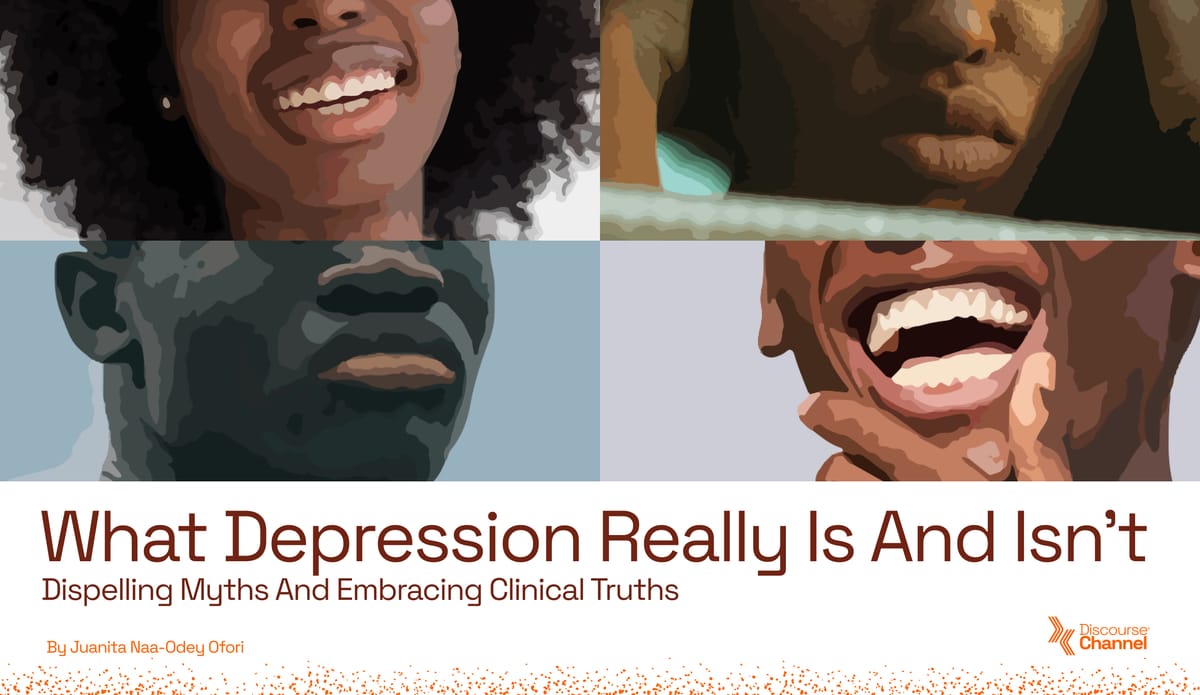
According to Flett and Hewitt (2020), high-functioning depressed individuals are able to maintain their looks, relationships, and employment even while they are experiencing inside pain. This syndrome, which is frequently referred to as "smiling depression," makes it more difficult to see and aid individuals who are in need of support. According to Atilola (2015), there is a cultural emphasis on endurance and strength, which may be a contributing factor to the urge to conceal emotions of sorrow. This emphasis is particularly prevalent in African cultures.
In many religious and African civilisations, depression is frequently mistaken as a symptom of spiritual sickness, weakness, or laziness (Osafo et al., 2018). This misconception also exists in other societies. Despite their destructive nature, statements such as "pray it away" and "you're just being ungrateful" are quite common. Although spirituality and religious support can be beneficial coping tools, it is damaging and erroneous to associate mental illness with spiritual failure (Koenig, 2012). This is because spirituality and religious support are the same thing.
Having a strong religion and being in excellent mental health are not mutually exclusive. Even if a person is deeply committed to their religious beliefs, they may nevertheless experience feelings of despair. - Koenig, 2012
Even though rejecting science ideas can make evidence-based treatment less available, using both faith-based and clinical methods together might help people's mental health.
The Importance of Support and Validation
Mood disorders are treatable. Talk therapy (such as cognitive-behavioral therapy), medication (such as selective serotonin reuptake inhibitors), behavioral adjustments, and peer support are all potential treatment choices (NICE, 2022). It is imperative that affordable treatment, culturally competent care, and public health awareness campaigns be prioritized.
First and foremost, the first step toward recovery is acknowledging that you are suffering from depression. The findings of Kola et al. (2021) indicate that community-based interventions, such as peer-support networks and mental health literacy programs, have the potential to reduce stigma and increase the number of individuals who seek assistance.
Through the promotion of mental health literacy, the provision of services for individuals who are depressed, and the encouragement of communities in Ghana to treat mental illness with understanding and compassion, The Mind Wins Foundation is working to help reduce this gap. In the work that the Foundation does, clinical expertise and personal experience serve as the foundation. This work represents a more holistic approach to rehabilitation that places an emphasis on accessibility, empathy, and African realities.
Conclusion
Understanding depression from a clinical and culturally informed viewpoint is absolutely necessary in order to make progress toward achieving mental health equity. The replacement of misunderstandings with facts has the potential to lead to the development of empathy, the reduction of stigma, and the saving of lives. Collaborative efforts between mental health organizations, educators, religious leaders, and policymakers are required in order to disseminate accurate information and provide treatment that is accessible to all.
Resources and Support
If you or someone you know is struggling with depression or mental health challenges:
Contact The Mind Wins Foundation
Email: [email protected]
Instagram: @themindwinsfoundation
DM us or reach out for referrals to mental health professionals, support circles, or educational content.
About the Author
Juanita Naa-Odey Ofori is the Executive Director of The Mind Wins Foundation, a mental health advocacy organization dedicated to creating safe spaces and awareness across African communities. As a survivor of Major Depressive Disorder, Juanita combines lived experience, academic insight, and community engagement to drive meaningful change. She is a Project and Administration Manager with a passion for mental health education and empowerment. She has worked with ACC across health projects with the CDC, WHO, and the FDA in Ghana.
Juanita is currently pursuing a degree in Public Administration, Sociology, Psychology, and Information Studies at the University of Ghana, where she integrates her academic work with her advocacy efforts.
Disclaimer
This article is intended for educational and awareness purposes only. It draws on peer-reviewed research and reputable clinical sources. It is not a substitute for diagnosis, therapy, or professional medical advice. Please consult a licensed mental health professional for personalized care.
References
World Health Organization: WHO & World Health Organization: WHO. (2023, March 31). Depressive disorder (depression). https://www.who.int/news-room/fact-sheets/detail/depression
Lolk, A. (2013). Diagnostic and Statistical Manual of Mental Disorders. https://doi.org/10.1176/appi.books.9780890425596
Atilola, O. (2015). Mental health service utilization in sub-Saharan Africa: is public mental health literacy the problem? Setting the perspectives right. Global Health Promotion, 23(2), 30–37. https://doi.org/10.1177/1757975914567179
Flett, G. L., Hewitt, P. L., Nepon, T., Sherry, S. B., York University, University of British Columbia, & Dalhousie University. (n.d.). The destructiveness and public health significance of socially prescribed perfectionism: A review, analysis, and conceptual extension. In Clinical Psychology Review (Vol. 93, p. 102130). https://hewittlab.sites.olt.ubc.ca/files/2023/01/Flett-Hewitt-et-al-SPP-Destructiveness.pdf
Koenig, H. G. (2012). Religion, Spirituality, and Health: the research and Clinical Implications. ISRN Psychiatry, 2012, 1–33. https://doi.org/10.5402/2012/278730
Kola, L., Kohrt, B. A., Hanlon, C., Naslund, J. A., Sikander, S., Balaji, M., ... & Patel, V. (2021). COVID-19 mental health impact and responses in low-income and middle-income countries: Reimagining global mental health. The Lancet Psychiatry, 8(6), 535–550. https://doi.org/10.1016/S2215-0366(21)00025-0
NICE. (2022, June 29). Overview | Depression in adults: treatment and management | Guidance | NICE. https://www.nice.org.uk/guidance/ng222
Osafo, J. (2019). From psychocentric explanations to social troubles. In Routledge eBooks (pp. 122–137). https://doi.org/10.4324/9780429460494-8