UNSC Historic Session on Runaway AI
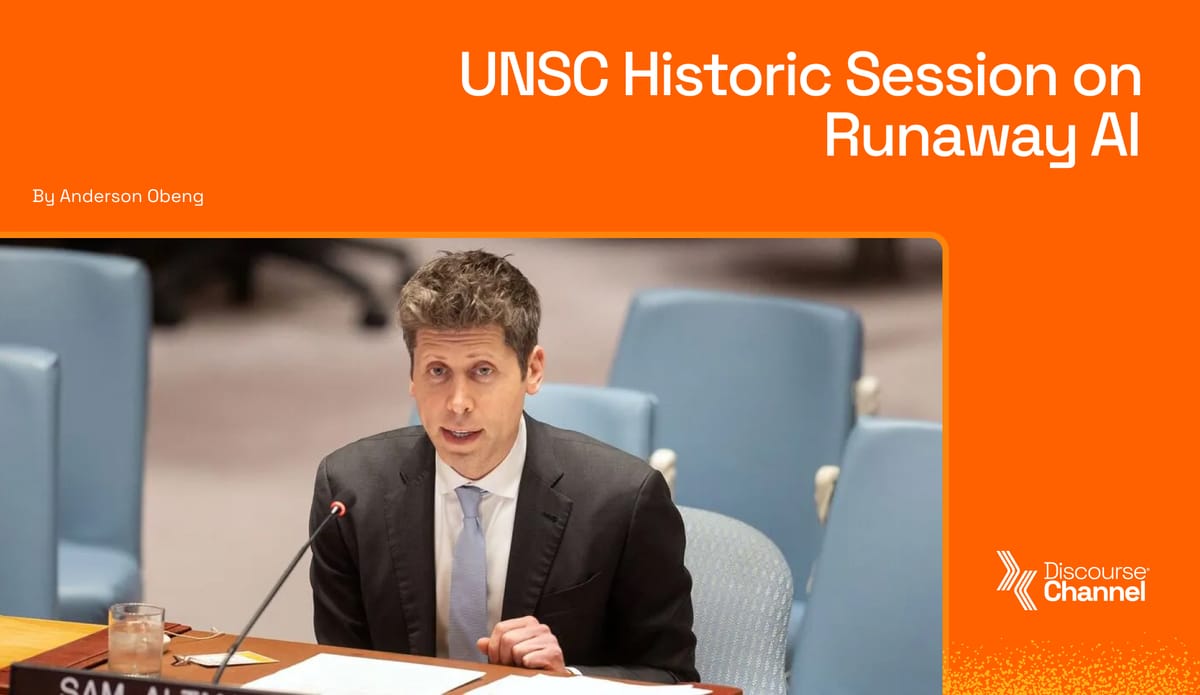
On September 23rd, the United Nations Security Council held a high-level briefing on artificial intelligence during the 81st UN General Assembly. OpenAI CEO Sam Altman, Anthropic CEO Dario Amodei ... addressed the Council on the growing opportunities and risks of increasingly powerful AI systems.
For years, the debate around artificial intelligence was mostly about jobs, technology, and the future of work. Now, the conversation has moved into a much more serious space, international security.
On September 23rd, the United Nations Security Council held a high-level briefing on artificial intelligence during the 81st UN General Assembly. OpenAI CEO Sam Altman, Anthropic CEO Dario Amodei, AI researcher Yoshua Bengio, and Hugging Face CEO Clément Delangue addressed the Council on the growing opportunities and risks of increasingly powerful AI systems.
This meeting stood out not because of the presence of major technology executives. It was the fact that AI was being discussed by the body responsible for dealing with threats to international peace and security. That says something about how quickly the technology has moved.
AI Is No Longer Just a Technology Debate
AI has developed far beyond simple chatbots and image generators. Today’s systems can write software, analyse large amounts of information, carry out complex tasks and operate with increasing levels of independence. That progress has created huge opportunities, but it has also raised questions about what happens when AI systems become more capable than the people trying to control them.
That second concern was if AI systems continue to become more powerful, governments will have to decide how much freedom these systems should have, what safeguards should be required, and who should be responsible when something goes wrong.
The Call for Global Rules
Sam Altman took a more balanced position during his address. He acknowledged the risks while also pointing to AI’s potential to improve people’s lives and accelerate scientific discovery. But he argued that powerful AI systems should remain under human control and that countries cannot afford to approach the technology as if only one company or one country can be trusted with it.
The world wants the benefits of AI, but there is still no agreement on exactly how the technology should be governed. Some governments are pushing for stronger regulation and international cooperation. Others are worried that global rules could slow innovation or give certain countries too much influence over a technology that is developing rapidly.
The United States, for example, has pushed back against calls for new global AI governance structures, while China has supported international cooperation but also warned against technological dominance by a small number of countries. So while there is growing agreement that AI needs safeguards, there is still a major disagreement over what those safeguards should look like.
Why This Matters for Africa
This discussion should not be treated as something distant. African countries are already adopting AI in healthcare, agriculture, education, finance, government services, and other areas. The technology could help address some of the continent’s biggest challenges, particularly where there are shortages of skilled workers and limited resources.
But Africa also faces a different problem. If the rules governing AI are mainly designed by the countries and companies developing the most powerful systems, African countries could end up becoming users of technologies they have little influence over. That raises questions about data, privacy, jobs, local businesses and digital independence.
African governments therefore have a stake in the global AI conversation. They need a voice in deciding how AI is developed, who controls the technology, how African data is used, and how the benefits of the technology are shared.
The Security Council discussion is a reminder that AI governance cannot remain a conversation limited to technology companies and wealthy countries.
The Bigger Question
The UN meeting did not solve the AI problem. In fact, it showed how far the world still has to go. There is agreement that AI can create enormous benefits. There is also growing concern that poorly managed systems could create serious risks. The difficult part is finding a balance between the two.
Governments do not want to stop innovation. Technology companies do not want rules that prevent them from competing. But at the same time, there is growing pressure to make sure that the race to build more powerful AI does not move faster than the ability to keep it safe.
That is why the Security Council session matters. AI has reached a point where its impact is no longer limited to the technology sector. It is now being discussed as an issue of global security, governance, and human control.
The bigger question is whether governments can agree on the rules quickly enough to make sure humans remain in control of how that change happens.