The Governance Gap: Why Africa's Fintech Revolution Needs Rules as Much as Rails
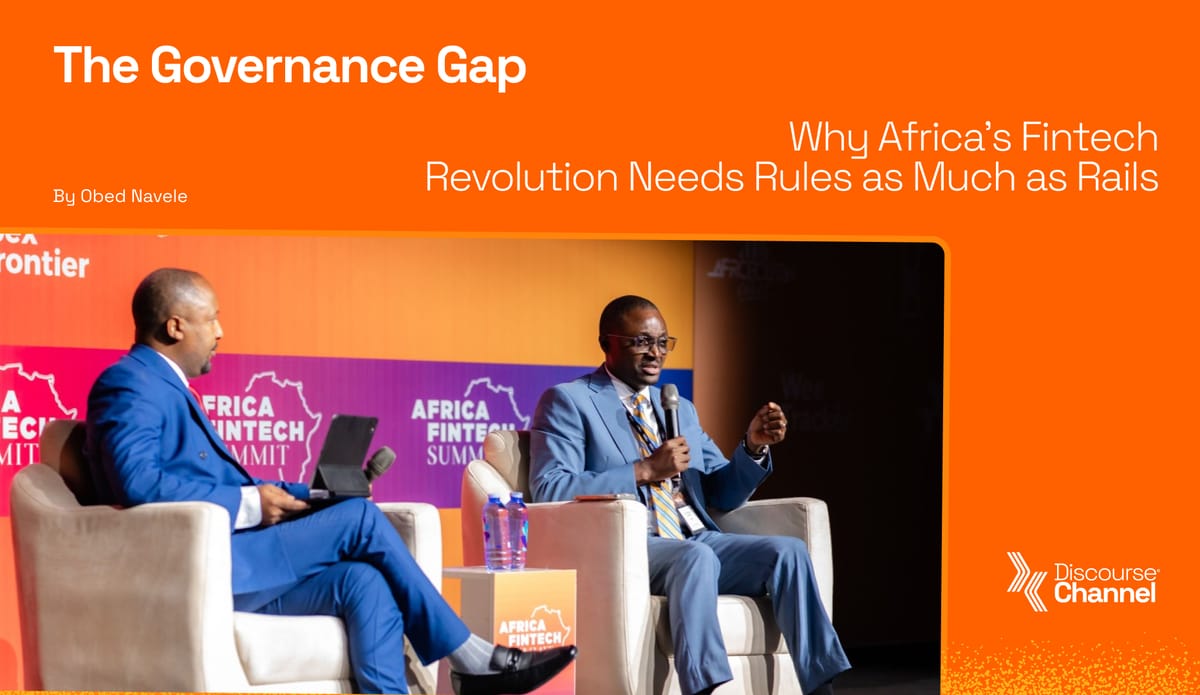
At recent gatherings where Africa's financial technology future has been debated, including the Africa Fintech Summit held in Washington D.C., one theme cut through the noise with unusual clarity: the continent is no longer building fintech as a sector. It is building fintech as infrastructure.
In 2007, a mobile phone operator in Kenya launched a payments feature that nobody asked for and regulators barely understood. Within three years, M-Pesa had moved more money than most African banks. Within a decade, it had been studied, replicated, and envied by financial systems from India to Mexico. The lesson was not simply that mobile money worked. The deeper lesson was that transformative financial infrastructure could emerge faster than the governance frameworks designed to contain or support it. That gap between the speed of innovation and the pace of regulation is now the defining policy challenge of Africa's fintech era.
The conversation is intensifying. At recent high-level gatherings where Africa's financial technology future has been debated, including the Africa Fintech Summit held in Washington D.C., one theme cut through the noise with unusual clarity: the continent is no longer building fintech as a sector. It is building fintech as infrastructure. And infrastructure, unlike apps or platforms, requires governance.
Chichi Bodart , Chief of Staff at the United Nations Global Compact, put it with striking directness at the Summit. "Powering the globe," she said, means Africa is not just contributing to someone else's financial system. It means Africa is the system. African founders setting the standards. African regulators shaping the norms. African infrastructure as the foundation the world builds on.
That is a statement of ambition. But embedded within it is an urgent policy question: if African infrastructure is to become the world's infrastructure, who governs it, how, and on whose terms?
The Infrastructure Imperative
For most of its fintech history, Africa has been described in terms of what it lacks: formal banking, credit history, and physical branch networks. That deficit framing, however accurate statistically, has obscured a quieter revolution in regulatory architecture.
Countries like Rwanda, Kenya, Nigeria, and Ghana have built some of the world's most progressive sandbox frameworks for financial innovation. The Central Bank of Kenya's regulatory sandbox, launched in 2019, allowed startups to test products under controlled conditions without triggering full licensing requirements. Similar frameworks have emerged across the continent, creating spaces where regulators and founders operate in genuine dialogue rather than adversarial standoff.
This is not accidental. It reflects a continental understanding that in economies where the majority of people remain outside formal banking, the cost of over-regulating innovation is measured not in compliance burdens but in excluded citizens.
Bodart framed the opportunity in similarly human terms: success, she argued, is not the number of unicorns or the size of funding rounds. It is the moment a market trader in Lagos or Ghana or Togo wakes up with access to credit, a digital identity, and a payment rail that connects her to the world on terms she controls. That last phrase matters. Terms she controls. Governance is precisely what determines who controls the terms.
The Sovereignty Question
As African fintech scales, a new political economy is forming around it, and the governance questions are growing more complex.
The rise of cross-border payment infrastructure anchored by frameworks like the African Continental Free Trade Area raises immediate questions about jurisdiction. When a merchant in Senegal pays a supplier in Ethiopia through a Rwandan-licensed payment platform using a Nigerian-built open banking protocol, which regulator has authority? Whose consumer protection standards apply? Whose data sovereignty laws govern the transaction?
These are not hypothetical edge cases. They are the daily reality of intra-African commerce, and the gaps in regulatory harmonisation remain significant. The AfCFTA, for all its promise, has not yet produced the interoperable financial regulatory environment that would allow fintech to serve as its true engine.
But with the structural opportunity, The AfCFTA provides the market. Fintech provides the architecture. And AI provides the acceleration. But architecture without agreed standards is chaos, not scale. The political will to harmonise financial regulation across 54 sovereign states is the true infrastructure challenge of the decade.
Alternative Data, AI, and the Regulatory Frontier
A particularly acute governance challenge sits at the intersection of artificial intelligence and financial inclusion. Across Africa, a generation of fintech companies is already using machine learning to extend credit to people. The traditional system cannot reach scoring them not on credit history but on mobile usage patterns, transaction behaviour, social connections, and a dozen other proxies.
This is not speculative. It is the operating model of companies that have already served tens of millions of previously unbanked customers. Bodart underscored the structural logic: Africa, she noted, is building with AI from the start, using alternative data, with machine learning embedded in the architecture of financial inclusion.
The policy implications are serious. Alternative data-driven credit scoring raises profound questions about algorithmic accountability, discriminatory proxies, and data rights. In jurisdictions without robust data protection legislation, borrowers may have little understanding of let alone recourse against the models that determine whether they access capital. The Nigeria Data Protection Act of 2023 and South Africa's POPIA represent steps forward, but implementation remains uneven and enforcement capacity thin.
The governance of AI in fintech is not a luxury reserved for wealthy markets. It is an equity issue. The same populations that fintech seeks to serve deserve transparency about the systems making decisions over their financial lives.
From Aid Architecture to Accountability Architecture
Perhaps the most significant governance shift happening beneath the surface of Africa's fintech growth is a philosophical one. The dominant paradigm for decades positioned African development as a recipient of external frameworks, regulatory templates exported from Basel, donor conditions attached to financial sector reform, development finance institutions setting the terms of investment.
That model is cracking. African regulators, the African Union, and increasingly African-led institutions like the United Nations Global Compact's Africa Business Leaders Coalition representing nearly 70 companies with over $170 billion in combined revenues are insisting on a different posture.
At the Unstoppable Africa convening referenced, African CEOs and heads of state sat together to demonstrate bankability. The distinction matters enormously in governance terms. Bankability implies accountability, disclosure, and standards. It implies that African financial actors are participants in not simply subjects of the global governance architecture for finance.
Global institutions like PayPal, are not returning to Africa to build their own infrastructure. They are coming to partner with fintechs that have already perfected operating in African conditions. That reversal of the learning dynamic is also a shift in regulatory leverage. Partners negotiate. Recipients comply.
Building the Rules Alongside the Rails
What Africa needs now and what its most sophisticated voices are beginning to demand is a parallel investment in governance infrastructure that keeps pace with technological infrastructure.
That means continental frameworks for data protection and algorithmic accountability. It means regulatory harmonisation that allows cross-border fintech to scale without encountering 54 different compliance walls. It means consumer protection standards that protect the market trader in Kigali with the same rigour applied to the institutional investor in London. And it means African regulators having a meaningful voice in the global standard-setting bodies the Financial Stability Board, the Basel Committee that shape the rules everyone else then exports.
Africa's fintech transformation is real, substantive, and accelerating. But infrastructure without governance is not a system. It is an experiment. And the continent that is being asked to power the globe deserves better than an experiment conducted on its people.
The rules and the rails must be built together. The trajectory is there. The political will to match it is the remaining question.