Africa’s Energy Transformation and the Struggle for an Inclusive Future
The AFRICA ENERGY TECHNOLOGY CONFERENCE - 2026 themed “From Borders to Bridges” , have held conversations on this same matter. Whether the continent can connect its resources to its people, its markets to its industries, and its ambitions to implementation.
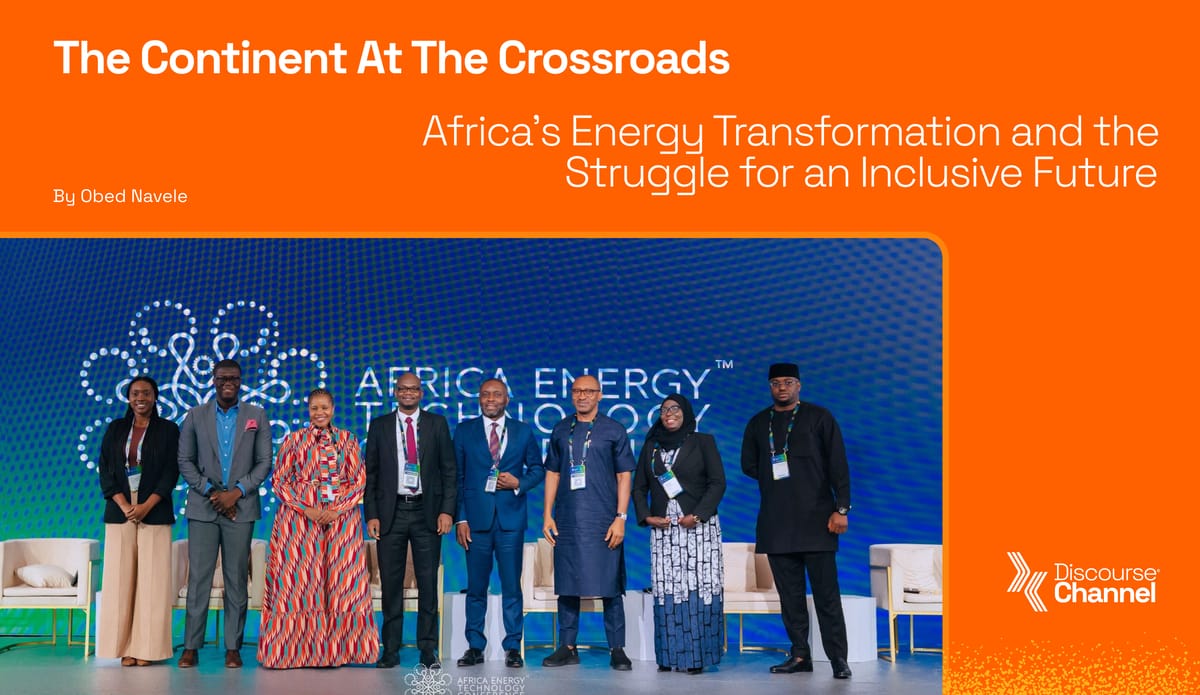
There is a particular cruelty to Africa’s energy condition. The continent sits atop some of the world’s most extraordinary reserves of oil, gas, coal, uranium, and rare earth minerals. Its rivers carry hydroelectric potential that could light entire regions. Its Saharan sunlight strikes the earth with an intensity that solar engineers in Germany or Denmark can only envy. And yet, hundreds of millions of Africans go to sleep each night without reliable electricity. Hospitals run on generators that run out of diesel. Factories operate below capacity because the grid cannot be trusted. Children study by phone-torch light. The paradox is not incidental; it is structural, historical, and deeply political. The AFRICA ENERGY TECHNOLOGY CONFERENCE - 2026 themed “From Borders to Bridges” Driving Intra-African Trade & Development through Energy & Technology Services, have held conversations on this same matter. Whether the continent can connect its resources to its people, its markets to its industries, and its ambitions to implementation.
Africa now stands at an intersection of competing forces: a global clean energy transition that demands the continent leapfrog the carbon economy, a rising generation of young people who will not wait for slow institutions, a geopolitical scramble for the minerals that make the new economy possible, and a continental ambition to finally industrialize on African terms. Whether these forces converge into genuine transformation or collapse under the weight of governance failures, financial dependency, and old inequalities repackaged in new language may be the defining question of the next three decades.
Africa’s Defining Infrastructure Moment
The scale of what Africa must build is staggering. The continent’s population is projected to reach 2.5 billion by 2050, with the largest youth cohort of any region on earth. Meeting the energy demands of that future for households, cities, industries, data centres, and farms will require investment in infrastructure that dwarfs anything the continent has attempted before. The African Development Bank estimates that Africa’s infrastructure financing gap runs to over $100 billion annually. Power generation, transmission lines, cross-border grids, clean cooking solutions, and digital connectivity are all simultaneously urgent.
What makes this moment different from previous infrastructure eras is the compression of timelines. Energy and technology are no longer separate tracks. Building a power plant today without embedding data systems, smart metering, and grid intelligence is already building the infrastructure of the past. African nations must therefore make decisions that are simultaneously about energy, digitisation, industrial policy, and economic sovereignty at the same time, with limited institutional capacity, and under constant pressure from external creditors and geopolitical actors who each carry their own agendas. Emilia Cedar Palm Akuma argued that Africa’s transformation “would never happen in isolation” energy without technology is underutilized potential while technology without energy is untold ambition. She challenged governments and investors to stop viewing Africa as “55 disconnected markets” and instead build one integrated energy and technology ecosystem.
Why Integration Matters More Than Ever
The phrase “from borders to bridges” resonates because African borders have historically been among the most expensive in the world. Colonial cartography fragmented ecosystems, divided river basins, separated communities, and created landlocked economies with no natural path to growth. Farid Gazali described Africa’s energy landscape as one shaped by borders to borders between markets, infrastructures, regulatory systems, financing capacities, and sometimes even borders between our own ambitions. Today, those same borders impose hidden taxes on every kilowatt-hour of electricity, every megabyte of data, and every container of traded goods that crosses them. Regional power pools in Southern, Eastern, Western, and Central Africa exist on paper and in aspiration, but operate far below their integrative potential.
The economic logic for integration is overwhelming. Energy corridors that connect surplus-producing nations to energy-deficient ones would reduce costs, improve resilience, and accelerate industrialisation across multiple economies simultaneously. According to President William Ruto, The Africa Continental Free Trade Area (AfCFTA), if genuinely operationalised, would create a market of 1.4 billion people and a combined GDP exceeding $3.4 trillion. Yet the infrastructure to serve that market, the transmission lines, the digital highways, the financial rails remains patchy and politically contested. The obstacle is rarely technical. It is almost always institutional and political: sovereignty anxieties, regulatory fragmentation, weak cross-border legal frameworks, and the persistent failure of states to trust each other with critical infrastructure.
The Politics Beneath the Transition
The global clean energy transition carries an uncomfortable asymmetry at its core. The industrialised world built its prosperity on coal, oil, and gas over a century of carbon-intensive growth that produced the climate crisis now being imposed as a constraint on African development. When African governments are told to abandon hydrocarbon revenues, skip the gas bridge, and go directly to renewables, they are being asked to accept a developmental shortcut that no wealthy nation has ever itself taken. The moral dimension of this is rarely acknowledged with sufficient candour in international climate forums.
Gas remains the fault line. For many African nations with newly discovered reserves, natural gas represents not environmental recklessness but economic opportunity: the chance to monetise a domestic resource, generate fiscal revenues, provide transition-period energy security, and build the industrial base that gives clean energy its eventual foundation. From Karine James, The right of the Global South to industrialize, must remain central to energy debates, insisting that development choices cannot be separated from questions of sovereignty and long-term economic survival. The argument for a “just transition” that recognises Africa’s historical emissions innocence and present developmental imperatives is not a rejection of climate science. It is a demand for equity in how the global energy transformation is financed and sequenced. Climate finance pledges repeatedly made and repeatedly missed by the Global North have eroded trust in international frameworks that African negotiators are still expected to endorse.
Technology, AI, and the New Industrial Race
Energy and technology have become inseparable. The grids of the future are intelligent systems. AI-managed, data-driven, predictively maintained, and cybersecured. The factories of the next decade are automated. The services that anchor middle-class prosperity are increasingly digital. In this context, Africa’s energy transformation is simultaneously a technology transformation, and the question of whether Africans own the technology powering their future carries enormous stakes.
The risk is vivid and familiar: that Africa becomes a consumer market for technology it does not produce, a data source for platforms it does not own, and a workforce for industries whose intellectual property sits elsewhere. The continent’s software talent is real and growing Nigerian fintech, Kenyan e-commerce, South African deep tech, and Egyptian AI startups represent a genuine innovation culture. But talent alone does not build technological sovereignty. That requires investment in research institutions, local data infrastructure, African-owned cloud systems, and the kind of patient capital that understands technology development as a long-term industrial strategy, not a short-cycle return.
Who Gets Left Behind?
Every era of African economic transformation has generated a familiar pattern: growth that concentrates at the urban apex, capital accumulation among connected elites, and marginalisation that hardens rather than softens. The energy transition will reproduce this pattern unless inclusion is treated as a structural design principle, not a rhetorical afterthought. Youth and women are invariably invoked in transformation language and invariably underrepresented in the ownership, governance, and decision-making structures that determine what gets built and who benefits.
Africa’s youth are not a future resource waiting to be activated, they are present, educated, connected, and impatient. Excluding them from the transformation economy through skills systems that teach yesterday’s competencies, finance systems that will not fund first-time entrepreneurs, and regulatory environments that protect incumbents is not merely unjust. It is a structural risk. A continent that fails to channel the productive energy of its demographic majority into the formal economy will not build the consumer markets, the tax base, or the political stability that transformation requires. Rural communities deserve the same interrogation: whether solar microgrids, digital connectivity, and clean cooking solutions reach villages as quickly as they reach capital cities will be the empirical test of whether any government’s transformation agenda is genuinely national.
Financing the African Future
Infrastructure financing is where the language of transformation collides most violently with structural reality. African projects routinely fail to reach financial close not because they lack merit, but because risk perception shaped by political ratings, currency volatility, regulatory uncertainty, and historical association inflates the cost of capital to levels that make viable projects unviable on paper. The result is that African governments must either accept expensive external financing on terms that erode fiscal sovereignty, or watch critical infrastructure remain unbuilt.
The counter-argument gaining serious momentum is this: African capital must finance African infrastructure. The continent’s pension funds, sovereign wealth funds, and insurance assets collectively hold hundreds of billions of dollars, much of it invested in foreign securities while domestic infrastructure gaps grow. Regional development banks, the African Export-Import Bank, and the African Development Bank represent the institutional architecture for a different model. But architecture without political commitment is decoration. What is required is a deliberate, coordinated redirection of African savings toward African assets backed by harmonised legal frameworks, transparent procurement, and governance standards that give institutional investors the confidence to deploy capital at home.
The Governance Test
Governance is where every ambitious plan either becomes a system or becomes a speech. Africa has produced extraordinary vision documents, national energy strategies, continental integration frameworks, digital economy masterplans whose shelf lives rarely survive the political cycles of the governments that authored them. The gap between policy articulation and policy implementation is not accidental; it reflects genuine structural deficits in state capacity: bureaucracies under-resourced for regulatory complexity, legal systems not yet calibrated for cross-border infrastructure, and public-private trust relationships corroded by decades of contract disputes, policy reversals, and corruption.
None of this is destiny. Several African states have demonstrated that capable, accountable institutions are buildable, that regulatory environments can become investor-grade, that anti-corruption frameworks can develop real teeth, and that long-term infrastructure planning can survive government changes. But these examples remain too exceptional. The scale of the coming transformation demands that governance capacity be treated as infrastructure itself, as urgent, as investable, and as strategic as any transmission line or data centre.
More Than Energy
Africa’s energy transformation is not, at its deepest level, about gigawatts or grid coverage or green bonds. It is about whether the continent can finally close the circuit between its extraordinary resources and the wellbeing of its people, whether it can build systems that channel wealth inward rather than outward, that democratise industrial opportunity rather than concentrating it, and that give ordinary citizens a stake in the infrastructure that shapes their lives.
The geopolitical forces circling Africa’s energy and mineral wealth, China's infrastructure diplomacy, Europe’s green supply chain demands, America’s critical minerals strategy, Gulf capital’s search for productive deployment are not inherently hostile. But they are primarily self-interested, and will serve African development only to the extent that African institutions and negotiators are capable of extracting genuine value from the relationships. That requires continental solidarity, policy coherence, and the kind of strategic patience that has historically been Africa’s scarcest resource. The question, then, is not whether Africa will be transformed. Transformation is already under way in the renewable energy projects multiplying across the continent, in the fintech ecosystems rewriting how money moves, in the young entrepreneurs building companies that did not exist a decade ago. The question is who the transformation serves, who governs it, who finances it, and who is left in the dark when it is declared a success. Africa has the resources, the talent, and for the first time in generations something approaching the geopolitical leverage to answer that question on its own terms. Whether it has the institutional will to do so is the challenge that no summit theme, however well chosen, can resolve on its behalf.