The Bundibugyo Blind Spot: What the WHO's PHEIC Really Reveals About the Limits of Global Outbreak Architecture
17 May 2026, World Health Organization Director-General Tedros Adhanom Ghebreyesus declared the ninth PHEIC in the International Health Regulations era. The numbers in the official tally eight confirmed cases against 246 suspected and 80 suspected dead.
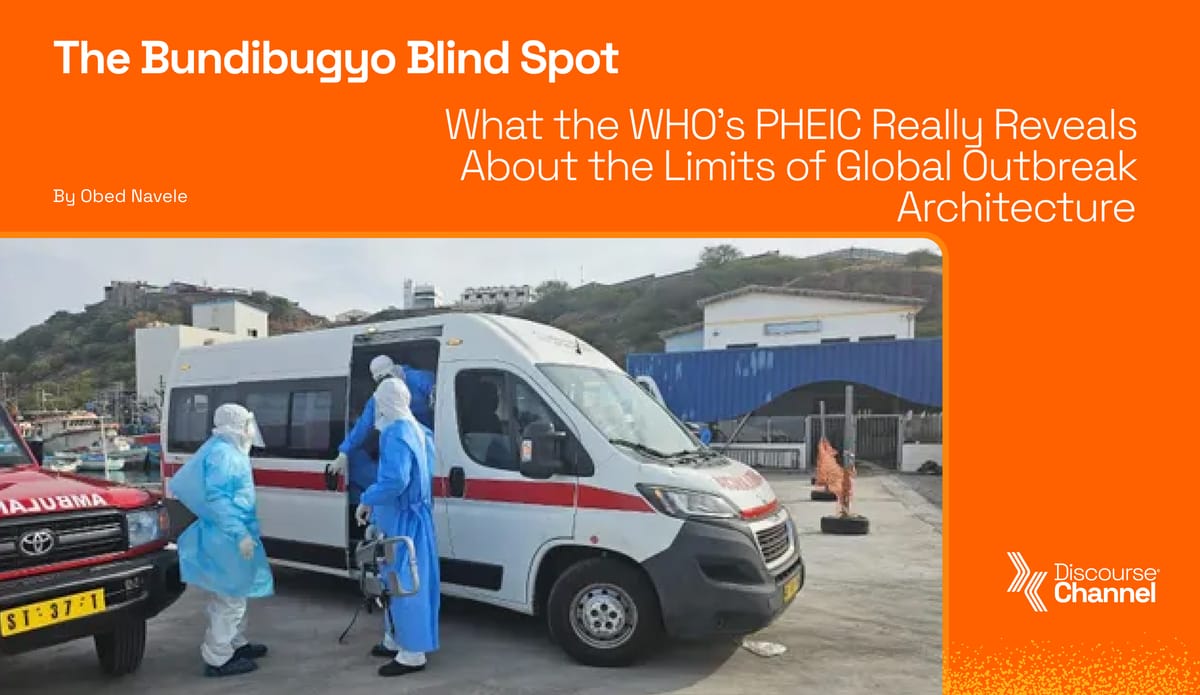
This article presents a structural critique of the DRC–Uganda Ebola response, analyzing critical issues including therapeutic gaps, nosocomial amplification, conflict logistics, and the governance of panic. The analysis highlights how these systemic factors shaped the emergency management, moving beyond clinical aspects to examine broader operational and political failures.
17 May 2026, World Health Organization Director-General Tedros Adhanom Ghebreyesus declared the ninth PHEIC in the International Health Regulations era. The numbers in the official tally eight confirmed cases against 246 suspected and 80 suspected dead. This should be read not as an epidemiological inventory, but as a confession of systemic failure: a three-week diagnostic lag, a therapeutic toolbox that is functionally empty, and a response architecture stress-tested against a strain the world has seen only twice in recorded history.
The Bundibugyo Outbreak's Core Crisis
The standard Ebola response plan utilizing monoclonal antibodies and the Ervebo vaccine is ineffective against the current outbreak, which is caused by the distinct Bundibugyo virus (BDBV) rather than the Zaire strain. Because the BDBV envelope glycoprotein structure differs significantly from Zaire ebolavirus, existing treatments cannot achieve the necessary cross-protective binding to be clinically effective.
The historical evidence base for BDBV is vanishingly thin: a 2007 outbreak in western Uganda (131 cases, 42 deaths) and a 2012 outbreak in the DRC's Province Orientale (57 cases, 29 deaths). Two data points across 19 years. There are no late-stage candidate vaccines in clinical development that could be expeditiously deployed. What this means in practical terms is that Ituri Province is fighting a Category-4 hemorrhagic fever with tools that predate molecular medicine: isolation, barrier nursing, fluid and electrolyte replacement, and aggressive symptomatic management.
The diagnostic invisibility compounded mortality risk in two directions simultaneously: infected patients remained in general wards and informal clinic settings, accelerating nosocomial spread, while response resources were not mobilised. When a classical public health approach replaces a pharmaceutical one, the operational timeline extends dramatically. Ring vaccination can compress an exposure window to days; contact tracing and isolation alone, across a network of informal health facilities in Ituri's semi-urban sprawl, may take weeks per cluster. Each additional week of uncontrolled community transmission is a week in which the suspected case count of 246 migrates toward the confirmed column and the suspected death toll of 80 migrates toward the irreversible.
The Healthcare-Associated Transmission Crisis
The initial alert to WHO on 5 May 2026 was triggered not by a community death cluster, but by the mortality of four healthcare workers in Mongbwalu Health Zone within four days of each other. This is the signature pathology of a healthcare system that has become an amplifier rather than a firebreak.
The "informal healthcare facility" , a category that encompasses everything from licensed private clinics to single-room community injection posts staffed by paramedics is the structural epicentre of this crisis. In Ituri and North Kivu, the density of such facilities reflects a decades-long failure of public healthcare investment, not a cultural preference for informal medicine. Patients experiencing fever, intense malaise, and haemorrhage naturally seek the nearest available care. Those facilities, operating without real-time laboratory diagnostics, without trained IPC officers, and frequently without adequate PPE stocks gowns, gloves, face shields, and high-filtration masks proceed with standard clinical assessment. A single venous blood draw, an ungloved vital-signs check, or the preparation of a body for burial can constitute a decisive transmission event.
A further compounding factor is the three-week lag between symptom onset in the index case and the laboratory confirmation of BDBV on 15 May. During that period, patients presenting with classical viral haemorrhagic fever symptoms were almost certainly triaged and treated as cases of malaria, typhoid, or other endemic febrile illness precisely because the diagnostic reflex points to what clinicians see routinely, not to a species of Ebola documented only twice in human history. Low clinical index of suspicion is not a clinician failure in this context; it is a systemic one, traceable directly to the absence of point-of-care multiplex diagnostics capable of discriminating among BDBV, SUDV, and EBOV without centralised PCR.
The consequence is that health facilities in Bunia, Rwampara, and Mongbwalu became what epidemiologists grimly term "nosocomial amplification events" sites where a low-level community outbreak acquired the infrastructure to propagate itself efficiently across a large number of simultaneous contacts.
The Terrain Challenge Between Covert Spread And Conflict Logistics
The apparent epicentre of this outbreak is Mongbwalu, a high-traffic artisanal mining hub in Ituri Province. Mining communities are, from an infectious disease standpoint, among the most challenging transmission environments imaginable: high population density in informal settlements, continuous inflow and outflow of workers from multiple health zones, economic incentives that make self-isolation financially untenable, and social networks that extend across provincial and national borders. The epidemiological trace-back exercise is ongoing, but the directional flow is already clear from Mongbwalu to Rwampara to Bunia, following the gradient of healthcare availability and commercial connectivity.
Ituri Province shares porous borders with Uganda and South Sudan. Bunia's health zone sits within 500 kilometres of Uganda's capital. Two confirmed cases in Kampala individuals who travelled from DRC and had no apparent epidemiological link to each other appeared on 15 and 16 May 2026 within 24 hours of each other. The body of the first, an elderly Congolese man who died in a Kampala hospital on 14 May, was transferred back to DRC the same day, before Ebola was confirmed an immediate vector for ancestral burial transmission practices that have historically sustained outbreak chains.
The response calculus for contact tracing in this terrain is stark. Contact tracing requires stable addresses, functional telecommunications, community trust, and safe access for field teams. Ituri and North Kivu possess none of these in sufficient measure. Response teams navigating these corridors face not just logistical obstruction but active security threats. The 2018–2020 Zaire EBOV outbreak in this same geographic corridor 3,470 cases, 2,287 deaths, a PHEIC declared in July 2019 provides the operational precedent: response teams were shot at, treatment centres were burned, and community distrust generated deliberate flight from surveillance into unmonitored secondary transmission chains. That outbreak ultimately required 22 months and the full force of a multi-agency international response to extinguish, even with Ervebo and monoclonal antibodies available. The current outbreak has neither, and is beginning in an environment of equivalent or greater insecurity.
The Policy Architecture
WHO's simultaneous PHEIC declaration and advice against international travel or trade restrictions reflects a tension that has defined every major outbreak since SARS: the divergence between political optics and epidemiological evidence. Border closures are intuitive, photogenic, and demonstrably counterproductive. Uganda and DRC's shared border stretches across hundreds of kilometres of poorly mapped terrain; the formal crossing points at which exit screening is being deployed represent a fraction of the permeable frontier. A travel ban of official routes does not stop population movement, it reroutes it into the informal channels that surveillance systems cannot see. The 2014 West Africa Ebola epidemic generated extensive evidence that border closures delayed the arrival of medical personnel and supplies while failing to prevent case exportation, at a cost of significant diplomatic and economic damage to already fragile states.
The more critical governance intervention and the one most consistently under-resourced is community engagement operating at the level of religious institutions, traditional chiefs, and local civil society. The 2018–2020 North Kivu response demonstrated that community-led surveillance, in which village health workers were trained and compensated as frontline epidemiological assets, consistently outperformed top-down military or police-enforced quarantine in both uptake and accuracy of reporting. Heavy-handed cordon sanitaire operations do not contain Ebola; they generate the flight that propagates it.
The structural governance challenge is compounded by WHO's ongoing budget crisis, partially precipitated by the United States' withdrawal from the agency under the Trump administration. The $500,000 released from the Contingency Fund for Emergencies is a functionally inadequate initial mobilisation for an outbreak of this complexity. The 2018–2020 response ultimately drew on resources exceeding $1.1 billion. There is, moreover, no existing Bundibugyo-specific research consortium, no stockpile of experimental therapeutics under compassionate-use authorisation, and no accelerated regulatory pathway pre-negotiated for candidate BDBV vaccines. The R&D ecosystem that produced Ervebo and the monoclonal antibody platforms was built through painful post-hoc investment after the 2014–2016 catastrophe killed more than 11,000 people. The world is now demonstrating, with elegant consistency, that it did not learn the meta-lesson that investment must precede, not follow, catastrophe.
The Architecture of Inadequacy
What the Bundibugyo PHEIC exposes, beneath its laboratory-confirmed case count, is not simply an outbreak of a rare filovirus, it is the routine collision between the geography of disease and the geography of investment. The communities in Ituri's mining belt have lived inside this collision for decades: no diagnostic infrastructure calibrated to their biological risk, no pharmaceutical pipeline prioritising their pathogen burden, no healthcare workforce of sufficient size or protection to serve as anything other than a casualty in the first wave of transmission.
The immediate operational imperatives are clear: emergency deployment of portable Bundibugyo-capable multiplex PCR diagnostics beyond Kinshasa's INRB laboratory; rapid field training and PPE saturation for informal healthcare providers; community health worker activation and financial compensation as the primary contact-tracing mechanism; and immediate negotiation with armed actors to establish protected corridors for response teams a process that takes months, not days. Simultaneously, the WHO, Wellcome Trust, CEPI, and national NIH equivalents must initiate accelerated trials for candidate BDBV vaccines and broad-spectrum filovirus antivirals under emergency frameworks.
The deeper reform is political and structural: a binding, adequately financed pandemic prevention fund that does not require mass mortality as its activation criterion. The 2018–2020 Zaire outbreak killed 2,287 people in the same province now burning with Bundibugyo. The system learned enough to stop that virus. It did not learn enough to build the tools for the next one. The gap between those two lessons is measured, today, in 80 suspected dead in Ituri and an unknown, far larger number of community deaths that no surveillance system has yet reached.