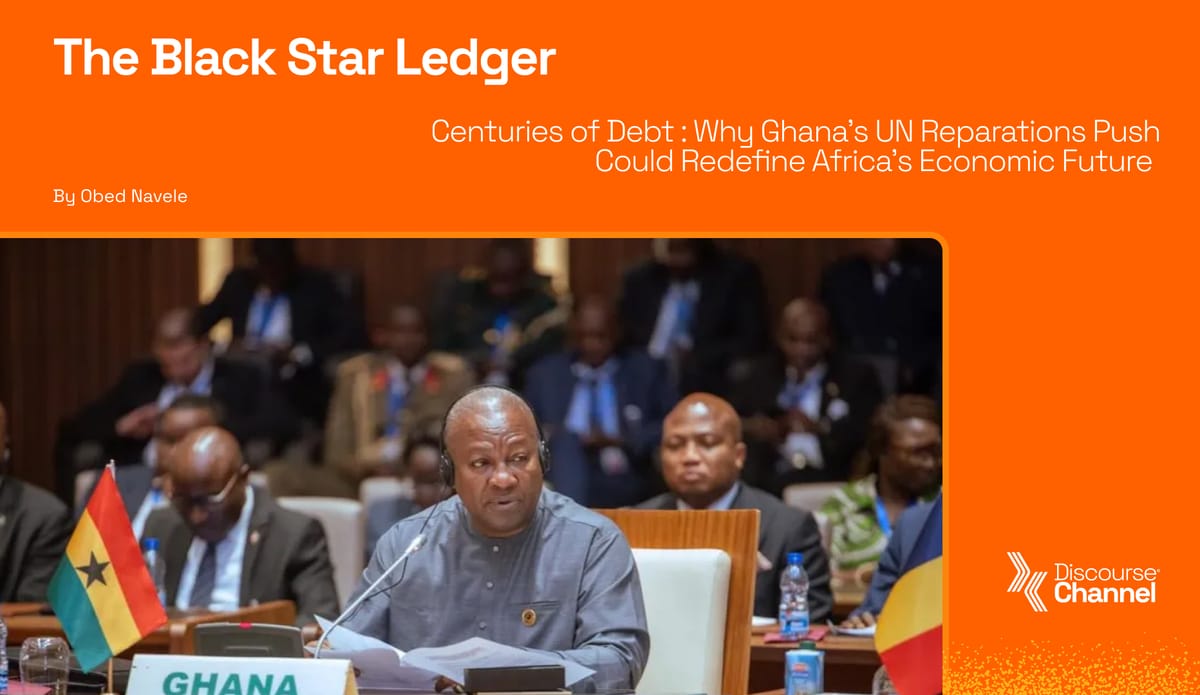
THE BLACK STAR LEDGER Centuries of Debt : Why Ghana’s UN Reparations Push Could Redefine Africa’s Economic Future
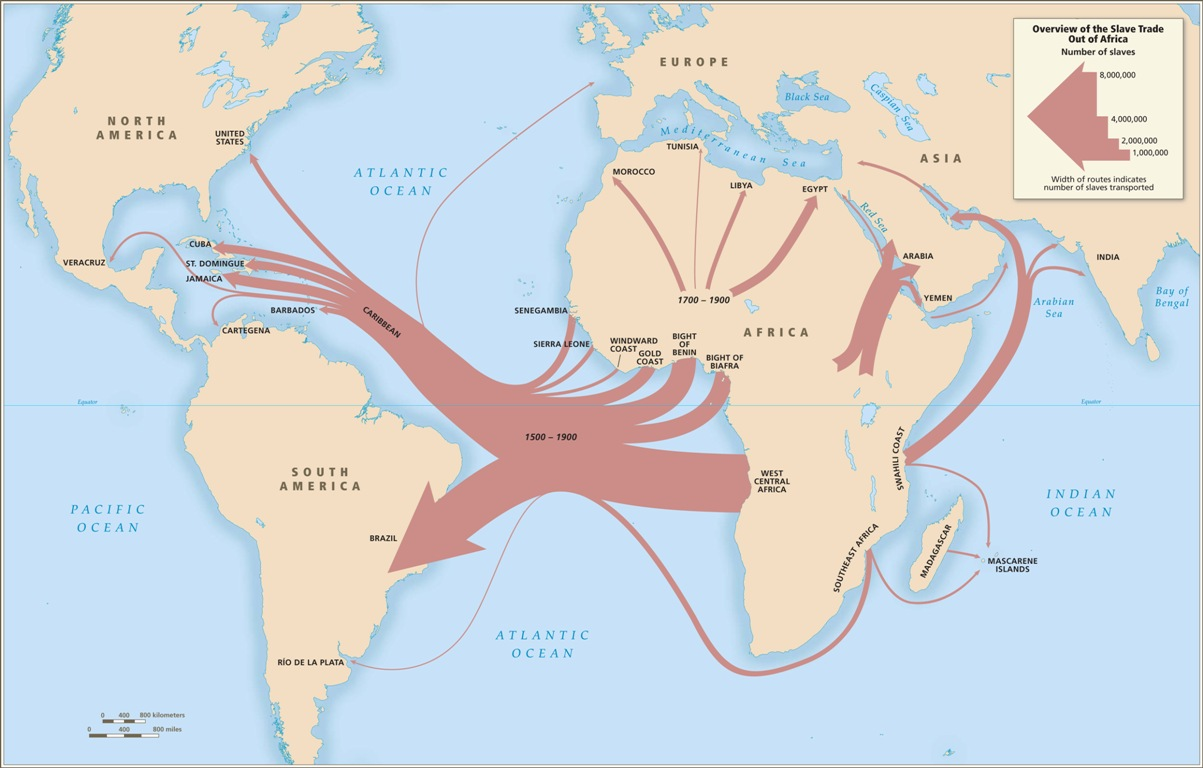
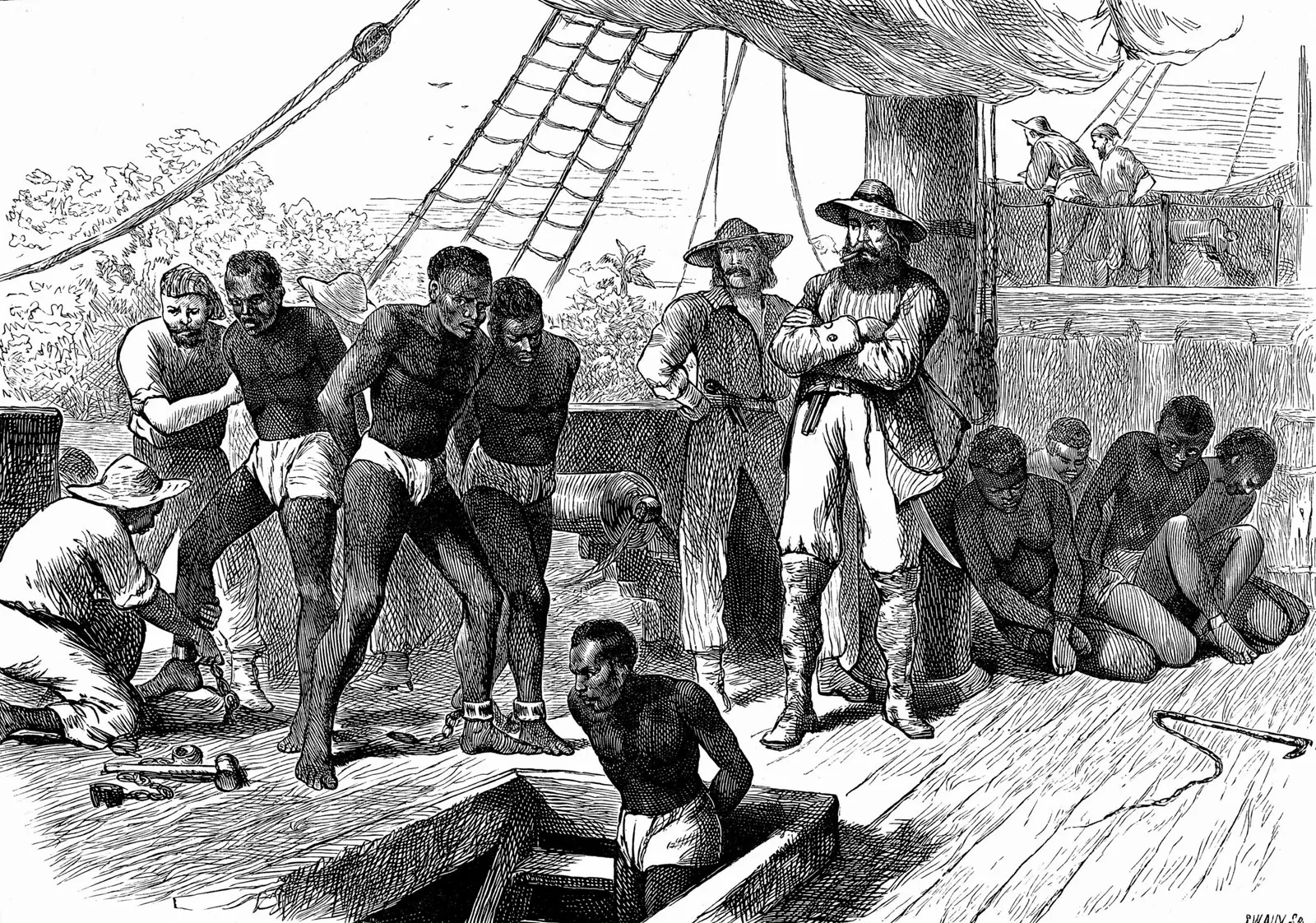
Over the course of four centuries, ~12.5 million Africans were forcibly transported through the transatlantic slave trade, making enslavement a brutal reality for millions. In a vote, 123 countries at the UN formally declared the transatlantic slave trade the gravest crime against humanity
The global economy as we know it today, is still running on unpaid bills, with total global debt reaching a record high of $348 trillion at the end of 2025. Over the course of four centuries, approximately 12.5 million Africans were forcibly transported through the transatlantic slave trade, making enslavement a brutal reality for millions. Today, the regions affected by this remain among the poorest and underdeveloped countries in the world. Research suggests that if the transatlantic slave trade had never occurred, nearly 72 per cent of the income gap between Africa and the rest of the world would not exist. Meanwhile, in the international financial market today, many developing nations are forced to borrow at interest rates approaching 10%, while the wealthy economies that historically accumulated riches during the colonial era often borrow at rates below 1%. This creates a cycle where the poorest countries pay the most to access the capital they need to grow. These are not coincidences; they seem to have some undeniable correlations. For centuries, the economic consequences of slavery have been treated as historically acknowledged occurrences but separated from present-day reality. Yet this article suggests a different truth: the past is not past, it still lingers and the consequences can be felt in the present and future.
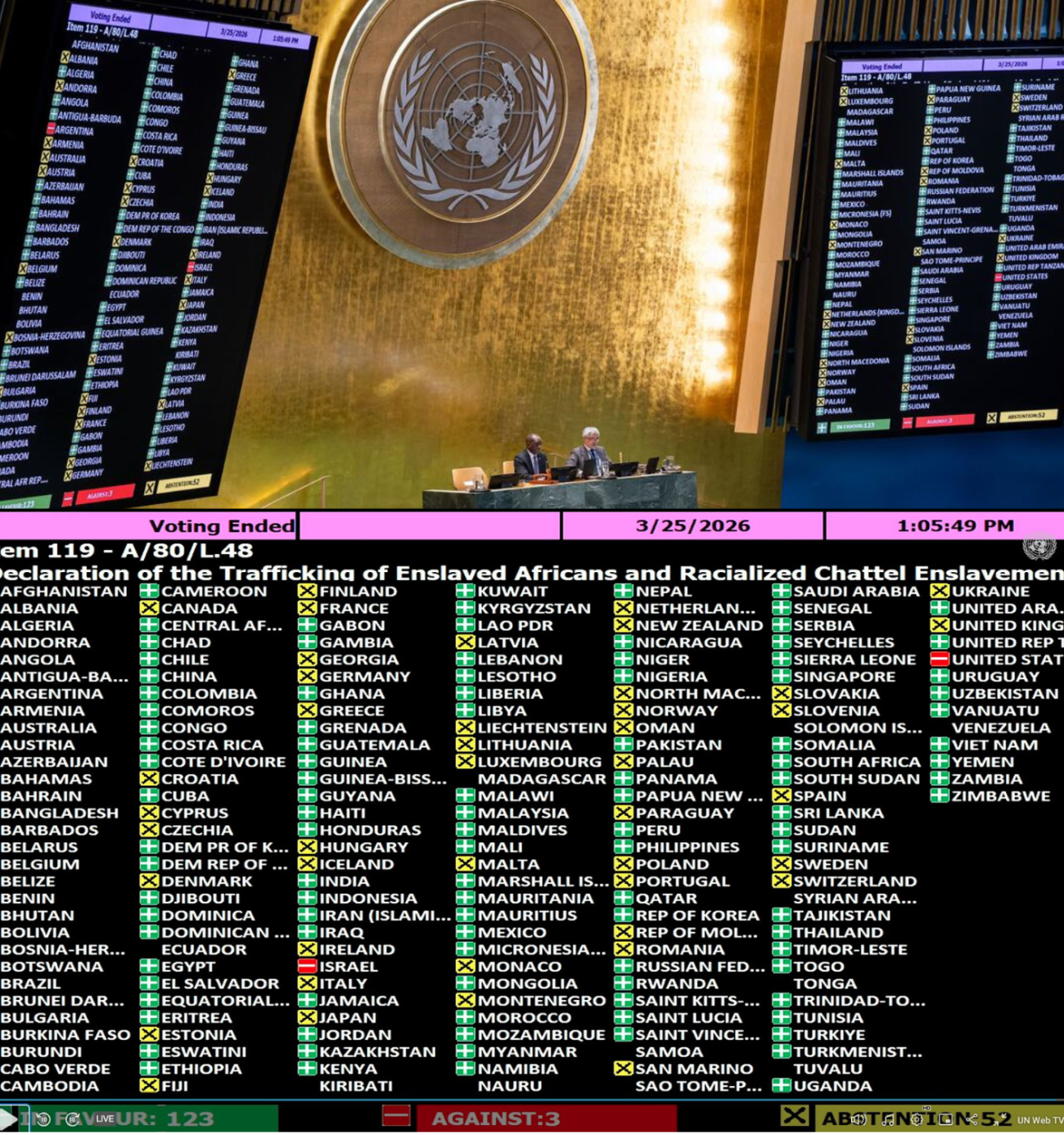
On March 25, 2026, this issue moved from being an academic debate to a formally internationally recognized issue . In a decisive vote, One hundred and twenty-three countries at the United Nations formally declared the transatlantic slave trade the gravest crime against humanity in recorded history. Ghana led the charge. The significance of that moment lies not in symbolism but in implication, because once the scale of the damage is measured, the next question becomes unavoidable: What would it mean to settle a debt of this magnitude?. The vote did not create reparations, nor did it force payments. It didn’t settle anything overnight, but it did something just as important: It changed the global conversation from “Was this wrong?” to “What are we going to do about it?”
This Is What You Should Know;
The economic consequences are not merely historical; they are present and measurable. Economist Nathan Nunn of Harvard University conducted landmark research linking countries’ slave trade exposure to their current GDP. His findings are stark: the countries from which the most slaves were taken are today among the poorest on the continent, and this correlation holds even when controlling for geography, colonial history, and other development variables.
Most striking of all: Nunn’s calculations suggest that if the slave trades had never occurred, 72 percent of the average income gap between Africa and the rest of the world would not exist today. Africa, in other words, would likely be economically comparable to Asia or Latin America. That is not a historical footnote but a present-day price of an unpaid debt.
The demographic toll was equally catastrophic. In 1750, Africans accounted for roughly 13 percent of the global population. By 1900, that figure had collapsed to 8 percent, a demographic hollowing-out caused directly by the removal of millions of people in their most productive and fertile years. Researchers estimate there would have been 112 million more Africans alive by the 20th century had the slave trade never occurred. The continent did not return to its 1750 share of global population until 2014 more than 250 years later. This is the context in which the reparations debate must be understood. It is not about relitigating the past, naming the structural forces that continue to shape the present is what this is about.
Ghana’s Leadership Leading The Narrative
Understanding the significance of why Ghana is leading this fight, you must understand what Ghana is in the geography of this history. The Ghanaian coastline was not a passive bystander to the slave trade. Cape Coast Castle and Elmina, both UNESCO World Heritage Sites today, were literal processing facilities for human cargo. Tens of thousands of enslaved Africans passed through their dungeons before the door of no return. That history has shaped Ghana’s moral identity and its sense of obligation to the diaspora in a way that is unique among African nations.
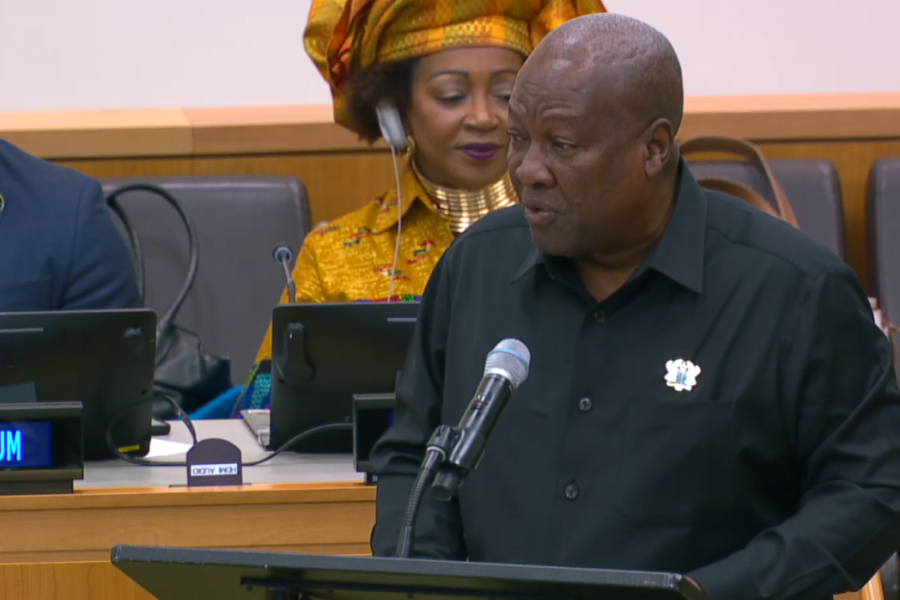
What is new is that Ghana has translated that moral weight into diplomatic strategy at the highest level. President John Dramani Mahama, who also holds the designation of African Union Champion for Reparations, presented the landmark resolution on March 25, 2026 on behalf of the 54-member African Group, the largest regional bloc in the United Nations. It was the culmination of more than a year of careful multilateral negotiation, consultation with civil society, and coalition-building across the Global South. Ghana’s strategic approach has three distinct dimensions.
1. Diplomatic rallying the African Group and securing the votes of 123 nations, a supermajority that included most of the Global South.
2. Institutional building the architecture for reparations through bodies like the AU Decade for Reparations (2026–2036), the proposed Global Reparations Fund to be headquartered on the African continent, and the Accra Reparations Conference framework.
3. The Right of Return programme. The “17th Region” concept recognizing the African diaspora as part of the national fabric is both symbolic and economic. Ghana’s earlier “Year of Return” initiative alone generated over $1.9 billion, proving that reconnection has tangible impact.
Legal Foundations:
Challenging the ‘It Was Legal Then’ Argument
For decades, the primary legal shield used by former slave-trading nations was simple: “It wasn’t illegal at the time.” Therefore, they argued, no legal liability arises. The United States restated this position explicitly in its ‘no’ vote on March 25, 2026, declaring it does not “recognise a legal right to reparations for historical wrongs that were not illegal under international law at the time they occurred.”
Resolution A/80/L.48 challenges this defence at its legal foundation through the principle of jus cogens, a Latin term meaning ‘compelling law.’ Jus cogens norms are peremptory norms of international law from which no derogation is permitted. They include prohibitions against torture, genocide, and crimes against humanity. The argument now is: slavery falls into that category. Meaning it was always wrong even when it was legal. The crucial point is that, jus cogens norms are not created by treaties or state consent; they derive from the fundamental moral order that underlies all international law. This does not automatically trigger compensation, but it shifts the legal and diplomatic terrain by: Undermining the retroactivity defense, Opening pathways to International Court of Justice (ICJ) advisory opinions, Strengthening the negotiating position of African and Caribbean states In global diplomacy that shifts matters.
FINANCE:
The Odious Debt Argument — And Why It Changes Everything
Honestly, this always comes down to money, right?” Yes It does. And this is where most conversations stall. People ask: How do you even calculate something like this? Why should current generations pay? Where would the money go? Fair questions. But there’s another way to look at it. Right now, African countries are borrowing money at interest rates close to 10% . Countries like Germany? Less than 1%. Ghana spends about 26% of its revenue just servicing debt. France? Around 3%. So the argument emerging isn’t just “pay us.” It’s: “Stop charging us to participate in a system built from extracting our wealth.” That’s where ideas like debt cancellation come in, not as charity, but as correction.
The argument being advanced within the AU and the reparations movement is straightforward: meaningful reparatory justice must include a fundamental reform of the global financial architecture. This means debt cancellation as a partial payment on the historical debt owed to Africa. It means reform of IMF conditionality structures that replicate colonial power dynamics. It means the establishment of the proposed Pan-African Credit Rating Agency, which would offer alternative risk assessments tailored to African economic contexts rather than perpetuating the negative risk-perception cycle imposed by Western ratings agencies. The Lomé Declaration on Debt, adopted at the AU’s first dedicated Debt Conference in Togo in May 2025, called for exactly these reforms. It is not coincidental that the same year the AU designated as its Year of Reparations was also the year it convened its first ever continental debt conference. The wealth extracted through slavery financed the Industrial Revolution, built institutions, and established the global financial architecture that African nations are now paying to access at punishing rates. This has real consequences. Reduced investment in healthcare, Underfunded education systems, Limited infrastructure development. African Arguments, February 2025 “Debt cancellation is not enough if we do not also transform the colonial architecture that is still in force.”
THE CREATIVE ECONOMY;
Ownership, Attribution, and the Culture That Built the World
The theft that accompanied the transatlantic slave trade was not limited to human bodies and labour. It included culture, knowledge, aesthetic forms, and creative traditions, resources that were extracted, transformed, and commercialised without credit or compensation to their originators. African music, design, storytelling, fashion, and spiritual traditions form the bedrock of significant portions of the global entertainment and creative industries. The roots of jazz, blues, rock and roll, and hip-hop together form the foundation of the most commercially dominant music forms of the last century trace directly to African and African-American traditions born in the crucible of enslavement. Yet the financial and cultural ownership of these forms has historically been concentrated in Western hands. UN Resolution A/80/L.48 addresses this directly, calling for the prompt and unhindered restitution of cultural items including artworks, monuments, museum pieces, documents, and national archives to their countries of origin without charge. This is a starting point, but the creative economy argument extends well beyond museum artefacts.
Ghana’s reparations framework includes a push for a broader architecture of cultural and economic ownership. This means intellectual property frameworks that recognise and compensate for African traditional knowledge. It means development investment in African creative industries film, music, fashion, and digital media as part of a reparations compact. It also means decolonising the global streaming and distribution systems through which African content is monetised, often at deeply unfavourable terms for African creators. Nigeria’s Nollywood, Ghana’s Ghallywood, the explosion of Afro-beats globally, the growing international market for African fashion design, these are not soft-power stories. They are economic stories. The creative economy is one of the fastest-growing sectors in Africa, and a reparations framework that invests in its infrastructure, legal protection, and global distribution would generate returns far beyond the cultural.
TECHNOLOGY;
The Digital Frontier — A New Form of the Old Extraction?
Africa is now one of the fastest-growing digital markets globally, with a young and rapidly connected population. A study of the sub-Saharan African mobile economy projected over 600 million unique mobile subscriptions by 2025. The continent’s young, tech-native population represents an extraordinary economic opportunity. But the current model of digital development is reproducing a familiar dynamic: high-value activities, system architecture, core development, intellectual property ownership, data monetisation all remain concentrated outside the continent, while Africa is largely relegated to the role of consumer and low-level support provider.
What might reparations look like in this context? Concretely, it could mean: preferential access to satellite and broadband infrastructure for countries most affected by the slave trade. It could mean technology transfer agreements embedded in development partnerships, rather than proprietary licensing arrangements that perpetuate dependency. It could mean investment in African AI research capacity, data sovereignty frameworks, and green technology infrastructure resources that will define economic competitiveness for the next generation.
Rwanda and Kenya offer early models. Rwanda’s investment in locally owned data centres and fibre-optic networks has created jobs and reduced dependency on foreign corporations. Kenya’s tech ecosystem has generated continent-wide innovation in mobile payments, logistics, and digital finance. These are not miracles of market efficiency, they are the results of deliberate policy choices. A reparations-informed digital agenda would scale these choices across the continent with the backing of international investment and technology partnerships that Western nations owe as part of their historical obligation.
EDUCATION AND HUMAN CAPITAL:
The Brain Drain — Slavery’s Modern Echo
The slave trade was, among other things, a systematic extraction of human capital, the forcible removal of millions of people in their most productive years from the communities that needed them most. It is one of the bitterest ironies of our current moment that this process continues, in a voluntary but structurally coerced form, through what economists call ‘brain drain.’ The International Organisation for Migration (IOM) estimates that around 20,000 skilled professionals emigrate from Africa each year. Studies indicate that Africa loses approximately $2 billion annually to brain drain, as professionals and executives migrate to Australia, Canada, the United Kingdom, and the United States. Meanwhile, the United Kingdom benefits to the tune of approximately $2 billion per year from the contributions of African professionals including over 6,770 Nigerian nationals alone working in the National Health Service.
African healthcare systems are underfunded partly because of debt service obligations. African universities are underfunded for the same reason. African professionals therefore face a rational calculation: leave, or struggle within a system that lacks the resources to reward and support their work. The brain drain is not a failure of African ambition, but a predictable output of an unjust global architecture. A reparations framework that takes education seriously would look like this: sustained international investment in African universities and research institutions, structured not as aid but as a recognition of an obligation. Scholarship reciprocity agreements that ensure students trained abroad return to build African institutions. Medical and engineering debt relief programmes that make staying in Africa economically viable. And critically invest in the infrastructure, governance, and quality of life conditions that make return not merely possible but attractive.
Who Voted No — And What That Tells Us
Understanding the full significance of what happened on March 25, 2026, we must examine not just the 123 nations that voted yes, but the nature and reasoning of those who did not. The United States, Israel, and Argentina voted against the resolution. The US position that no legal right to reparations exists for historical wrongs not illegal under international law at the time is legally cautious but politically revealing. The country most directly and materially built on enslaved African labour, whose cotton economy was almost exclusively dependent on enslaved workers and which grew to become the world’s dominant economic power in part through that foundation, refuses to acknowledge any legal obligation arising from that history. The abstentions are equally significant. Every member of the European Union abstained. The United Kingdom abstained. Portugal, Spain, the Netherlands, France the nations whose trading companies and monarchies financed, organised, and profited most directly from the slave trade abstained. Their explanations of the vote acknowledged slavery’s horror while raising procedural objections about retroactive application of law and ‘unbalanced interpretation of historical events.’
Ghana’s Foreign Minister Samuel Okudzeto Ablakwa addressed this framing directly: “It is not about apportioning blame across generations or nations. It is not about reopening old wounds; it is about ensuring that those wounds are neither forgotten nor denied.” The geopolitical reading is clear. The abstentions and no votes represent nations that are willing to acknowledge slavery’s evil in moral terms while resisting any language that could strengthen claims for material repair.
What Africa Must Also Confront
For the reparations movement to succeed, it must also address internal challenges. Historically, some African actors participated in the slave trade. Acknowledging this does not dilute the broader responsibility, it strengthens credibility. More importantly, present-day governance matters. Corruption, weak institutions are also real and ignoring that weakens the argument.
Questions that must be addressed include:
• How will funds be managed?
• Which institutions will oversee implementation?
• How will transparency and accountability be ensured?
What does success actually look like?
The most transformative version of the reparations agenda isn’t about a one-time payment or a single policy, but using this moment to reshape how Africa’s economies, institutions, and global relationships are structured, deliberately and for long-term growth. At the core is a shift in how value is retained. Africa’s natural resources oil, gas, minerals, and agriculture must move beyond raw export toward processing and production on the continent. At the same time, the African Continental Free Trade Area (AfCFTA) has to function as intended: a unified market that reduces dependence on external partners and strengthens intra-African trade. Growth also needs to happen across sectors. Technology and the creative economy must expand together, with African ownership of platforms, intellectual property, and data. Education, in this context, becomes essential infrastructure, something to invest in, not rely on externally. The role of the diaspora is evolving as well. Rather than being seen mainly as a source of remittances, it becomes a partner in investment, innovation, and governance an active part of
What Comes Next
The March 25, 2026 UN resolution marks an important starting point. While it is non-binding, it establishes a strong global consensus that the transatlantic slave trade was a major crime against humanity and that its effects still matter today. What happens next depends on African nations and their partners staying united and organized. This includes pursuing legal steps like an ICJ advisory opinion, implementing the AU Decade for Reparations with clear goals, and maintaining consistent diplomatic pressure on countries involved in the slave trade. At the same time, Africa must strengthen its own institutions, such as financial systems, education, trade frameworks, and development funds so it can effectively manage and benefit from any outcomes of the reparations movement. In simple terms, the resolution acknowledged that a debt exists. Now the focus shifts to how that debt will be addressed over time, through coordinated political, legal, and institutional efforts.