Inside Senegal’s Leadership Rift: President Faye Dismisses Prime Minister Sonko
Senegalese politics is now at the center of one of the continent’s most closely watched leadership disputes. The fallout between President Bassirou Diomaye Faye and Prime Minister Ousmane Sonko has transformed what was once viewed as a united reform movement into a test of political cohesion ...
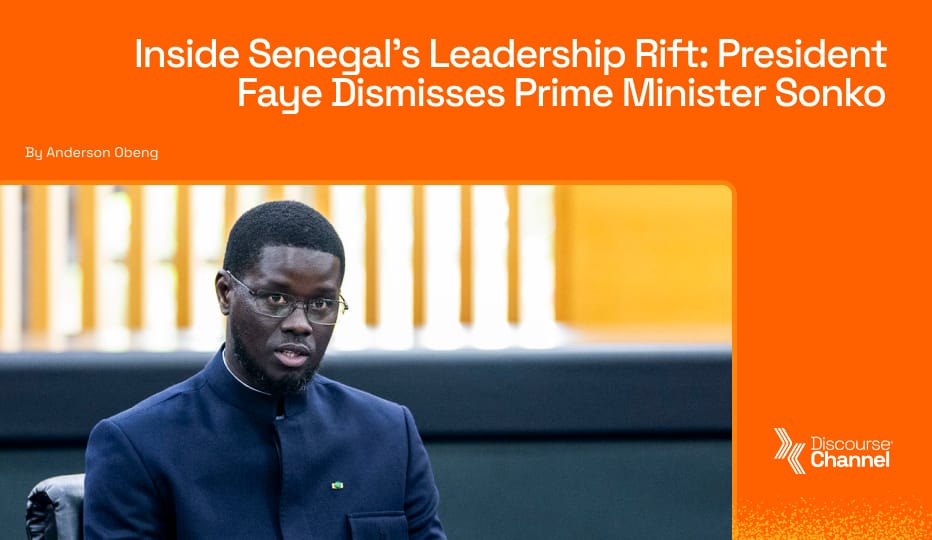
A political alliance that once symbolized a new era in Senegalese politics is now at the center of one of the continent’s most closely watched leadership disputes. The fallout between President Bassirou Diomaye Faye and Prime Minister Ousmane Sonko has transformed what was once viewed as a united reform movement into a test of political cohesion, governance, and institutional stability.
President Bassirou Diomaye Faye dismissed Prime Minister Ousmane Sonko and dissolved the government, triggering one of West Africa’s most significant political developments of the week. The move followed months of growing tensions between the two leaders, who rose to power together under the ruling PASTEF movement.
The dismissal marked a dramatic shift in a political partnership that had reshaped Senegal’s political landscape in 2024. Sonko, a highly influential political figure and leader of the ruling movement, had played a central role in Faye’s rise to the presidency after being unable to contest the election himself.
Analysts have linked the growing divisions to disagreements over governance priorities, economic policy, and the handling of Senegal’s worsening debt challenges. The tensions also emerged against the backdrop of ongoing discussions with international financial institutions and concerns about the country’s fiscal position.
The decision immediately raised questions about the future direction of Senegal’s government and the balance of power within the ruling movement. While President Faye moved quickly to appoint economist Ahmadou Al Aminou Lo as the new prime minister, the political story did not end there.
Just days after his dismissal, Sonko was elected Speaker of Parliament, giving him a powerful institutional platform and ensuring he remains a central figure in Senegalese politics. The development has created the possibility of a more complex political environment where executive and legislative influence could increasingly diverge.
The shake-up has also drawn attention beyond Senegal’s borders. As one of West Africa’s most influential democracies, political developments in Senegal are closely watched by investors, regional policymakers, and international institutions. The leadership dispute arrives at a time when the country is already facing economic pressures, debt concerns, and negotiations over financial reforms.
What we are watching:
- Ghana’s Parliament passed the Human Sexual Rights and Family Values Bill, one of the continent’s most consequential political developments this week.
- The African Union marked its 63rd anniversary while continuing its 2026 focus on sustainable water availability and safe sanitation systems.
The developments in Senegal, Ghana, and across the African Union point to a broader trend in African politics: institutions, governance systems, and policy choices are becoming increasingly central to continental conversations.
Whether through leadership realignments, legislative decisions, or regional policy agendas, governments across Africa are navigating growing demands around representation, economic management, social policy, and institutional reform.
The situation in Senegal may be particularly significant because it is not simply a cabinet reshuffle. It is a test of how one of Africa’s most closely watched political movements manages internal disagreements while maintaining stability, governing effectiveness, and public confidence in its institutions.