Illegal Mining Crackdowns Hit Everyone Except the Financiers
Illegal, small-scale gold mining in Africa is not sustained by desperate individuals. Estimates place its foreign-exchange contribution at roughly $11B, ahead of the $9B generated by large-scale, licensed miners, with an estimated 70%-80% of artisanal miners operating outside licensing frameworks.
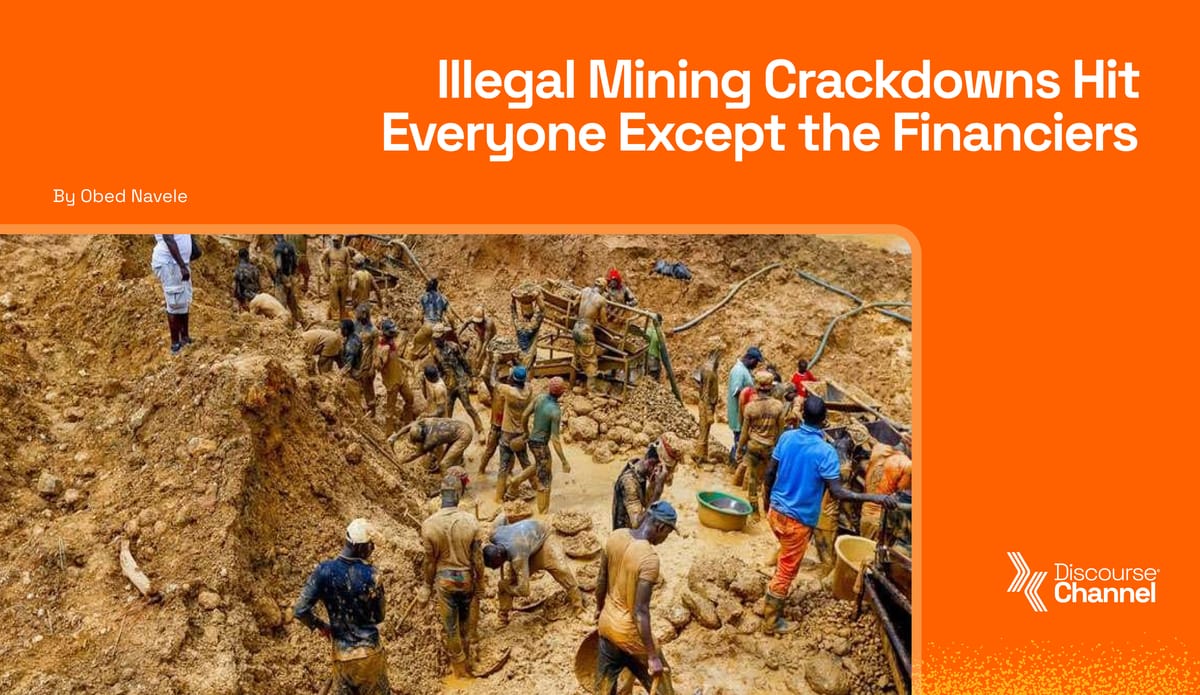
In the first seven months of 2026, Ghana's Ministry of Lands and Natural Resources reported hundreds of arrests, hundreds of seized excavators, and thousands of confiscated water pumps, generators, and dredging machines pulled from illegal mining sites. By July, more than 4,000 excavators were held at the country's ports under a new import-clearance regime. Forestry Commission satellite data put the damage at roughly 8,900 hectares of forest reserve lost to illegal mining as of the end of 2024, a 70 percent jump from 2021. The numbers describe a state at war with an industry operating inside its own borders. They do not explain why, after nearly a decade of declared wars, the industry is still there.
That gap between enforcement activity and enforcement outcome is the real subject of Ghana's galamsey problem, and it is the entry point for a wider continental question about who actually governs natural resources once they are mined.
The economy behind the excavator
Illegal, small-scale gold mining in Africa is not a fringe activity sustained by desperate individuals with shovels. Estimates place its foreign-exchange contribution at roughly $11 billion, ahead of the $9 billion generated by large-scale, licensed miners, with an estimated 70 to 80 percent of artisanal miners operating outside any licensing framework. Behind that output sits a layered commercial structure: financiers who front the capital for excavators and dredging equipment, landowners and chiefs who grant access to concessions and riverbanks, transport operators who move fuel and equipment to remote sites, and aggregators who buy raw gold before it re-enters the formal export chain, often laundered through legitimate buying centres. Each layer is a business relationship, and each has an interest in the operation continuing.
This is why crackdowns that target the visible end of the chain, the excavator operator, the site labourer, tend to look decisive without being disruptive. Security forces destroy machines and make arrests; the financing and demand structures behind those machines remain untouched, and new equipment and new labour move in behind them. The Africa Center for Strategic Studies has argued that this pattern is precisely why previous Ghanaian responses have struggled: not because the problem defies solving, but because interventions target the mining activity itself while leaving the political and economic systems sustaining it largely intact.
Where enforcement stalls
Ghana officials have made public statements on the issue. In July, the Lands Minister, Emmanuel Armah-Kofi Buah, told a policy dialogue with the IMANI Centre for Policy and Education that the country's difficulty was not in making arrests but in what follows them: sustaining prosecutions once suspects are in custody. Reporting on enforcement operations shows a recurring pattern in which foreign nationals caught in raids are deported rather than prosecuted, closing the case without touching whatever financing or documentation trail might otherwise be established. Two Chinese nationals identified as financiers of an operation in the Tano Anwia Forest were arrested in one October 2025 raid, a rare instance of enforcement reaching past the equipment operators toward the money behind them, and notable partly because it is unusual.
A quieter admission is also built into the government's own machinery. Ghana has recruited and trained around 2,000 "Blue Water Guards" to patrol rivers against dredging operations, and the minister has acknowledged bribery allegations within that programme's enforcement infrastructure, generating the same integrity problem it was built to solve. Civil society groups tracking the sector, including the Ghana Youth Environmental Movement and the Fix The Country Movement, have pointed to a related and more unsettling shift: operators who once worked to avoid detection now livestream mining activity on social media, apparently untroubled by the prospect of consequences. That is not the behaviour of an industry hiding from the state. It is the behaviour of an industry that has priced in the state's response.
The equipment question, and what it reveals
Government data on seized machinery is instructive less for its scale than for its incompleteness as a deterrent. Hundreds of excavators, thousands of water pumps and changfan machines have been destroyed or immobilised at sites since the start of 2026, alongside a new port-clearance regime aimed at stopping equipment before it reaches mining sites rather than chasing it afterwards. It is sound logic on paper. But it depends on a state capable of tracking imported machinery from port to end use across a country where concessions can sit idle for decades under speculative long-term leases, precisely the kind of unworked, unpoliced ground that becomes attractive to illegal operators. Cabinet has approved amendments capping large-scale mining leases at 20 years, down from 30 years renewable for a further 30, an acknowledgement that the formal licensing system itself has been generating the vacant terrain informal miners occupy.
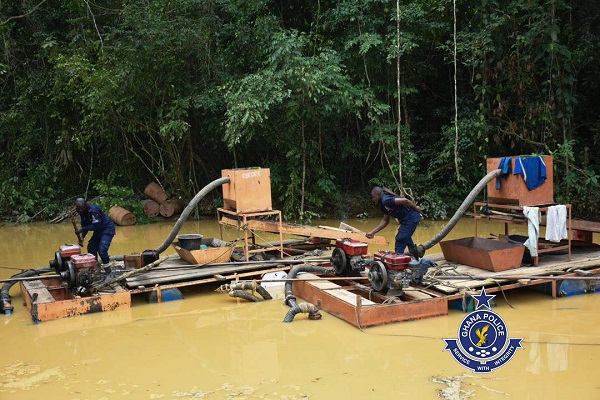
This is the structural point that gets lost in coverage built around raid counts and seizure tallies: enforcement capacity and governance capacity are not the same thing. A government can seize excavators indefinitely and still fail to answer the more basic questions: who financed them, who authorised access to the land they worked on, and why the same communities keep reappearing on enforcement lists years after being declared "reclaimed."
Beyond gold
The same architecture repeats itself, with local variation, across sand winning, illegal logging and other extractive economies on the continent. Sand winning along Ghana's coastline and rivers, much of it feeding an unregulated construction boom, follows an almost identical chain: financiers, land access brokers, transporters, and buyers who rarely ask where material originated. Illegal logging in forest reserves depends on the same permissiveness around chain-of-custody documentation that allows smuggled gold to re-enter formal export markets. In each case, the resource itself is not the vulnerability. The vulnerability is the institutional space between extraction and market: the paperwork, permits, customs checkpoints and buying centres where illicit material is meant to be filtered out and instead passes through with minimal friction.
The IMF's 2026 Article IV assessment of Ghana captured the stakes in stark terms; if illegal operators believe political connections place them beyond enforcement, the system will fail regardless of how many raids are conducted. That is a governance diagnosis, not an environmental.
West Africa Agri Show & 3rd National Annual Livestock Day
Theme: Empowering Agriculture. Driving Innovation. Connecting West Africa.
29th - 30th Sept, 2026 | The Palms Convention Centre, Accra, Ghana
A crisis of governance, not resources
None of this is unique to Ghana, and that is precisely the point of examining it as an entry case rather than an isolated national failure. Wherever African states have declared war on illegal extraction of gold in Ghana, sand along West African coastlines, and timber in Central African forest belts, the pattern of enforcement without disrupting underlying networks tends to recur. Raids generate headlines and arrest tallies that allow governments to demonstrate seriousness to domestic and international audiences. They rarely secure convictions of financiers, rarely trace confiscated minerals or timber through export documentation, and rarely ask why the officials, chiefs, or security personnel positioned to prevent illegal access to land and permits so consistently fail to do so.
Africa's natural-resource crisis, framed this way, is not a story about weak laws or insufficient military deployment. Ghana's legal framework Article 257 of the 1992 Constitution vesting all minerals in the state, the Minerals and Mining Act, and successive amendments has rarely been the missing ingredient. What is missing is a consistent willingness to apply that framework upward, into the financing, licensing, and political relationships that make illegal extraction survivable in the first place. Until African governments treat the space between the excavator and the export certificate as the actual site of enforcement, the crackdowns will keep working exactly as well as they have: loudly, repeatedly, and without disturbing the economy they are declared against.
The question this series ultimately has to sit with focuses on whether any government has yet been willing to enforce against the parts of the network it depends on politically to survive.