Africa's Sweetest Export Still Remains Unsatiating
Cocoa's troubles in Africa cannot be separated from the economic architecture within which it was introduced. The crop arrived in West Africa as part of a colonial export system designed to move raw commodities out of Africa and into European processing plants, refineries and factories.
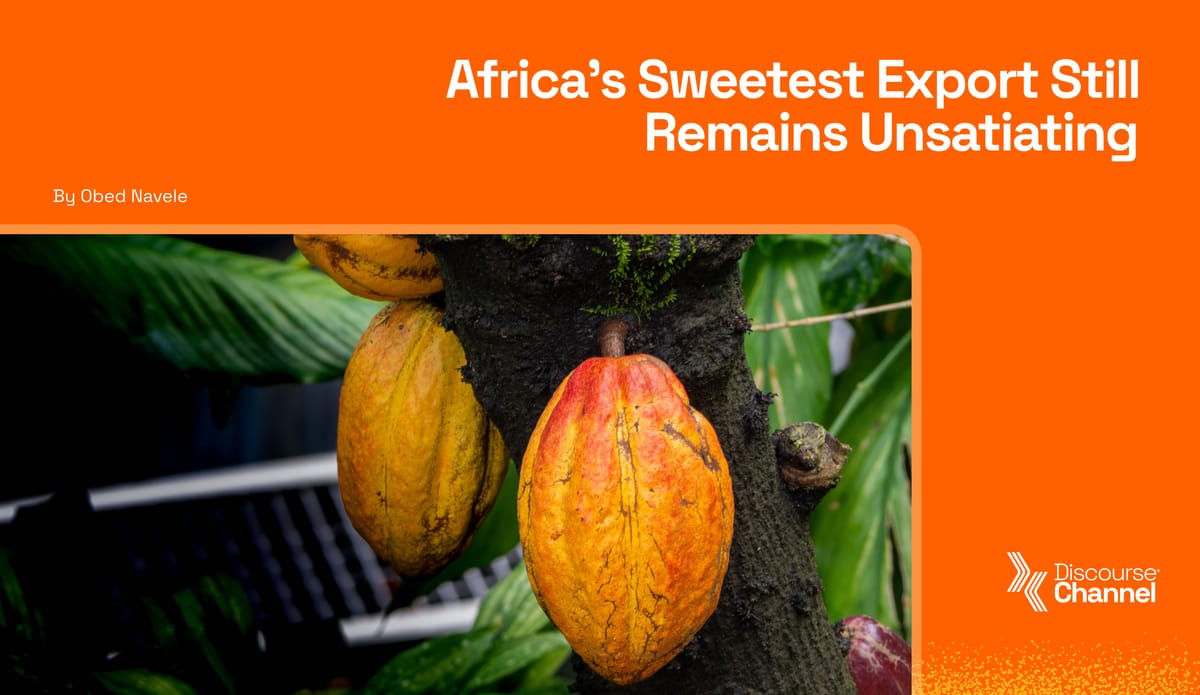
For more than a century, West Africa has fed the world's appetite for chocolate. Côte d'Ivoire and Ghana alone grow well over half of the cocoa that ends up as bars, spreads, and confections on supermarket shelves from London to Lagos, and together with Nigeria and Cameroon, the region supplies close to seventy percent of global output. Yet in the villages where that cocoa is grown, the story is poverty. Households that feed a two-hundred-billion-dollar global industry frequently cannot guarantee their own children a second meal. That contradiction, cocoa wealth sitting beside cocoa hunger, is not an accident of nature. It is the product of a system built long ago and only now, tentatively, being redesigned.
The irony of starving cocoa farmers
The numbers are difficult to reconcile with the scale of the industry built on top of them. Millions of smallholder cocoa farmers across West Africa earn incomes that fall well below internationally recognised poverty lines, even during years when global prices have surged. Studies of cocoa-growing districts in Ghana and Côte d'Ivoire consistently find high rates of food insecurity among the very households producing the beans, with many families reporting periods of hunger, reduced meals and reliance on starchy staples rather than diverse, nutritious diets. Malnutrition among children in cocoa-growing communities remains a persistent concern for public health researchers. This is not a coincidence of poor soil or bad weather. It reflects a structure in which the crop that dominates household labour and land use is also the crop least able, on its own, to guarantee that the household eats.
Part of the explanation lies in what economists call the displacement effect. As cocoa expands, it often does so at the expense of food crops. Land that once grew cassava, plantain or maize for household consumption is steadily converted into cocoa plantations, because cocoa is the cash crop and farmers need the cash. The result is a paradox: farming families become more dependent on markets to buy the very food they once grew themselves, even as the price they receive for their cash crop remains largely outside their control. When cocoa prices fall, or when payments are delayed, that dependence becomes dangerous. It is also why child labour persists so stubbornly in the sector. Low incomes make it difficult for households to hire adult labour, so families lean on their own children, a pattern that researchers and rights organisations have documented for decades without a durable solution.

In this episode of Discourse Brief, we sit down with Professor Karen Ferreira-Meyers of the University of Eswatini's Institute of Distance Education at eLearning Africa 2026.
We talk about what "Africa's time, Africa's terms" actually means beyond the slogan, why connectivity and data costs (not the technology itself) are the real barrier to access, how a six-week AI integration course is changing minds among nearly a thousand educators, and the one policy she'd write first if she had the power to close Africa's education access gap.
From Colonial Cash Crop to Modern Value Extraction
Cocoa's troubles in Africa cannot be separated from the economic architecture within which it was introduced. The crop arrived in West Africa as part of a colonial export system designed to move raw agricultural commodities out of Africa and into European processing plants, refineries and factories. That structure did not disappear with independence. It simply changed hands. Today, the overwhelming share of cocoa's value is still captured far from the farm gates, in the grinding, refining and branding stages of the supply chain that occur predominantly in Europe, North America and increasingly Asia. Producing countries retain the labour-intensive, climate-exposed, low-margin end of the chain, while the profitable end sits elsewhere. A relatively small number of multinational trading and confectionery companies control much of the processing and branding, and industry revenues running into the hundreds of billions of dollars a year sit uneasily beside farmer incomes that hover near, or below, extreme poverty thresholds. This is the deeper argument beneath the current crisis: cocoa has long functioned less as a pathway to African prosperity than as a mechanism through which value generated on African soil is realised elsewhere. Fixing farmgate prices, however necessary, treats a symptom. The underlying condition is a value chain in which growing is African, and profiting is not.
The Price Illusion
The past two years have exposed how fragile even a boom can be for the people actually growing the crop. Global cocoa prices tripled between 2023 and early 2024 after poor harvests in Côte d'Ivoire and Ghana driven by disease, ageing trees and erratic weather linked to El Niño. Farmgate prices in both countries rose sharply in response, and for a moment it appeared that cocoa farmers might finally share meaningfully in a price rally. But the surge proved short-lived. As supply recovered and demand in Europe and Asia softened, international prices collapsed by roughly half between August 2025 and early 2026, falling from levels above eight thousand dollars a tonne to closer to three and a half thousand. Because Ghana and Côte d'Ivoire had fixed their domestic farmgate prices to the earlier high-price environment, both governments were forced into painful corrections. Ghana cut its producer price by nearly twenty-nine percent in February 2026, a decision that stripped income from roughly eight hundred thousand smallholder households. Côte d'Ivoire cut its own price even more sharply. Cocobod, Ghana's regulator, was left with unsellable inventory, unpaid farmers, and a liquidity crisis serious enough to draw the attention of the International Monetary Fund.
The episode illustrated a structural weakness that price booms tend to obscure: when producing countries have limited control over the final price their cocoa fetches on the world market, and even more limited control over how much of that price ever reaches the farmer, prosperity remains conditional and reversible. A single season of falling futures prices can undo years of apparent gains.
Ghana's Reform Gamble
To its credit, Ghana has responded to this crisis with the most substantial cocoa sector reform package in a generation, rather than simply absorbing the shock and hoping prices recover. A new Cocobod bill before parliament would guarantee farmers a fixed minimum share, not less than seventy percent, of the gross free-on-board price for their cocoa, replacing a system in which the government could adjust the producer price administratively and unpredictably. A cedi-denominated cocoa bond is intended to reduce Cocobod's reliance on volatile external financing. Perhaps most significantly, the reform package includes a mandate to process at least fifty percent of Ghana's cocoa beans domestically from the 2026/27 season, alongside the revival of the state-owned Cocoa Processing Company. Ghana and Côte d'Ivoire have also moved to harmonise their marketing calendars and farmgate pricing mechanisms, an acknowledgment that uncoordinated price-setting between the two countries that together grow most of the world's cocoa has long invited smuggling and undermined both governments' bargaining power.
These are meaningful steps. A legally guaranteed share of the export price would give farmers predictability that discretionary price-setting has never offered. A serious push into local processing would begin to move Ghana up the value chain rather than leaving grinding and refining to companies headquartered elsewhere. But reform on paper is not reform in the pocket. Guarantees mean little if Cocobod's finances remain fragile enough to fall behind on payments again the next time global prices swing. Processing targets mean little without the electricity, capital and industrial capacity to hit them. And unless Nigeria, Cameroon and the smaller producing nations are drawn into a coordinated regional approach, Ghana and Côte d'Ivoire will continue negotiating a global market from a position weaker than their combined sixty percent share of world supply should allow.
Beyond the Farm Gate
The looming European Union deforestation regulation adds urgency and cost to this moment. Exporters will soon need to prove that cocoa entering the European market was not grown on recently deforested land, requiring farm-level geolocation mapping that many smallholders, already squeezed by falling farmgate prices, are poorly placed to afford. Absorbing that compliance burden without further impoverishing farmers will require serious public investment, not simply a regulatory mandate passed down the chain.
The longer-term answer has to be structural and thorough. West Africa does not need higher cocoa prices alone; it needs a larger share of what cocoa is ultimately worth, achieved through processing capacity, coordinated regional pricing among producing states, diversified household incomes that reduce dependence on a single volatile crop, and financial protections, such as the guaranteed FOB share Ghana is now legislating, that survive market downturns rather than collapsing with them. A regional or continental cocoa exchange, an idea now gaining currency among policymakers, could give African producers collective pricing power comparable to their collective share of world supply, rather than leaving Accra and Abidjan to set prices independently and absorb global volatility separately.
Cocoa did not create hunger in West Africa by accident, and it will not end it by accident either. Whether the crop becomes a genuine engine of prosperity or remains a story of wealth extracted and hunger left behind will depend on whether the reforms now underway in Ghana are matched, sustained and extended across the region. The world will keep eating chocolate. The question that matters is who, on the African side of that trade, finally gets to eat well too.
West Africa Agri Show & 3rd National Annual Livestock Day
Theme: Empowering Agriculture. Driving Innovation. Connecting West Africa.
29th - 30th Sept, 2026 | The Palms Convention Centre, Accra, Ghana