Ghana’s Textile Revitalization Gains Policy and Financial Backing
Ghana is stepping up efforts to revive its traditional textile industry, with new momentum building around cultural promotion and financial support. The country’s Creative Arts Ministry has introduced “Fugu Wednesday”.
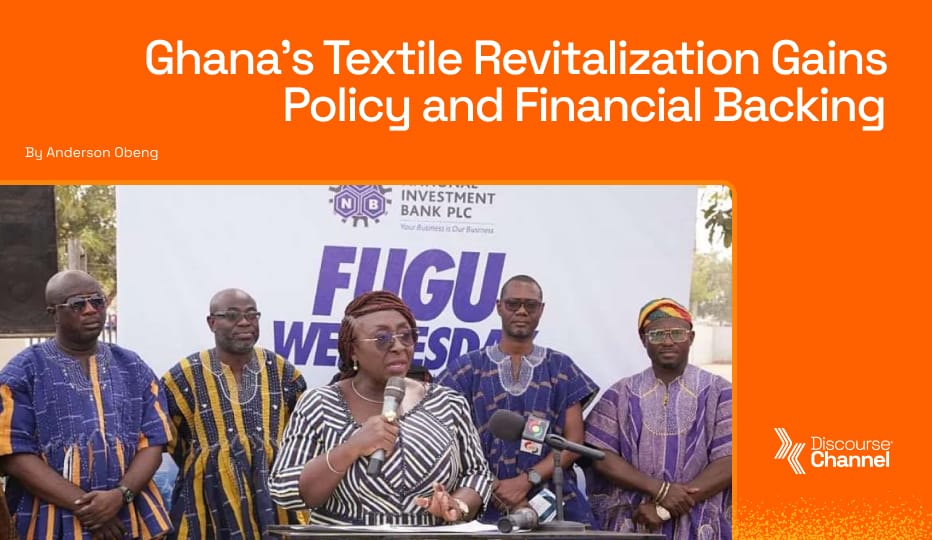
Ghana is stepping up efforts to revive its traditional textile industry, with new momentum building around cultural promotion and financial support. The country’s Creative Arts Ministry has introduced “Fugu Wednesday”, a campaign encouraging citizens to wear locally woven garments as a way to stimulate demand and sustain indigenous craftsmanship.
The initiative is part of a broader push to reposition Ghana’s textile sector, particularly traditional weaving as both a cultural asset and an economic driver. By embedding local fabrics into everyday fashion, policymakers are aiming to create consistent domestic demand for artisans while strengthening national identity through dress.
Financial institutions are also beginning to align with this vision. The National Investment Bank has signaled its support by pledging tailored credit products for textile producers and fashion entrepreneurs, addressing one of the sector’s most persistent constraints: access to financing. For many small-scale producers, limited capital has long restricted their ability to scale production, modernize operations, or reach broader markets.
Together, these efforts reflect a growing recognition that creative industries particularly textiles and fashion can play a meaningful role in economic diversification, job creation, and export growth. The combination of policy-driven demand and targeted financial support suggests a more coordinated approach to unlocking the sector’s potential.
What we are watching:
- A new initiative by UN Tourism and the TUI Care Foundation is channelling funding into grassroots creative sectors across Africa. The “Colourful Cultures” programme is supporting five NGOs in Mozambique, Namibia, Rwanda, and Tanzania, with a focus on empowering rural artists and integrating them into tourism value chains.
- Momentum behind local textiles is also being reinforced by financial sector participation. The growing involvement of banks highlights an emerging model where cultural heritage is treated not just as tradition, but as a scalable economic asset.
Ghana’s textile push illustrates a wider shift across Africa: creative sectors are increasingly being viewed through an economic lens, not just a cultural one. From rural artisan programmes to national fashion campaigns, there is a clear move toward formalizing and scaling industries that have historically operated informally.
The challenge, however, lies in execution. Sustained impact will depend on whether:
a. Financing reaches small-scale producers effectively
b. Demand extends beyond symbolic campaigns into consistent market growth
c. Supply chains and distribution networks can support expansion
If these elements align, Ghana’s approach could offer a replicable model, one where culture, finance, and policy intersect to build resilient creative economies.