From Financial Betrayal to Food Sovereignty: The Untold Story of Ghana's Agricultural Crisis
A 38-year veteran exposes the invisible architecture keeping Ghana's farmers poor while they feed the nation

The Question That Changes Everything
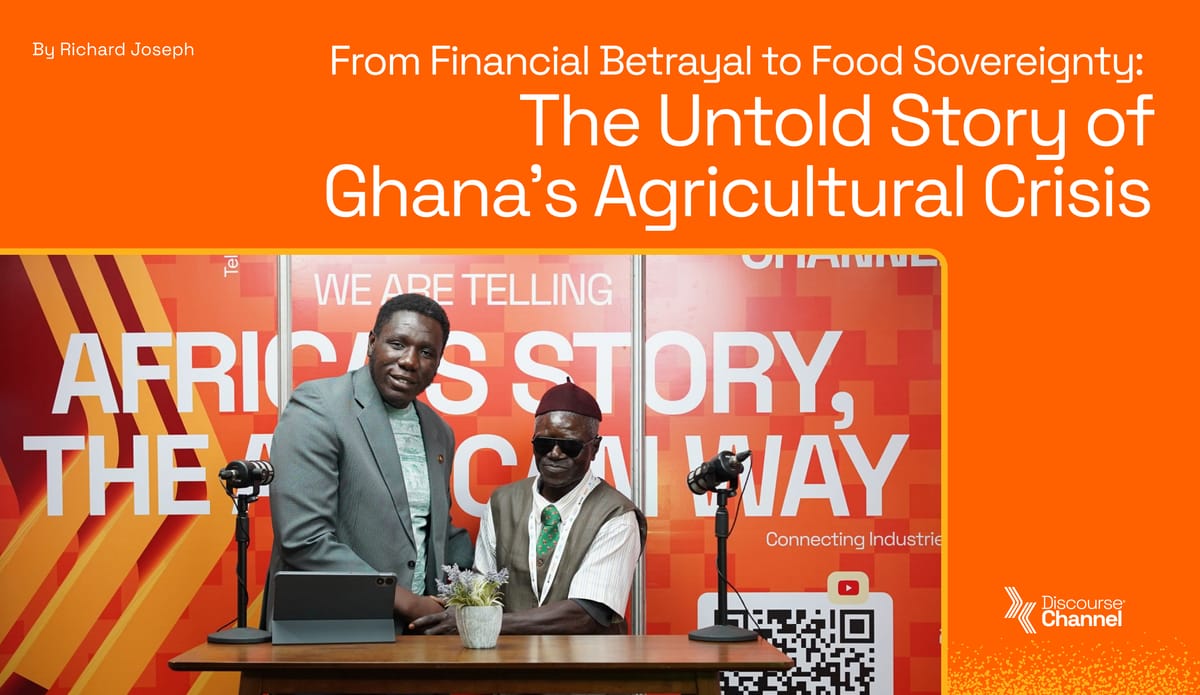
"How do we call farmers 'the poorest of the poor' when they literally feed entire nations?" John Kofi Kumah doesn't ask this rhetorically.
After 38 years building Ghana's agricultural capacity, watching GHS 15,000 of his retirement savings disappear into a collapsed bank in 2018, and managing a 15-acre farm in Pando that holds knowledge his country desperately needs but refuses to protect—he asks diagnostically.
This isn't a grievance. It's a structural autopsy
What We Found: Designed Abandonment
At Africa Discourse, we've documented institutional failure across the continent. But our conversation with Mr. Kumah revealed something more sinister than bureaucratic incompetence: systematic extraction disguised as agricultural development policy.
The evidence is everywhere if you know where to look.
The Banking Collapse Nobody Talks About
"Government weakened 22 financial institutions—the viable ones that were supporting agriculture: rice, maize, cassava, cowpea, plantain production, even cocoa production," Mr. Kumah explains. "They weakened all those banks and now their staff are languishing in their homes."
Since 2018, his retirement savings have remained locked. No recovery mechanism. No accountability. Just silence.
But here's what makes this more than a personal tragedy: those 22 banks were the only financial institutions actually supporting farmers. Their collapse wasn't collateral damage—it was the systematic removal of agricultural financing infrastructure.
The Decentralization Deception
The pattern continues at the local government level.
"The money gets to the assembly and doesn't get to the directors for agricultural work," Mr. Kumah reveals. "If it's 100,000, for instance, about 50,000 gets to agriculture. Meanwhile, you budget for this, you plan for it—and it doesn't arrive."
Agricultural officers receive motorbikes that they cannot fuel or maintain. Programs are planned with budgets that never materialize. The decentralization Ghana championed as democratic progress has become, in agricultural terms, a mechanism for diverting resources before they reach soil.
The Collateral Trap
Banks demand what farmers structurally cannot have: cash collateral.
Land? Rejected. "Our banks are ready to work on the lands or to take the lands to mortgage? No, no, no—they are in for cash or material things."
Most farmers remain in family houses. "Three, four farmers are still in the family house. How can they mortgage that house for a loan from the bank? It's family property."
The system demands proof of wealth from people it has systematically kept poor. Then blames them for lacking collateral.
"We've perfected the performance of caring while engineering extraction at every level". John Kofi Kumah's
The GMO Gamble Nobody Admits Is Failing
"I don't buy the idea of GMO because they're killing our seed industry—our local seed industry," Mr. Kumah states flatly. "Most of our local seeds, germplasm, are still what they must be. But the GMOs are liable for any attack by diseases, pests, fungal, and bacterial viruses."
His reasoning is grounded in environmental science: "The local varieties are hardened because they already adapted to the environment. You bring in these GMOs—they're new and they cannot tolerate the environment.
They're prone to diseases of all nature." The crisis? "These GMOs by their make are just formulations which are not in conformity with our localities." Yet policy continues pushing foreign seeds while local research—germplasm studies conducted by Ghana's own crop research institutes—"gathers dust in file cabinets."
The research exists. The solutions are documented. But implementation requires admitting the GMO experiment was premature. So research stays filed, communities stay hungry, and the narrative stays unchallenged.
The Child Labour Paradox
Here's where policy reveals its blindness to farming reality.
"Use your child now to bring firewood from the farm for her own or his own heating of water early morning? They say child labor. The farmer produces tomatoes—takes the child to go and sell the produce after school, maybe between three and six? Child labour."
Mr. Kumah's frustration is palpable: "The farmer is tired from farm. How can that be a little support to that little boy tomorrow morning for his food money or pocket money to go and buy porridge or beans at school?"
The consequence? "Now you go to the school—they want somebody to weed their parks for them. There's no labour."
More critically, generational knowledge transfer has stopped. "Our children's hands, their palms are as soft as cotton. But their parents' palms are as hard as iron."
Agricultural skills die with the current generation because policy criminalized the traditional apprenticeship system—without providing alternatives.
The Graduate Trap
Even those who train as agricultural professionals face structural impossibility.
"If I come out of university fresh and I pay my transportation to my home, how can I get money—about 500 cedis—to buy a knapsack? Not even a motorized sprayer, a manual sprayer."
The arithmetic is brutal: university graduates return home unable to afford basic equipment. A manual knapsack sprayer now costs about 700 cedis. Meanwhile, they've exhausted family resources on tuition, rent, books, feeding.
"How can I go into agriculture?" Mr. Kumah asks. The question needs no answer.
The system trains agricultural professionals it structurally prevents from farming.
The Economic Species We're Ignoring
Mr. Kumah's farm holds an economic potential Ghana refuses to recognize.
Eight acres host patrol wood—locally called "wodwo"—whose substance is used for artifacts and gun handles.
"It's an economic species which I have reserved there for almost 25 years now," he explains. "Most of the lands no longer have that particular wood. When I saw the potential, I reserved it and added more."
Then there's Forest Sweetener: a natural sugar alternative bearing violet fruits. "When you take it, the sweetness remains on your tongue. Whatever you take after that actually becomes very sweet. You need not use any artificial sugar."
These aren't marginal crops. They're economic opportunities hiding in plain sight—ignored because policy focuses on imported solutions rather than local innovation.
What Transformation Actually Requires
Mr. Kumah's prescription is deceptively simple: "True transformation doesn't need more pilot projects that mysteriously vanish. It doesn't need more consultants or policy papers."
What it needs:
1. Radical Accountability "That should have a mechanism to monitor. If 10,000 is given for a group to use, it is used accordingly and not diverted into anybody's venture as an individual."
Track every allocated cedi to actual soil. Strict monitoring and evaluation—not as bureaucratic burden, but as sacred responsibility.
2. Agriculture as Business, Not Charity "We have to see agriculture as a business. We see agriculture as still subsistence-level agriculture in Ghana. It must be seen in West Africa as a real business—and business is business. It must be seen as an economic business, not just a way of life."
3. Direct Farmer Support "Is it possible for the government to create a solution where farmers can directly access maybe mobile money loans individually, and then when they produce they can use some of their produce to offset the loans?"
Mr. Kumah affirms: "That would be very ideal."
4. Pressure Group Formation "Education—we have three pressure groups. Health—we have about four pressure groups. So the amount of pressure on government... Have you ever heard of an agriculturist going on strike in Ghana before?"
Without organized advocacy, agricultural concerns remain invisible to power.
The Pattern We Can No Longer Ignore
This isn't about one farmer's struggles. It's about how Ghana has engineered extraction into every policy
structure while performing concern in every speech.
Consider the sequence:
→ Weaken banks that support farmers
→ Divert decentralization budgets at assembly level
→ Push GMO seeds that fail locally but never admit failure
→ File research solutions that could help communities
→ Reject land as collateral while demanding cash farmers can't accumulate
→ Criminalize traditional knowledge transfer
→ Train agricultural graduates who can't afford basic equipment
→ Ignore economic species with proven market potential
Each decision, viewed in isolation, might seem like policy adjustment. Viewed together, they form what Mr. Kumah calls "designed abandonment."
Not accidental failure. Not bureaucratic inefficiency. Systematic extraction with a development narrative attached.
The Gap Between Speech and Soil
"Lip service is paid to agriculture in Ghana," Mr. Kumah states. "You want to hear big, big talks about agriculture. You go to the ground—nothing is there."
The speeches happen. The workshops convene. The initiatives launch.
Then: "Most of these talks end here. Just after this, most of the talks end here."
Meanwhile: "I work in agriculture 30 years—nothing to write home about. Even my money now is locked up with GN Bank and nobody has given me a year to get my small money. GHS 15,000. It's locked up there since 2018."
The distance between policy declaration and resource flow has become the defining feature of Ghana's agricultural governance.
What This Means for Africa
Ghana's story isn't unique. Across the continent, we see similar patterns:
→ Agricultural budgets diverted before reaching farmers
→ Traditional farming knowledge criminalized as "backwards"
→ Local seed varieties abandoned for foreign alternatives that fail
→ Research conducted but never implemented
→ Young graduates trained but structurally prevented from practicing
The question Mr. Kumah poses applies continent-wide: How do we call farmers "the poorest of the poor" when they literally feed nations?
The answer is uncomfortable: We've designed systems that extract value from agricultural producers while attributing their poverty to their own inadequacy.
What Africa Discourse Is Watching
Whether Ghana—and other African nations—will shift from rhetoric to radical accountability.
Whether agricultural policy will track every allocated cedi to actual soil.
Whether monitoring and evaluation becomes sacred responsibility rather than bureaucratic performance.
Whether we'll stop accepting "pilot projects" that vanish after photo opportunities.
Whether we'll treat agriculture as profitable business reality instead of charity narrative.
Your Turn
What broken system have you witnessed that everyone pretends is working?
What "lip service" have you heard so often it's become background noise to real crisis?
This is what happens when we choose accountability over applause. When we document what we've been trained to ignore.
Share your experience in the comments. Let's map the power structures keeping our farmers poor while they feed nations.