Females in Africa's Agricultural Spaces
Africa has a huge opportunity to make agriculture its economic driver. However, the potential for this is far from being made exhaustive use of, one reason being that women face considerable difficulties in their economic activities.
Editor's note: This piece continues our earlier reporting on women driving Africa's economy. Where that piece looked at the broad sweep of women's economic contribution across sectors, this one goes into the soil into who owns the land, who works it, who profits from it, and who is systematically shut out.
There is an economic sector in Africa worth $1 trillion a year, and yet most of the people who work in it are invisible. Banks do not see them. Buyers do not see them. Traders and insurers do not see them. African Development Bank Group President Akinwumi Adesina has made versions of this point in speeches on smallholder finance for years that Africa's farmers remain economically invisible even as they feed the continent.
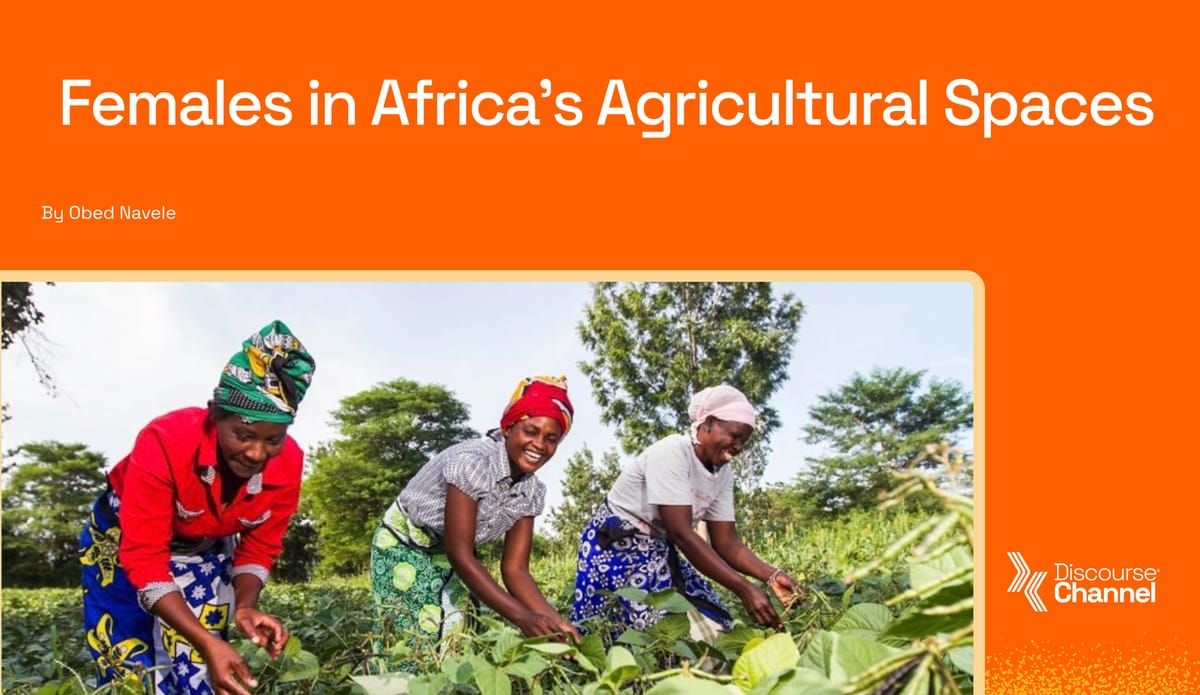
Africa has a huge opportunity to make agriculture its economic driver. However, the potential for this is far from being made exhaustive use of, one reason being that women face considerable difficulties in their economic activities. These smallholder farmers often live in remote areas with unreliable connectivity and few links to markets, leaving them with no digital footprint and limiting their access to better prices, loans and innovative agricultural inputs like climate-resistant seeds. If you are driving along any major highway in Africa, you will not miss women crowding at bus stops, farm produce in their hands, seeking possible buyers for their wares.
The exact size of that share is one of the most repeated and least re-checked numbers in African development discourse. The commonly cited figure, that women contribute 60–80% of agricultural labor in sub-Saharan Africa, traces back to a 1972 UN Economic Commission for Africa estimate that was never fully substantiated and has been recycled in policy documents ever since. More recent, plot-level research across several sub-Saharan countries puts the real average closer to 40%, ranging from roughly 50–61% in Malawi, Tanzania, and Uganda down to under 30% in Ethiopia and Malawi . What is not contested is the underlying FAO estimate that agriculture accounts for roughly 21% of sub-Saharan Africa's GDP, and that women supply a substantial, if imprecisely measured, share of the labor behind it. Statistical data for Ghana show that women account for about half of the agricultural labor force and produce a majority of the country's food crops.
In the context of African development, access to land and other resources is basic to livelihood, and therefore a matter of fundamental rights. The dominance of agriculture in most African economies makes land ownership one of the clearest determinants of who earns and who does not. A World Bank study found that women make up about 60% of the informal sector in sub-Saharan Africa and provide roughly 70% of total agricultural labor in the region again, a figure that should be read as an estimate, not a census. Women are the principal food producers in most African households and carry primary responsibility for family food security. Yet their central position in production contrasts sharply with the systematic discrimination they face reinforced by custom, convention, culture, and law in access to and control over the assets that would let them participate fully in the region's growth.
According to the Center For Women's Land Rights, 65% of land in Kenya is governed by customary law, which gives men precedence in ownership. In Tanzania, women make up roughly seven in ten agricultural workers but hold only a small fraction of registered land titles, a gap that turns unequal ownership into a financing problem, since land that cannot be titled cannot be used as collateral for a bank loan.
The Historical Root
This is not simply a present-day policy failure. Much of the customary land regime that disadvantages African women today was hardened, not invented, by colonial administrations that formalized male-only inheritance and titling systems to simplify tax collection and resource extraction. Pre-colonial land-use arrangements in many parts of the continent were more fluid, with women holding recognized, if informal, use rights over the plots they farmed. Colonial land codes converted informal use into formal exclusion, and post-independence governments largely inherited those codes rather than rewriting them. Understanding this history matters for policy: it explains why "modernizing" land law without deliberately correcting for a colonial-era bias tends to reproduce the same exclusion in new legal language.
Women Transforming the Sector
Despite these systemic hurdles, a new generation of women is rising to transform African agriculture from subsistence farming into a thriving, modern industry. These leaders are not just growing crops; they are building value chains, processing food, and creating technology solutions.
In Kenya, Wanjiru Mambo, founder of Wedgehut Foods Limited, is revolutionizing the potato value chain. By forging alliances with major banks and seed producers, she ensures quality produce reaches national markets, directly uplifting small-scale farmers. Similarly, Claire van Enk co-founded Farm to Feed, a digital platform that aggregates surplus and "imperfect" produce, drastically reducing food waste while increasing incomes for farmers who would otherwise lose their harvest.
In Zimbabwe, Emilia Chisango stands as a titan of industry. A former chartered accountant, she built the Hempac Group, which includes a robust agribusiness unit that creates jobs and supports local communities. Her journey from corporate boardrooms to agricultural empire building exemplifies the diversification women are bringing to the sector. Meanwhile, in Madagascar, Zebeline Ertance founded Videeko Vanilla, an exporter that prioritizes employing local women, ensuring that the profits from one of the world's most valuable spices remain within the community.
Further west, in Mali, Rokiatou Traoré leads the Herou Alliance, focusing on land restoration and climate resilience. In Nigeria, Ifeyinwa Ogar established Roki Foods to provide affordable, nutritious food bundles, leveraging her banking background to solve local food security issues. These women, along with innovators like Dr. Phindi Cebekhulu-Msomi in South Africa, who drives climate-smart solutions in water and energy for agriculture, proves that when women lead, the entire ecosystem becomes more resilient and inclusive.
The Weight of Exclusion: Critical Challenges
The path for these pioneers and the millions of smallholder farmers they represent is obstructed by deep-seated structural challenges.
Access to Productive Resources: The most glaring deficit is land ownership. With customary laws often barring women from holding titles, they remain tenants on land they have cultivated for generations. This lack of ownership extends to other productive assets; women have significantly less access to improved seeds, fertilizers, and mechanization tools compared to their male counterparts, limiting their yield potential.
Access to Finance and Financial Services: The lack of land title creates a collateral vacuum. Banks, bound by traditional risk models, view women farmers as high-risk borrowers. Consequently, women receive less than 10% of total credit going to small-scale agriculture in Africa. Even when micro-loans are available, high interest rates and short repayment terms often mismatched with agricultural cycles trap women in debt rather than lifting them out of poverty.
Access to Infrastructure: Rural infrastructure remains critically underdeveloped. Poor road networks increase post-harvest losses, as women struggle to transport perishable goods to markets before they spoil. Furthermore, the lack of reliable electricity and storage facilities forces women to sell their produce immediately at low prices rather than storing it for better market conditions.
Access to Training and Technology: Extension services, which provide vital agricultural training, historically target male heads of households. Women are frequently bypassed, leaving them without knowledge of modern farming techniques, pest management, or climate adaptation strategies. Additionally, the digital divide is stark; with lower rates of mobile phone ownership and internet access, women miss out on digital market information and mobile banking services that could bypass traditional gatekeepers.
Access to Information: Market asymmetry plagues women farmers. Without real-time data on pricing in different markets, they are vulnerable to exploitation by middlemen who dictate unfair prices. This information gap prevents them from making informed decisions about what to plant, when to sell, and where to get the best return on their labor.
The Climate Compounding
None of the above sits still. Climate change is not a separate crisis layered on top of these structural gaps it is actively widening them. Women farmers, concentrated in rain-fed smallholder plots with the least access to irrigation, insurance, or climate-resistant seed varieties, absorb the earliest and hardest shocks from shifting rainfall and rising temperatures. At the same time, women carry the disproportionate burden of unpaid domestic labor fetching water and fuel, tasks that grow heavier as climate stress reduces the availability of both. The result is a double exposure: less capacity to adapt, and more work generated by the failure to adapt. Climate finance mechanisms, carbon credit markets, adaptation funds, resilience-linked lending are beginning to route capital toward smallholder agriculture, but most of these instruments were not designed with women's land-tenure exclusion in mind, and risk reproducing the same collateral barriers that already lock women out of conventional credit.
The Generational Shift
A quieter change is underway alongside the structural one: a younger cohort of women is entering agribusiness not through inherited land but through technology, aggregation platforms, and processing routes that partially sidestep the collateral problem even as they leave the underlying land question unresolved. Claire van Enk's Farm to Feed model is one example of this pattern: value captured through logistics and market access rather than land ownership. This generational shift raises its own open question, one worth tracking in future reporting whether platform-based agribusiness models can scale fast enough to matter at a continental level, or whether they remain a workaround for the few with the capital and networks to build them, while the land question itself stays unresolved for everyone else.
Emerging Opportunities
Despite these challenges, the landscape is shifting, offering unprecedented opportunities for women in agribusiness.
Political Will: There is a growing recognition among African governments and the African Union that gender equality is an economic imperative. Initiatives like the International Year of the Woman Farmer 2026, are galvanizing policy reforms. Countries are increasingly pressured to harmonize statutory and customary laws to secure women's land rights, recognizing that tenure security is the bedrock of agricultural investment.
Agribusiness Growth Potential: The projection that Africa's food market will reach $1 trillion by 2030 presents a massive opportunity. As the continent urbanizes, the demand for processed, packaged, and convenient food is skyrocketing. Women are uniquely positioned to lead this value-addition revolution, moving from selling raw commodities to producing finished goods, thereby capturing a larger share of the consumer dollar.
Regional and Global Value Chains: The full implementation of the African Continental Free Trade Area AfCFTA is a game-changer. By reducing tariffs and simplifying trade protocols, AfCFTA opens a market of 1.3 billion people. Specific programs are now emerging to help women-led SMEs navigate these new trade rules, meet international quality standards, and connect with buyers across borders. This integration allows women to scale beyond local markets, transforming smallholder operations into continental enterprises.
The Way Forward
To fully unlock the potential of women in African agriculture, a coordinated, multi-stakeholder approach is essential.
First, legal and policy reforms must be accelerated. Governments must enact and enforce laws that grant women equal rights to own and inherit land. Without title deeds, other interventions will have limited impact. Digital land registries can help bypass corrupt or biased local customary systems.
Second, financial products must be reimagined. Financial institutions, supported by de-risking facilities from development banks, should develop collateral-free lending models based on cash flow, psychometric testing, and group guarantees rather than physical assets. Mobile money platforms should be leveraged to provide micro-insurance and savings products tailored to agricultural cycles.
Third, investment in rural infrastructure is non-negotiable. Governments and private investors must prioritize roads, electricity, and cold storage facilities in rural areas. Reducing post-harvest losses is the quickest way to increase women's incomes without requiring them to grow more food.
Fourth, extension services must be gender-intentional. Agricultural training programs must actively recruit and train women, utilizing female extension agents who can better reach rural women. Digital literacy programs should be integrated to ensure women can access market data and financial services via mobile phones.
Finally, strengthening collective power is crucial. Supporting women's cooperatives and producer organizations allows them to aggregate produce, negotiate better prices, and access inputs in bulk. These collectives also serve as powerful advocacy groups to demand policy changes at national and regional levels.
The invisibility of Africa's women farmers is a choice, not an inevitability. Land law, credit models, extension design, and infrastructure spending are all decisions someone made and someone can unmake. Addressing the root causes of exclusion, while building toward the opportunities now opening up, is how Africa turns its agricultural sector into the engine of prosperity it is already positioned to be driven by the hands already feeding the continent.
This piece continues a series we are building at Africa Discourse Channel on the sectors where women are quietly driving Africa's economic growth agriculture here, and others to follow. Each installment will look at a different sector through the same lens: where the structural barriers sit, who is breaking through them anyway, and what it would take to make that the rule rather than the exception.