Can The Social Media Blackout Really Curb ‘False Information’ in Gabon?
The People of Gabon woke up, reached for their phones and realised their social platforms were gone. No timelines, no updates, no instant reactions. A digital blackout justified by the government's reason to control the spread of false information.
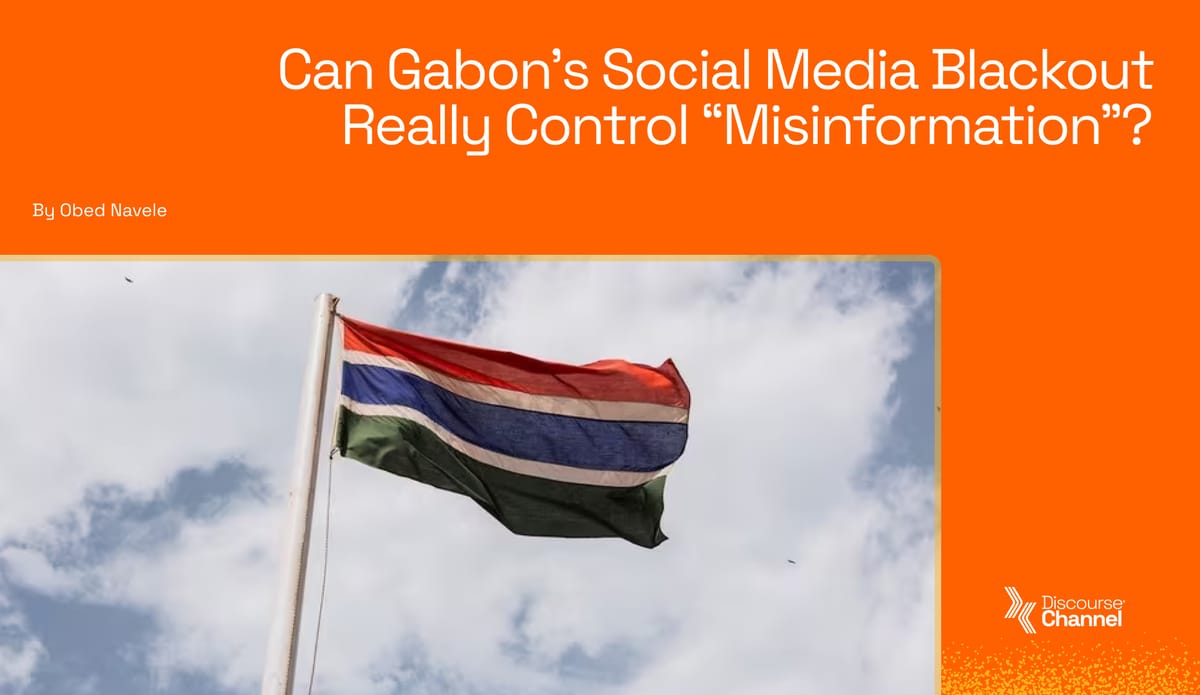
The Internet has become a basic utility for humans. These days, almost everyone is connected to the internet. Today, social media has become an integral part of our modern human life that we cannot do without. It defines our daily rhythm, offering unparalleled opportunities for connection, education, trade, social change and mobilization. However, it has the potential to create a channel for misinformation, panic, and chaos. The People of Gabon woke up on Wednesday, 18th February, 2026, reached for their phones, and realised their social platforms were gone. No timelines, No updates, No instant reactions. Just a digital blackout justified by the government's reason to control the rapid spread of false information.
The government's decision to suspend social media platforms reflects a growing concern about the power of online platforms to shape public discourse and influence national security.
Now this is what happened
On the morning of February 18, 2026, the digital pulse of Gabon flatlined. For a nation of 2.5 million people and users, the "refresh" button didn't work. The High Authority for Communication (HAC) had issued a televised decree: social media was suspended "until further notice". This wasn't a technical glitch; it was a deliberate choice to pull the plug on the nation's most active public square.
The official reason was a "flood" of inappropriate content. Authorities cited a dangerous rise in:
- Hate Speech & Defamation: Content allegedly undermining human dignity and social cohesion.
- Misinformation: The spread of false narratives that the government claims threaten the stability of state institutions.
- Cyberbullying: Unauthorized disclosure of personal data that was stoking real-world conflict.
Digital Censoring?
Gabon's Social Media Shutdown Raises Questions. Was it a coincidence, or is it part of a growing trend? And why now, when social media has become an integral part of our lives?
In an age where news often breaks first on social media, sometimes before it's verified, the shutdown has sparked a heated debate. Was it a necessary intervention to protect public order, or an overreach that threatened freedom of expression? The answer lies in understanding the delicate balance between regulating online content and preserving the fundamental right to information.
The timing is not a coincidence. This "digital curfew" arrived as President Brice Oligui Nguema faced his first major wave of domestic unrest. Since December, teachers and health workers have been striking over pay and working conditions. By cutting access to platforms like Facebook, TikTok, and WhatsApp, the state effectively disrupted the primary tools used for organizing these protests and encouraging citizen journalism.
The Immediate Impact
For some citizens, the suspension brought a sense of calm. Without the constant stream of alarming updates and speculative commentary, people relied more on traditional media, government-verified and approved statements, and offline conversations. In this form, the shutdown achieved its immediate objective: slowing the spread of misinformation
"A taxi driver was interviewed and seemed unbothered about the move, telling the BBC: There's no smoke without fire. "For the authorities to take such a decision, something must have certainly prompted it."
What was the cost?
When the news broke about the blackout, it sounded like another policy headline, serious, distant, abstract. That distance collapsed following interviews with individuals living in Gabon. What emerged wasn't a debate about platforms or regulation, but a collection of interrupted lives, delayed plans, and halted ambition.
Commenting on the issue with the Bureau at ADC, Mr Claude Emmanuel NdongMebale, a Gambian artist preparing for the final stages of an art exhibition. His voice was steady, but his frustration surfaced as he explained how central social media had been to the project. He said social media was his primary tool for inviting participation, building momentum, and coordinating collaborations with artists and partners across borders. Much of the exhibition’s life had been taking shape online until it suddenly wasn’t. Now, he said, "preparing the exhibition feels like working in isolation, cut off from the public and collaborators it was meant to reach". “Art needs air,” he told me. “Right now, it feels like we’re suffocating it.”
Another conversation followed with Brand’O, a fashion designer whose brand has been built almost entirely through social media. For him, the blackout is not an inconvenience but a destabilising blow. He said Orders have stalled, international clients are unreachable, and completed collections remain unseen. He also described the experience as being frozen in motion, working each day without the ability to move forward.
Speaking on condition of anonymity with the BBC, a restaurant owner in the capital, Libreville, told the BBC the suspension would greatly affect his business, since he uses social media for promotion. "Almost 40% of my customers decided to order or come to the restaurant after seeing our advertising on social media… I won't be able to catch new customers, because clients are attracted by what they are seeing, reviews from friends, pictures," he said. "We are entering a phase where we don't even know if we are moving forward with global development or if we are sliding backwards into total underdevelopment."
Listening to these stories, the phrase “false information” began to feel too small to contain what people were actually experiencing. Small business owners who depend on Instagram and WhatsApp for sales are steadily losing business by the hour. Media practitioners and digital journalists faced barriers to real-time reporting. Content creators, marketers, and online workers were cut off from their primary tools of work. None of them spoke about the politics of the issue; theie focus was entirely about survival. This is where policy collides with reality.
In modern African economies, social media is not merely social; it is an important economic infrastructure. Any disruption, therefore, affects livelihoods, not just conversations. Misinformation is real; it causes harm, it fuels fear and division. Governments have a responsibility to protect citizens from chaos and incitement. That is not in question. But silence is a blunt instrument. When social media is switched off, it silences more than what is intended. What happens when an artist cannot invite the world into his work? When a designer cannot sell what he creates? When a restaurant owner cooks without certainty?
In these moments, misinformation stops being abstract. The blackout itself becomes a disruption; quiet, creeping, and deeply personal.
The Question That Remains
What stood out was not anger, but fatigue. People are adapting again, calling instead of messaging, printing instead of posting, waiting instead of sharing. Underlying it all is a question few articulate openly:
Is this the only way?
- Can misinformation be addressed without shutting down entire digital communities?
- Can accountability exist without collective punishment?
- Can trust be built through silence?
I did not experience the blackout directly. But through these conversations, I felt its weight. Policies are often written in the language of necessity and security. Lived experiences speak another language, the language of interruption. Perhaps that is where the real conversation should begin. Not with platforms, but with people. Not with control, but with care. Because in trying to control the narrative, we must be careful not to mute the very voices that give a society its pulse.