Africa's Traffic Problem Isn't Traffic
Traffic congestion across African cities strips workers, traders, and families of hours, income, and time together, not because of too many cars but because homes, jobs, and services are built too far apart, making it a planning failure that no app or highway alone can fix.
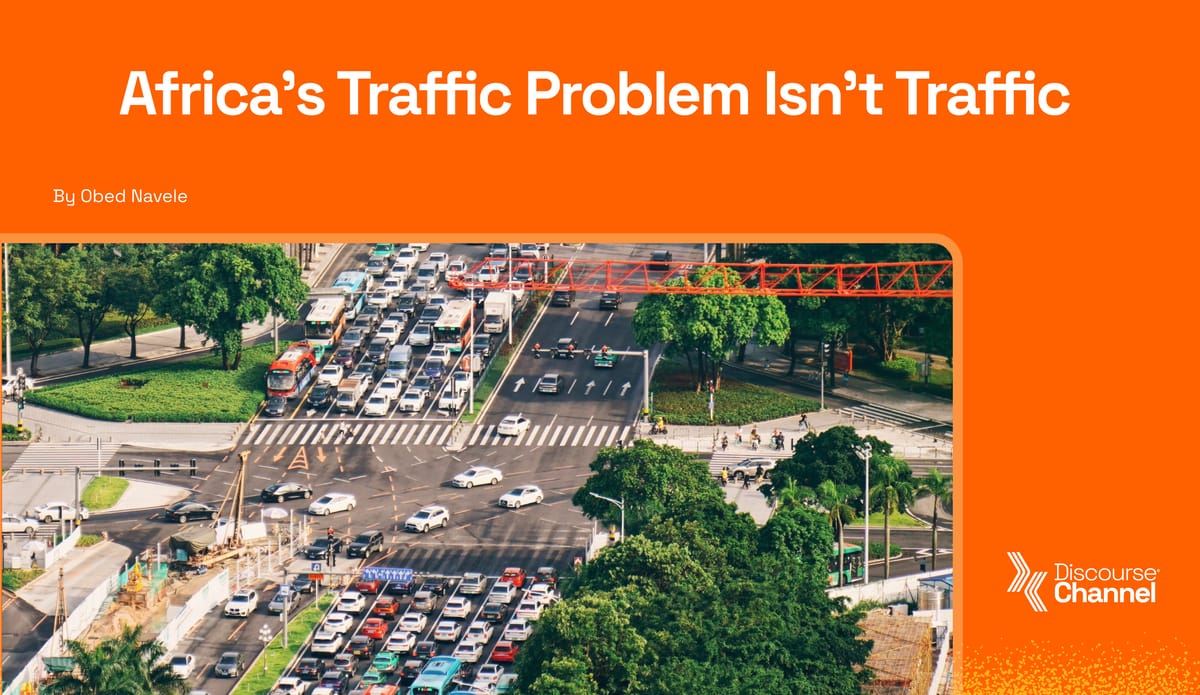
EDITOR'S NOTE: This is a part of a continuing examination of the structural issues shaping development. From governance and education to infrastructure and urban planning, exploring the systems that quietly determine how people live, work and build their future. In this piece, we examine a crisis so familiar that many have stopped questioning it: traffic congestion.
Cities are designed to create opportunity. They bring people closer to jobs, schools, hospitals, markets and each other. When a city moves efficiently, time becomes an asset that fuels productivity, value and economic growth. But when movement slows to a crawl every day, that same city begins to consume the very opportunities it was built to create.
Traffic congestion has become one of the defining realities of modern urban life. People now organize their lives around roads that can no longer keep pace with the demand. What was once considered a rush-hour inconvenience has evolved into a structural challenge with profound consequences for individuals, businesses and economies.
To understand what traffic truly means beyond statistics and headlines, we spoke with commuters across Accra and several other cities. Rather than asking the familiar question, "Is traffic bad?", we asked something more revealing: "What does your day actually look like because of traffic?"
The answers painted a picture that was remarkably consistent despite differences in profession, income and location. People described waking up long before sunrise, sacrificing hours every day to unpredictable journeys, missing important family moments, losing business opportunities and arriving at work already mentally exhausted.
These are some of their experiences.
"I wake up around 3:30 a.m. every day just to prepare and catch an early bus. Even after leaving home before sunrise, I still spend hours on the road. By the time I arrive at work, I am already physically and mentally exhausted." - Office worker, Accra, Ghana
"Traffic has taken away valuable time with my family. I leave home before my children wake up and sometimes return when they are already asleep. The road has become the place where I spend most of my day." - Lecturer, Lagos, Nigeria
"As a trader, time directly affects my income. When I spend hours stuck in traffic transporting my goods, some products lose their freshness and I lose money before I even reach the market." - Market trader, Accra, Ghana
"Every day, I spend hours behind the wheel trying to move people from one place to another. Traffic affects my fuel costs, my income and the number of trips I can complete in a day." - Commercial driver, Accra, Ghana
These testimonies reveal a truth that statistics alone often fail to capture. For millions of people, the commute is no longer a simple journey between home and work. It has become an exhausting daily struggle that shapes when they wake up, how they earn a living, how much time they spend with loved ones and how much energy they have left at the end of the day. The most important lesson from these stories is that traffic is not merely about delayed journeys, but about the gradual erosion of time, health, productivity, income and opportunity. Every additional hour spent in unnecessary congestion is an hour that cannot be invested elsewhere. Over weeks, months and years, those lost hours accumulate into lost possibilities.
This is why traffic deserves to be understood differently
Traffic is commonly defined as too many vehicles competing for limited road space. That is technically correct, but the definition is far too narrow to explain what commuters experience every day. The real problem is not a transportation issue but the visible outcome of deeper failures in urban planning, infrastructure investment and public coordination.
A city functions through movement. Workers must reach their offices, students their classrooms, traders their markets, patients to hospitals and goods to their destinations. When that movement becomes slow, unreliable and unpredictable, every sector that depends on it begins to lose efficiency. Traffic therefore becomes a multiplier of existing challenges. It increases the cost of doing business, widens inequality, reduces access to opportunity and weakens economic competitiveness. Perhaps the greatest danger is that congestion has become so common that many people have stopped questioning it. Hours spent in traffic are increasingly accepted as a normal part of daily life rather than recognised as evidence of a system that is failing to serve the people who depend on it.
The Cost of Every Commute and Why Congestion Happens
A worker who loses three hours a day to the road has already spent a third of their working life before they sit down at a desk. That time does not return. It leaves them tired before they do anything productive, slow to think, and less able to give the focus their job requires. Multiply that across a city's workforce and the loss stops being personal. It becomes economic. Businesses lose predictability: meetings shift, deliveries arrive late, and logistics firms burn fuel idling instead of moving goods. Those costs travel downstream. A trader who spends hours stuck with perishable stock passes the loss on to customers. A delivery rider who completes fewer trips earns less that day, with no salary to fall back on. In cities where a large share of workers depend on daily, activity-based income, traffic does not just waste time, it removes income directly from people who cannot afford to lose it.
It is tempting to blame traffic on population growth and rising car ownership, and both play a part. But the deeper cause is how cities have been built. Homes have spread far from offices, schools and markets, forcing long daily journeys by default. Jobs and services cluster in a handful of districts, pulling everyone toward the same roads at the same hours. And where public transport is unreliable, people turn to private cars and informal transportation means, adding more vehicles to roads that were never designed to carry them. A city is a connected system, housing, transport, work and services are meant to work together. When they don't, a worker turns down a good job because the commute is unsustainable for their salary, a student skips an opportunity because reaching it takes too long, and a small business stays small because it cannot move its goods to meet demand. More roads offer temporary relief, not a fix, for a problem rooted in planning.
Who Carries the Weight
Traffic does not fall on everyone the same way. Low-income workers are often pushed to the edges of cities by housing costs, then pay for cheaper rent with longer, costlier commutes to where the jobs are. Many depend on crowded public transport with little flexibility when delays hit meaning they absorb the worst of congestion while contributing the least to it. For Africa's young people, the cost is measured in more than money. Time lost in traffic is time not spent building a business, learning a skill or gaining the experience that shapes a career. A continent counting on its youth for a demographic dividend cannot afford to let its most productive hours evaporate on the road.
The damage extends beyond people's wallets and calendars. Idling engines burn fuel, driving up emissions and worsening air quality for everyone living near busy roads, a public health cost as real as any economic one. And when roads seize up, so do the services that depend on them: ambulances delayed, fire crews and police arriving too late to make a difference. A transport system that cannot move in a crisis is not just inconvenient. It is a vulnerability built into the city itself.
None of this is inevitable. Roads, transit systems and zoning rules are decisions, not accidents of growth made by governments that choose where to invest and where not to.
Can Technology Solve It?
Technology can ease the strain, but it cannot replace planning. Smart traffic systems that adjust signal timing in real time, apps that route drivers around congestion, and ride-sharing platforms that put more people in fewer cars all cut waste at the margins. Digital logistics tools help businesses predict delays instead of absorbing them blind. Remote and hybrid work, where jobs allow it, removes some commuters from the road entirely rather than making their trip faster. But none of these tools fix a city where homes and jobs sit hours apart, or where public transport cannot be trusted. Technology works best alongside investment in transit and smarter city planning as a way to manage a functioning system, not a substitute for building one.
Traffic is often treated as background noise, the price of living in a growing city. But every hour lost on the road is an hour taken from a business, a family, a student's education or a young person's future. The testimonies at the start of this piece describe a system quietly working against the people it is meant to serve. Fixing it will not come from a single new highway or app. It will come from cities built so that homes, jobs, schools and services no longer sit hours apart. Until that happens, the question is not whether traffic will keep growing. It is how much more of Africa's time it will be allowed to take.