Africa's Infrastructure Crisis Is Also a People Problem
There is a story that does not get told: like what citizens do, or fail to do, in the spaces that governance, however broken, cannot fully reach. That story is less comfortable. It implicates people who are not in power, who do not control ministries, sign oil contracts, or command police forces.
There is a story the continent tells itself, and it is not entirely wrong. Colonial extraction hollowed out administrative institutions. Structural adjustment programmes dismantled public services before local alternatives existed. Predatory lending cycles have transferred sovereign wealth into the accounts of foreign creditors for generations. Corrupt governing classes, many of them groomed under authoritarian arrangements that colonial powers either installed or tolerated, have treated the treasury as a personal endowment. None of this is myth or excuse-making. It is a well-documented, quantifiable history.
And yet, there is a second story that does not get told with the same clarity as the one about what citizens do, or fail to do, in the spaces that governance, however broken, cannot fully reach. That story is less comfortable. It implicates people who are not in power, who do not control ministries or sign oil contracts or command police forces. It implicates the ordinary African, the voter, the driver, the office worker, the landlord, and the market trader. Precisely why it tends to be deflected, delayed, or dissolved into the more satisfying grammar of systemic critique. This report insists that both stories must be told simultaneously and that the refusal to tell the second one honestly is itself a form of civic failure.
What Infrastructure Cannot Do Alone?
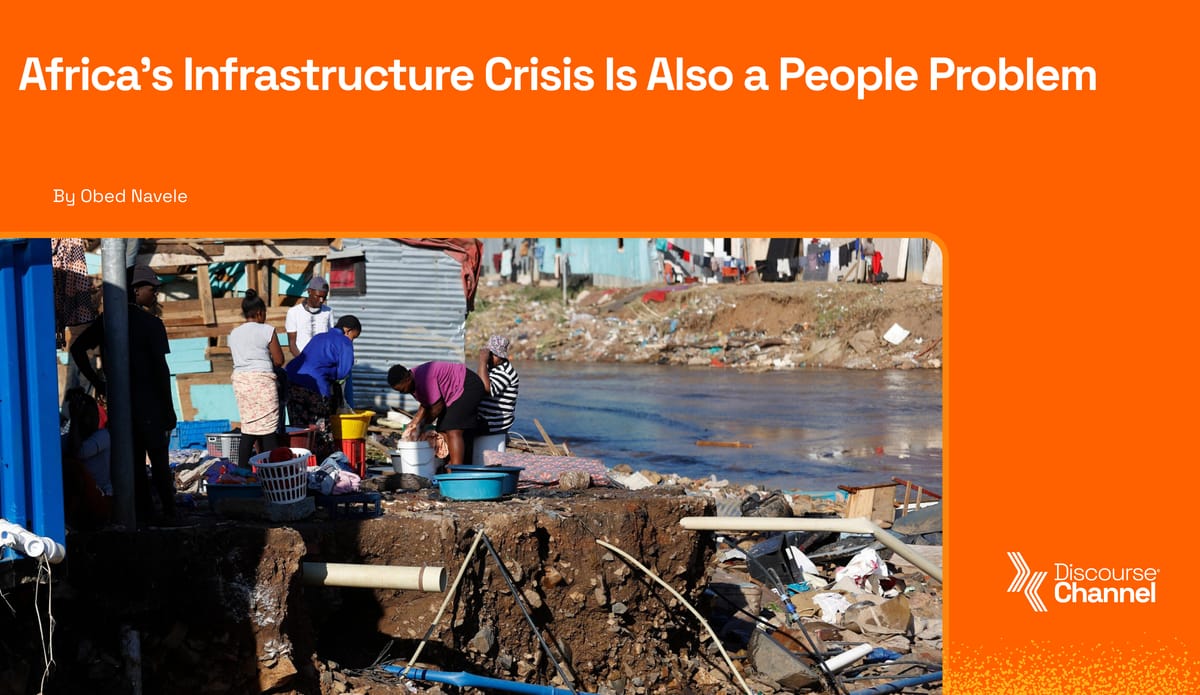
In the wet seasons of 2025, deadly floods hit Accra, Lagos, Nairobi, and Lusaka, killing residents, destroying homes, and forcing emergency power cuts. In each city, overwhelmed drainage systems led to submerged substations and widespread blackouts, exposing how climate extremes are pushing already-strained electricity grids to the breaking point. The pictorial evidence was devastating. The commentary that followed was largely accurate in its identification of culprits: inadequate drainage investment, informal settlements built on floodplains and waterways because formal housing was priced out of reach, and climate intensification driven by emissions that Africa barely produces. All true.
What the commentary consistently underweighted was the role of blocked drains. Not metaphorically blocked, physically blocked, choked with plastic, polythene bags, styrofoam containers, household refuse, and construction debris deposited there incrementally, day by day, by the residents of the very neighbourhoods that are flood-prone.
Drainage systems across West African cities function, where they function at all, at below half their designed capacity. The engineering may be generally imperfect, but a gutter that could carry a quarter of the water load carries none when it is choked with solid waste. The flooding incidents that end up taking a child's life are the product of both a governance failure and the ten thousand individual decisions to use a public drain as a community garbage dump.
This is not a minor footnote. It is structural, in the literal sense: it changes the physical structure of the drainage network. And it cannot be solved by infrastructure spending alone, because new drains will block at the same rate as old ones if the civic behaviour does not change. The World Bank's own urban resilience interventions in Antananarivo and Abidjan have documented this pattern: rehabilitated drainage systems degraded faster than projected because maintenance assumed behavioural conditions that did not exist. Engineering without civic culture is drainage that drains into itself.
The Road Reflects Reality
Africa's road fatality rates are among the highest on earth by any comparative metric not purely because roads are bad, though many are, but because roads that are bad are navigated as though they were good, at speeds and with manoeuvres that assume infrastructure and emergency response capacity that simply does not exist. The commercial driver who overtakes on a blind curve is not doing so because the government failed to build a dual carriageway. He is doing so because he has made a calculated decision about his time, his passengers' patience, and the probability of an oncoming vehicle, a calculation that systematically underweights lives.
This is a moral failure not an institutional one. Traffic codes exist in every African jurisdiction. They are widely known, routinely ignored, and selectively enforced but selective enforcement is not the same as non-existence. The matatu driver in Nairobi who runs a red light at 11 p.m. because he believes no one is watching, the Accra trotro that parks mid-road to pickup passengers because the extra ninety seconds of pulling at the designated bus stop feels unnecessary. The private car that mounts the pavement when a junction is congested: these are not responses to systemic failure. They are the daily renegotiation of shared public space according to the logic of individual convenience, and their aggregate cost is measured in lives, in fuel waste, in the economic drag of cities where movement has become unreliable.
The poverty defence does not hold here. Rwanda's Kigali maintains lower road fatality rates than cities with comparable or higher GDP per capita elsewhere on the continent. The difference is not primarily infrastructure, it is enforcement culture, and more than enforcement, a collectively internalised understanding that public space carries obligation. That this is achievable is not a theoretical claim. It has been demonstrated. Its absence elsewhere is therefore not inevitable.
The Microeconomics of Apathy
In 2024, informal employment accounted for an estimated 85.3% of total employment across Africa, a figure that carries within it a staggering range of human experience, from entrepreneurial dynamism to survivalist necessity. But contained within that figure is also a significant stratum of formal-sector employment where the work ethic crisis is most legible and most economically consequential: the government office where files move only under the lubrication of unofficial payments; the hospital where the nurse who has been paid arrives an hour late and leaves an hour early; the public institution where the official with authority over a licence or approval treats that authority as a revenue stream rather than a public function.
Corruption at this quotidian level is often analysed as a product of low public-sector wages and low wages are real, and they matter. But the analysis is incomplete if it stops there, because the same low-wage conditions produce different behavioural outcomes in different institutional cultures. The teacher in a Rwandan classroom and the teacher in a comparable Congolese classroom may face similar salary constraints. What differs is the social expectation of what the role requires, and whether that expectation is internally held or purely externally enforced. The expectation, once internalised, changes behaviour even in the absence of a supervisor. Its absence creates the conditions for what economists call low-effort equilibrium: everyone does less because everyone expects everyone else to do less, and the expectation becomes self-fulfilling at institutional scale.
This is not a comfortable observation, because it assigns some share of responsibility to individuals operating within genuinely difficult material conditions. It does not excuse the state that created those conditions. But it resists the seductive implication because it is exculpatory that behaviour is entirely determined by circumstance, that people are simply the passive products of the institutions that surround them. That premise, if taken seriously, would render civic agency impossible by definition. And if civic agency is impossible, there is no politics, only waiting for a different government.
The Ballot and Its Price
Vote buying has become alarmingly common across multiple African electoral systems, with both voters and candidates participating in a transactional relationship that undermines democratic legitimacy. In Nigeria, December 2025, the House of Representatives voted to reject a proposed clause that would have criminalised voter inducement at party primaries a decision that drew sharp criticism from former presidential candidate Peter Obi, who noted that the culture of vote buying had spread beyond formal politics into town unions, village associations, and student elections. The legislators who voted to protect the practice were, in their own calculation, protecting themselves. But they were also, not incidentally, protecting the voters who will accept the next envelope.
This is the argument that produces the most resistance: that ordinary citizens who sell their votes are not merely victims of a corrupt system but active participants in its reproduction. The defence of such citizens typically invokes economic desperation and desperation is real, and should not be romanticised away. Research confirms that beneficiaries of vote-buying are less likely to support punishing politicians, and that many voters do not object to, and may even prefer, corrupt politicians who direct some of the extracted resources back to their communities. This is rational, in a narrow sense. It is also catastrophic, in the long-term sense, which matters the most.
The catastrophe is this: the politician who buys votes must recoup the investment. The recoupment comes from contracts, from diverted funds, from inflated procurement from exactly the public resources that would otherwise have funded developmental projects. The voter who accepted the cash payment for the primary vote is therefore not insulated from the consequences of the corruption they enabled; they are, quite specifically, the person who fall victims to floods that the diverted drainage construction budget would have prevented. The transactional logic defeats itself. It is a form of collective self-harm operating on a cycle long enough that the connection between cause and effect is obscured.
Yet research from Malawi suggests that voters consistently express support for candidates who campaign on anti-vote-buying platforms and who promise community goods over electoral handouts evidence that the preference for integrity is latent even in high-corruption environments. It exists. It can be activated. Its consistent suppression by a combination of elite manipulation and short-term personal calculation is not destiny.
Poverty Doesn't Justify Corruption
None of the above is an argument that systemic conditions are irrelevant. They are not irrelevant. The settlement on the floodplain exists because formal housing is unaffordable. The people responsible for blocking the drains may be doing so partly because the waste collection service that should exist, does not. The driver who ignores traffic codes operates in an environment where enforcement is selective and frequently corrupt. Structural conditions always shape behaviour, this is not in dispute.
What is in dispute is whether structural conditions fully determine behaviour, whether they render individual and collective moral agency inoperative. This claim is far stronger than the evidence supports. Across the continent, communities operating under identical or worse material conditions have produced radically different civic outcomes in different domains: cleaner public spaces, lower road fatality rates, higher voter integrity in specific elections, more reliable public service delivery. The variation exists. It is not random. It is explicable, in significant part, by differences in civic expectation, social norm, and collective accountability.
The poverty alibi, in its strongest form, is itself a form of condescension, it implies that poor people cannot be moral agents, that economic constraint removes the capacity for civic responsibility, that the person disposing of waste in a gutter has no available alternative to doing so. This is empirically false in most cases, and philosophically dangerous in all cases, because it forecloses the only avenue through which enduring change is possible. Systems are changed by people who insist on behaving differently within them, who refuse the low-effort equilibrium, who maintain the expectation of civic function even when the state does not model it. That is not a counsel of passivity toward systemic failure. It is the precondition for any politics that is more than complaint.
What Measuring Progress Actually Requires
The honest measure of a developing society's progress is not the number of Chinese-built highways or the aggregate value of foreign direct investment announcements. It is whether public space is treated as belonging to everyone, which means it cannot be degraded by any one person with impunity. It is whether a vote retains its meaning as a judgment of fitness for office rather than a commodity with a market price. It is whether public sector workers experience their roles as a form of service that requires effort in the absence of a supervisor. It is whether the person who sees someone blocking a drain says something, or whether the social cost of saying nothing has been lowered sufficiently that silence is no longer the default.
None of this replaces the demand for better governance, greater accountability, more equitable resource distribution, or the structural transformation of colonial-era economic arrangements that continue to extract value from the continent. Those demands are legitimate and urgent. But they exist alongside the demand that citizens examine their own contribution to the conditions they inhabit instead of it.