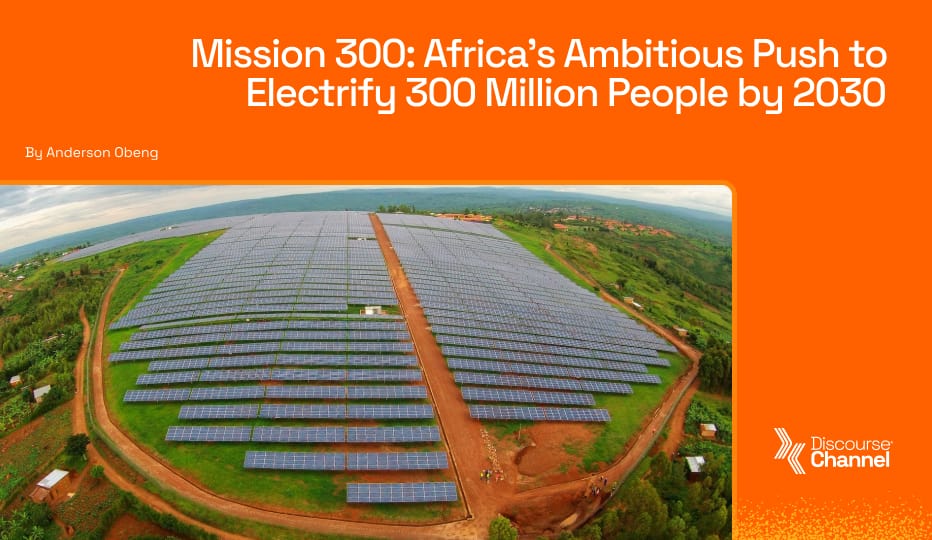
Mission 300: Africa’s Ambitious Push to Electrify 300 Million People by 2030
Across the continent, unreliable or nonexistent power continues to limit agricultural productivity, weaken value chains, and constrain industrial growth. This reality placed energy access at the center of discussions during the African Development Bank Annual Meetings.
For millions of Africans, the challenge is not simply producing food, it is processing it, storing it, transporting it, and getting it to markets efficiently. Behind many of these bottlenecks lies a less discussed constraint: electricity. Across the continent, unreliable or nonexistent power continues to limit agricultural productivity, weaken value chains, and constrain industrial growth. This reality placed energy access at the center of discussions during the African Development Bank Annual Meetings.
African development finance institutions rallied behind the Mission 300 coalition during the African Development Bank (AfDB) Annual Meetings, strengthening support for one of the continent’s most ambitious energy access initiatives.
The program, a joint effort between the African Development Bank and the World Bank, aims to provide electricity access to 300 million Africans by 2030, addressing one of the continent’s most persistent development challenges.
While the initiative is fundamentally an energy program, its implications extend far beyond electrification. Access to reliable power remains a critical constraint across agricultural value chains, particularly in processing, storage, refrigeration, irrigation, and manufacturing activities that add value to agricultural products before they reach consumers.
In many African countries, farmers often lose significant portions of their harvest due to inadequate storage infrastructure and limited processing capacity. Without reliable electricity, cold-chain systems, agro-processing facilities, and food preservation technologies remain difficult to operate at scale. Mission 300 is therefore being positioned not only as an energy intervention but also as a catalyst for food security, industrialization, and economic transformation.
The initiative also reflects growing recognition among policymakers and development institutions that energy access is directly linked to broader economic outcomes. Reliable electricity supports small businesses, manufacturing operations, healthcare systems, digital infrastructure, and educational institutions, creating multiplier effects across multiple sectors.
Discussions at the AfDB meetings highlighted the importance of coordinated financing, public-private partnerships, and long-term infrastructure investment to achieve the coalition’s target. The scale of the challenge remains significant, with hundreds of millions of Africans still lacking reliable access to electricity despite years of investment efforts.
Beyond energy access itself, Mission 300 represents a broader attempt to address structural barriers that continue to limit productivity and competitiveness across African economies. For agriculture in particular, improved electrification could strengthen value addition, reduce post-harvest losses, improve supply chains, and create new opportunities for rural industrial development.
What we are watching:
- Governments and development institutions continued raising concerns about rising food prices, climate-related disruptions, and supply-chain challenges affecting food systems across Africa.
- New funding commitments targeting agricultural research, climate adaptation, and food-system resilience attracted significant attention during the week.
- Technology-driven farming solutions continued gaining momentum across the continent.
Taken together, these developments point to a growing shift in how Africa is approaching food security and agricultural development.
The conversation is increasingly moving beyond production alone toward the systems that support productivity, energy infrastructure, climate resilience, financing, technology, and value addition. Mission 300 sits at the intersection of these priorities because electricity influences nearly every stage of the agricultural economy.
As countries seek long-term solutions to food insecurity, energy access is becoming less of a standalone infrastructure issue and more of a foundational requirement for economic transformation, industrialization, and agricultural competitiveness across the continent.