Africa's Education Sovereignty Still Being Financed Elsewhere.
African classrooms are trained on datasets representing under 0.1 per cent of African linguistic and cultural material. Inside the ministerial round table, every delegation reached for the same vocabulary, but almost none reached for the same number.

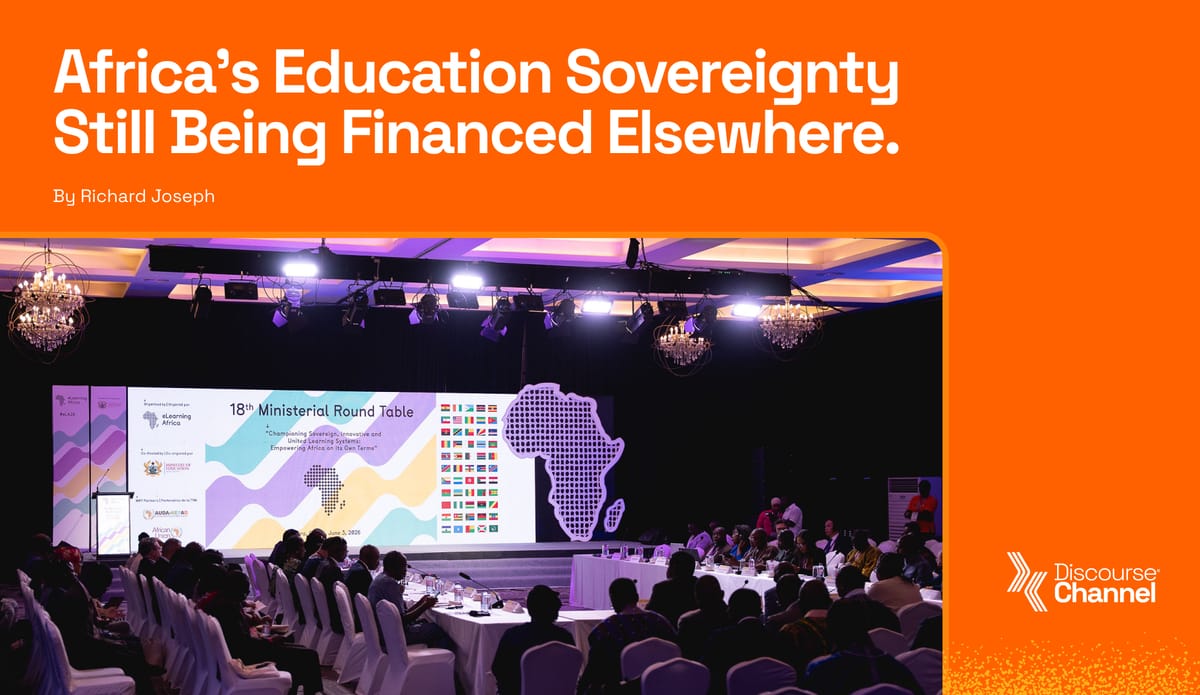
For close to five hours across three sessions, ministers, deputy ministers and their representatives from more than a dozen African countries took turns at a round table in Accra, and nearly every one of them reached for the same word: sovereignty. Educational sovereignty. Digital sovereignty. Data sovereignty. Hardware sovereignty.
It is rare for a single term to unite a room this diverse in fiscal capacity, political system and colonial inheritance so completely. It is worth asking what that unity was actually built on, and whether it survives the walk from the round table to the treasury.
FACTS
The round table ran three sessions: infrastructure and finance for digital learning and skills development; AI, innovation and human capacity for Africa's digital future; and continental solidarity and cross-border collaboration for resilient learning systems. Delegations from Ghana, Sierra Leone, Togo, Benin, South Africa, Mozambique, the Democratic Republic of Congo, Zimbabwe, Namibia and Gabon spoke, alongside UNESCO's Edmund Muokala, AUDA-NEPAD-linked consultant John Kimotho of the SPS Foundation, and civil-society voice Hon. Michael Onyango of The 4gotten Bottom Millions (4BM) Kenya.
According to Mr. Onyango, nine of the world's ten largest technology firms are American; the global frontier-tech market is valued near 1.3 trillion dollars, of which Africa commands roughly 1 per cent of global compute capacity even as continental broadband penetration approaches 45 per cent; South Africa alone holds about 85 per cent of the continent's existing operational data capacity; and AI systems now entering African classrooms are trained on datasets representing under 0.1 per cent of African linguistic and cultural material. He set this against a demographic fact repeated in the room; that Africa will hold a quarter of the world's population and more than 40 per cent of its youth by 2050 and only 2 per cent of African university graduates currently hold degrees in frontier-tech disciplines.
Specific national commitments were named on the record. Togo disbursed 1.35 billion CFA francs through technical and financial partners in 2025 and plans to recruit 700 digital-transformation specialists by 2030; Namibia confirmed that, since January 2026, tuition and registration for first degrees at public and private tertiary and technical institutions are fully government-subsidised, alongside a national education allocation near 30 per cent of the budget; Zimbabwe described a national high-performance computing facility, a national data centre, locally hosted large language models for indigenous languages, and laptops manufactured domestically through the Harare Institute of Technology and Bindura University; South Africa's Deputy Minister of Basic Education, Dr. Makgabo Reginah Mhaule, outlined a national AI-in-education framework built on the POPIA data-protection act.
The African Continental Qualifications Framework, an African Union policy validated in 2023 and now engaging around 40 national qualifications authorities, is due before ministers for formal approval by the end of 2026. Ghana's deputy minister proposed that African governments commit 1 to 2 per cent of annual GDP to a pooled continental digital-infrastructure fund.
The moderator noted that email traffic between African countries commonly routes through servers in Europe or North America before reaching its destination, and that the African Union's continental internet exchange, launched the previous year, drew 200 million African users within a day of going live.
Kimotho's AUDA-NEPAD consultation, drawn from 40 ministries of education, identified fragmented national policy as the dominant cross-cutting barrier to progress, and set a target of reaching over 200 million basic-education learners within three years through a standards-based, offline-first digital public infrastructure built around devices already in hand rather than computer labs.

The Wavve of African Discourse is now streaming on Spotify.
Bold conversations, real context, and African voices shaping the future. From policy to culture, The Wavve is where discourse becomes direction.
OUR ANALYSIS
Listening closely, the room was using one word to mean four different things. For Dr Mhaule, sovereignty was regulatory and evidentiary: a data-protection act, a framework of questions every AI tool must answer before it enters a classroom, a teacher's right to inspect and adapt an algorithm's logic. For Zimbabwe, it was physical: a data centre you own, a GPU cluster you host, a laptop assembled on your own soil. For Kimotho, it was architectural: design the system to keep data local by default, offline-first, so sovereignty is built into the standard rather than negotiated deal by deal. For Hon. Onyango, it was adversarial and geopolitical: break dependence on a handful of foreign firms through legislated data localisation and regulatory sandboxes. These four are not incompatible, and they were never reconciled into one plan in the room they were shared in, which leaves whoever drafts the eventual communiqué a single word carrying four unresolved theories of change.
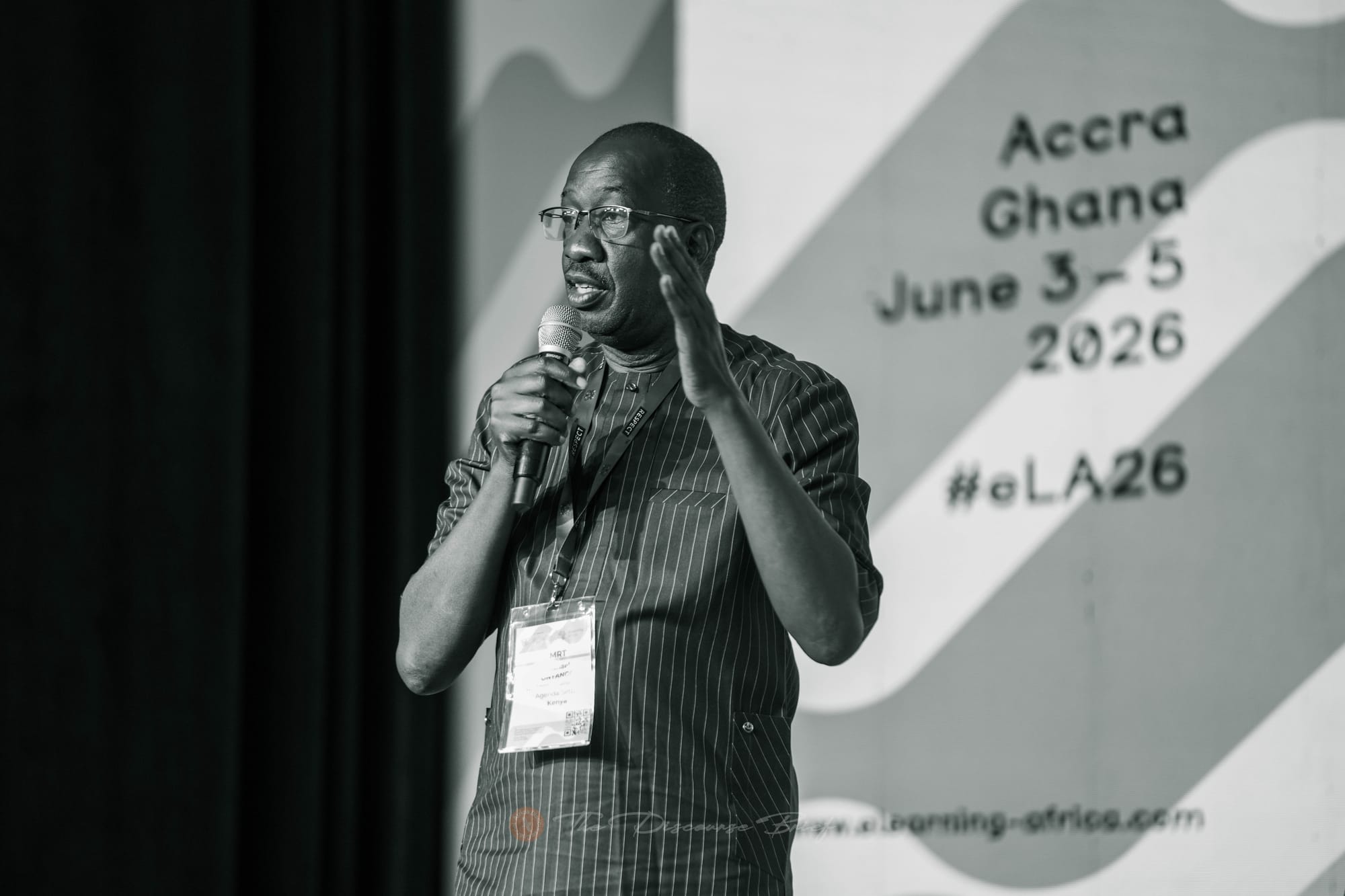
Hon. Onyango's numbers were the clearest test of what that unity is worth. If South Africa alone holds roughly 85 per cent of the continent's existing data capacity, and the continent as a whole commands about 1 per cent of global compute, then Zimbabwe's account of its own sovereign stack, however real at national scale, describes what is achievable under favourable conditions in one country, not what exists continentally. The distance between the loudest sovereignty claims made at that table and the numbers describing continental capacity is the more important narrative to surface, ahead of any single delegation's account of its own progress.
The room also reproduced, live, the very problem it had just been told about. Kimotho's own study of 40 ministries named fragmented policy as the top barrier to scale. Within the hour, Zimbabwe was describing its own data centre and device-manufacturing line, Togo its own connectivity and teacher-certification plan, Benin its own digital campuses, South Africa its own AI framework, the DRC its partnership with the World Bank and the French development agency, and the qualifications framework its dependence on the European Training Foundation. Each is a legitimate national or bilateral response. However, by each speaker's own account, none of them was yet talking to the others.
Togo's technical and vocational training director made this explicit from the floor, calling for a shared continental guide to drafting national AI policy so that fifty-four separate efforts do not produce fifty-four incompatible ones; a proposal that echoed, almost exactly, the finding Kimotho had presented earlier that same day.
The sharpest financing idea of the day arrived late, and from a minister rather than a technical presentation:
If we are not prepared to put sufficient resources to bear, then we would have a very serious challenge in achieving our objective. — Deputy Minister, Ministry of Education, Ghana
His proposal, that African governments commit 1 to 2 per cent of annual GDP to a pooled continental digital-infrastructure fund, is specific and trackable in a way most of the day's language was not. When an ed-tech founder later asked, who was actually going to pay for any of it, the answer offered from the floor pointed not to a future donor but to capital African governments and citizens already control: the domestic financing behind Ethiopia's Grand Renaissance Dam, and the scale of diaspora remittances returning to the continent each year. Both are real, present-tense pools of money. Neither had, by the session's close, been attached to an actual mechanism.

Africa's Home for Ideas, Innovation and Sustainable Solutions for Digital Education, Training and Skills Development since 2005
ROOM FOR DISAGREEMENT
Zimbabwe's account of its own stack deserves more than polite acknowledgement. A national high-performance computing facility, a national data centre, locally hosted language models and domestically manufactured laptops, if accurately described, are evidence that sovereignty at meaningful scale does not require waiting for continental consensus to arrive first; one country can move alone and still move.
However, the case against reading every parallel national effort as wasteful duplication has real force too: Togo, Benin and Gabon each running a separate digital-university pilot, before continental standards exist, means several approaches get tested under real conditions before anyone is asked to converge on a single template, which may be safer than premature standardisation around one, possibly wrong, model.
Hon. Onyango's four-firm framing, while directionally accurate about compute and cloud concentration, may also understate how mixed African infrastructure markets already are, with Chinese, Gulf and regional telecom capital all competing for the same contracts rather than a clean binary of African dependency against a handful of Silicon Valley firms.
WHAT ELSE MATTERS
Two floor interventions, easy to lose in a room dominated by ministers and infrastructure figures, are worth carrying forward on their own terms.
The Africa Dyslexia Organisation's point, that dyslexia, ADHD, dyscalculia and dyspraxia go largely unidentified and unsupported across the continent, is a reminder that a sovereignty agenda measured in data centres and hardware can still design out a meaningful share of learners if inclusive design is treated as an afterthought rather than a starting condition. And UNESCO's Edmund Muokala reframed the entire day earlier with a simpler image: literacy as the trunk, AI competence as a branch, and no branch growing stronger than the trunk carrying it — a caution against reading any single country's data centre or AI framework as sufficient on its own, absent the foundational reading and writing skills the whole structure depends on.
SOLUTIONS IN ACTION
Some of what was proposed in Accra already has a working precedent rather than a blank page to build from. The African Internet Registry, AFRINIC, exists today because a small group of African technologists, working from a modest seed budget and office space donated by Mauritius, decided decades ago that IP-address assignment for the continent should not sit permanently in Europe or North America; proof that a patiently built, self-funded continental institution is achievable rather than aspirational.
The African Union's continental internet exchange, which reportedly drew 200 million users within a day of launch, is evidence that continental digital infrastructure can scale fast once it exists. The qualifications framework's cross-border recognition mechanism is already operating across roughly 40 national authorities and carries a dated milestone worth tracking: ministerial approval by the end of 2026. And Zimbabwe's proposal to extend the Southern African Development Community's cyber-infrastructure-sharing protocol continent-wide gives the pooled-investment idea a working regional template.
Read against everything said in Accra, the round table's real achievement was reaching consensus on a word faster than it reached consensus on a number.
Every delegation could say sovereignty without hesitation. Only one delegation said what percentage of GDP it would take, and only one intervention pointed to money that already exists rather than money still being requested.
Whether this round table amounts to more than its own communiqué will not be settled by how the final text reads. It will be settled by whether the pooled infrastructure fund, the shared continental AI-policy guide, and the SADC-style sharing protocol survive past the coffee break they were raised in.
Editorial note
The facts, figures, and quotations above are drawn from the recorded proceedings of the 18th Ministerial Round Table at e-Learning Africa 2026 in Accra. Risk framing, comparative analysis, and the judgments in ADC Analysis and Solutions in Action are ADC's own interpretive assessments, kept distinct from reported facts throughout.