Africa’s Data-Center Boom Signals a New Phase of Digital Transformation
Investment in data centers emerged as one of Africa’s most important technology stories this week, reflecting growing demand for the infrastructure powering the continent’s digital economy.
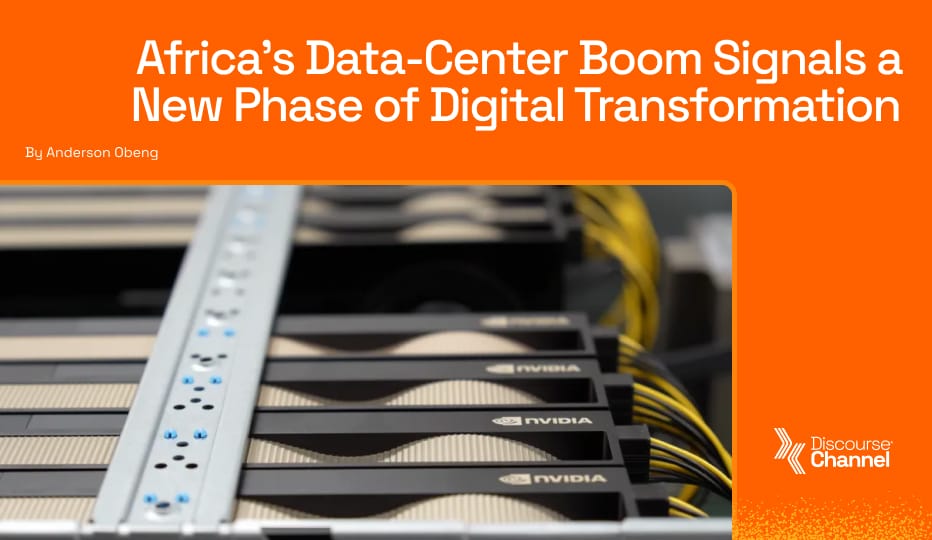
The race for Africa’s digital future is no longer happening only through apps, startups, or artificial intelligence platforms. Increasingly, the competition is shifting beneath the surface, to the infrastructure that stores, processes, and moves data across economies. As demand for digital services grows, data centers are emerging as one of the continent’s most strategic assets.
Investment in data centers emerged as one of Africa’s most important technology stories this week, reflecting growing demand for the infrastructure powering the continent’s digital economy.
The surge is being driven by the rapid expansion of artificial intelligence, fintech services, cloud computing, e-commerce platforms, streaming services, and digital public infrastructure. As more businesses, governments, and consumers rely on digital systems, the need for local data storage and processing capacity has become increasingly urgent.
For years, much of Africa’s digital activity depended on data being processed and stored outside the continent. However, growing concerns around latency, cybersecurity, regulatory compliance, and data sovereignty are encouraging greater investment in local infrastructure. Governments and private-sector players are increasingly recognizing that digital transformation requires not only software and connectivity but also the physical infrastructure that supports them.
The expansion of data centers is also becoming closely linked to Africa’s AI ambitions. Artificial intelligence systems require significant computing power, data processing capabilities, and reliable cloud infrastructure. Without these foundational systems, large-scale AI deployment remains difficult to achieve.
Beyond technology, data centers are increasingly being viewed as economic infrastructure. They support financial services, digital trade, telecommunications, government services, and cross-border business operations. Their growth reflects a broader shift in which digital infrastructure is becoming as strategically important to modern economies as roads, ports, and power systems.
The investment momentum also highlights a growing recognition that control over digital infrastructure plays an important role in economic competitiveness. As African countries seek to strengthen digital sovereignty and reduce dependence on external systems, data centers are becoming central to long-term technology and development strategies.
What we are watching:
- African governments are increasingly engaging in discussions around AI regulation, data ownership, privacy, and digital sovereignty as artificial intelligence becomes more integrated into economies and public services.
- Investors continued directing capital toward telecommunications networks, cloud systems, connectivity projects, and broader digital infrastructure initiatives across the continent.
- Mobile money, digital payments, and digital credit ecosystems continued expanding across multiple African markets.
Africa’s technology story is increasingly moving beyond applications and platforms toward infrastructure ownership.
The rapid growth of AI, fintech, cloud services, and digital commerce is creating demand for stronger local systems capable of storing, processing, and securing data at scale. At the same time, governments are paying closer attention to regulation, digital sovereignty, and the strategic importance of controlling critical digital assets.
Taken together, these developments suggest that the next phase of Africa’s digital transformation may be defined not only by innovation itself, but by who owns and operates the infrastructure that makes that innovation possible.