Africa Pushes Back on America's New Health Aid Agenda
Ghana became one of the more high-profile withdrawals when talks over a proposed $109 million, five-year US aid package collapsed after Washington allegedly demanded access to Ghanaian citizens' personal data.
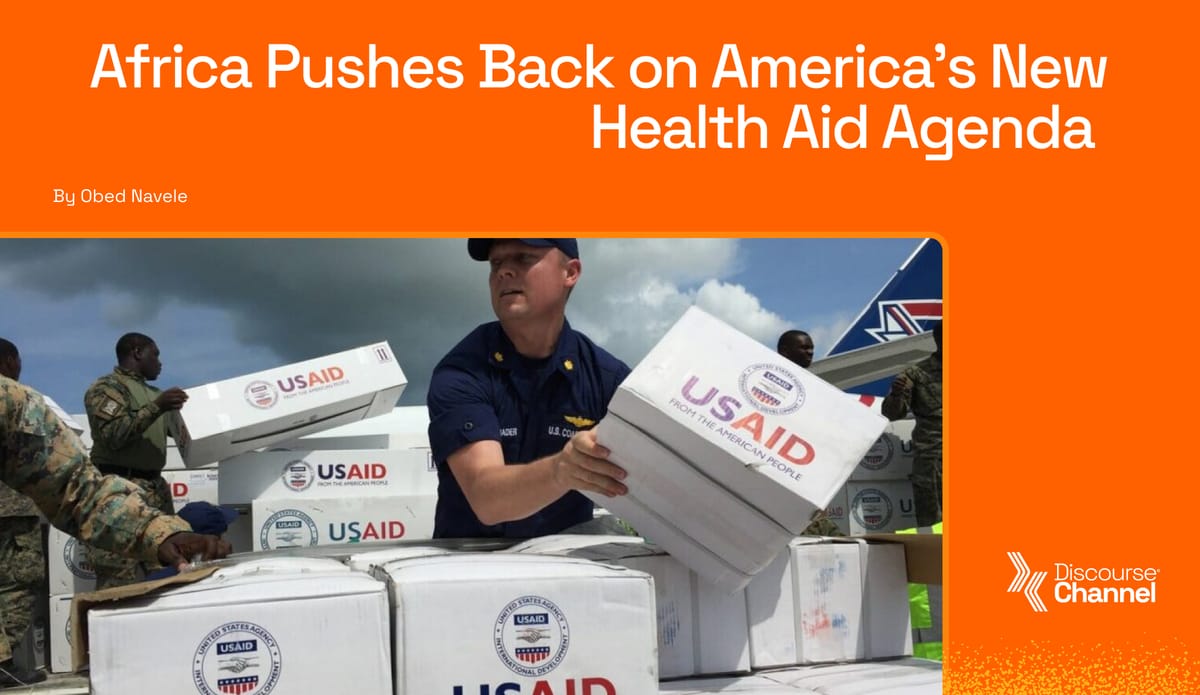
There is growing anger over a series of bilateral health agreements being negotiated between the United States and African countries. not just for what they offer, but for what they demand in return.
Beneath the headline figures billions of dollars in health funding commitments is a growing chorus of African governments, public health bodies, and civil society voices raising the alarm over a new model of US global health engagement that critics say prioritises American interests over African sovereignty.
At the centre of the controversy is data: who owns it, who controls it, and who ultimately benefits from it.
Aid With Conditions: What These Health Deals Actually Require
Following the dismantling of most of its development agency, USAID, the Trump administration has been pursuing a series of bilateral health agreements with African countries under what it calls its "America First Global Health Strategy." At least 17 African nations have signed deals, collectively securing a reported $11.3 billion in aid commitments.
But the terms attached to that funding are proving deeply contentious.
As of late February 2026, Jean Kaseya, Director-General of the Africa Centres for Disease Control and Prevention, warned last week that African countries could be required to share sensitive pathogen and health data with the United States as a condition of receiving support. The critical question Kaseya raised is one with no satisfactory answer yet: if African nations provide the biological and epidemiological data that enables the development of new vaccines, diagnostics, or treatments, what guarantees do they have that those products will be equitably accessible to their own populations? The answer, it appears, is none.
Ghana Walks Away
Ghana became one of the more high-profile withdrawals when talks over a proposed $109 million, five-year US aid package collapsed after Washington allegedly demanded access to Ghanaian citizens' personal data. A source close to the government told AFP that after Accra rejected the request, the US negotiating team became "hostile" and increased pressure on officials.
The package, which could have supported efforts against HIV/AIDS, malaria, tuberculosis, and other infectious diseases, is now off the table. The US State Department declined to discuss the specifics of the negotiations but maintained it still wishes to strengthen bilateral relations with Ghana.
Ghana's exit is not an isolated case. Zimbabwe walked away from a proposed $367 million US health agreement earlier this year, describing the deal as "unequal" and citing concerns over the sharing of sensitive health data and national sovereignty. The government was blunt in its assessment: the terms on offer did not reflect a partnership between equals.
Zambia has delayed signing its own agreement, with officials raising concerns over provisions that could affect national interests. Reports indicate that Zambia's deal would have involved US access to its strategic mining resources, a condition that sits entirely outside the scope of a health partnership and has intensified scrutiny of what Washington is actually seeking through these agreements.
In Kenya, a court suspended the country's signed agreement over data-sharing concerns, suggesting that legal challenges may become a growing tool for citizens and institutions to contest these arrangements.
Data Is the New Gold
To understand why these deals are generating such alarm, it helps to zoom out from health policy entirely. Africa is no longer negotiating only land, minerals, or labour in its global relationships. It is negotiating data. Pathogen samples, patient records, biometric systems, mobile money transactions, and AI training datasets are becoming the strategic resources of the 21st century and they are flowing out of the continent at a pace that most governments have not fully reckoned with.
The health deal framework sits within this larger extraction story. When African health ministries are asked to share disease surveillance data, genomic sequences, and outbreak records as a condition of funding, they are being asked to part with something that has genuine long-term economic and scientific value. That data is foundational to vaccine development, drug trials, and epidemiological modelling. In the hands of well-resourced pharmaceutical and biotech industries, it generates intellectual property, patents, and profits almost none of which return to the countries that provided the raw material.
This is not hypothetical. The COVID-19 pandemic demonstrated exactly how this dynamic plays out. African nations contributed patient data and biological samples to the global research effort. When vaccines arrived, the continent was last. When treatments were developed, pricing placed them out of reach for most African health systems. The bilateral deals now being negotiated risk institutionalising that imbalance not as an accident of global market forces, but as a contractual arrangement.
The Africa CDC's intervention signals that the continent's public health leadership understands what is at stake. Data sovereignty is not a bureaucratic concern. It is a development issue, a health security issue, and increasingly, a question of who controls the infrastructure of Africa's future.
Aid Versus Agency: Is the Model Broken?
The tensions surfacing across these negotiations are forcing a deeper question that African policymakers and economists have circled for decades: is the aid model itself becoming obsolete?
The traditional architecture of health aid wealthy governments funding programmes in lower-income countries, setting the terms, measuring the outcomes, and retaining ownership of the knowledge generated was always a relationship of dependence. What has changed is that African governments are increasingly naming that dependence as a problem rather than accepting it as a condition.
The African Union's Agenda 2063 framework envisions a self-financing continent capable of funding its own development priorities. The African Development Bank has been scaling health financing instruments. Pan-African institutions like the Africa CDC were explicitly built to reduce the continent's reliance on external public health architecture. These are not rhetorical aspirations but active institutional projects.
The irony of the current moment is that the Trump administration's dismantling of USAID which many observers saw as a catastrophic blow to African health systems may in fact be accelerating a long-overdue reckoning. If the United States is no longer a reliable partner, and if reliability now comes with conditions that undermine sovereignty, then the case for building African-led, African-financed health systems becomes not just ideological but urgent and practical. Regional health financing pools, African pharmaceutical manufacturing capacity, and continent-wide regulatory harmonisation are not new ideas. They are proposals that have stalled repeatedly for lack of political will and funding. That calculus may now be changing.
A Crowded Field: How Other Powers Compare
Framing this story purely as a conflict between the United States and Africa misses an important layer of complexity. Africa is not navigating a single dominant relationship. It is managing a field of competing global powers, each with its own model and its own agenda.
China has invested heavily in African infrastructure through the Belt and Road Initiative, building roads, railways, ports, and increasingly, digital infrastructure. The conditions attached to Chinese financing are different; they tend to involve debt structures, equity stakes, and resource collateralisation rather than data or political conditions but they are not absent. Several African governments have discovered that Chinese loan terms carry their own forms of asymmetry, particularly where strategic assets serve as collateral.
The European Union's engagement model emphasises regulatory alignment and trade agreements, often requiring African countries to adopt European standards as a condition of market access. This too shapes domestic policy in ways that are not always in African interests. India and Gulf states are emerging as alternative partners, often positioning themselves as less conditional. But their scale of engagement in health specifically remains limited.
What this landscape tells us is that every major power is pursuing relationships with Africa that serve its own strategic interests. The US framework is simply more visible right now because it has arrived abruptly, attached to explicit political conditions, and been met with equally explicit pushback. The deeper pattern of global powers seeking data, resources, regulatory influence, and geopolitical alignment in exchange for development support is consistent across partners.
What a Fair Deal Looks Like
The governments that have walked away from these agreements have done so on instinct and principle. What is still missing is a shared African framework that defines, clearly and collectively, what equitable partnership actually requires.
Several principles are already being articulated by public health advocates and African institutions. Any agreement involving the transfer of health or citizen data must include explicit commitments to equitable access meaning that vaccines, diagnostics, and treatments developed using African data must be available to African populations at affordable prices. Data governance provisions must sit within African legal frameworks, not be subordinated to foreign regulatory systems. Technology transfer clauses must be mandatory, not aspirational, so that African countries build domestic manufacturing capacity rather than permanent import dependence. And conditions unrelated to the stated purpose of an agreement whether religious, political, or resource-related must have no place in health partnerships.
What It Means on the Ground
Behind every dollar figure in these negotiations is a lived reality that rarely makes it into the policy debate. When Ghana walks away from $109 million, that is not an abstraction. It is malaria treatment for communities in the Northern Region. It is an antiretroviral supply chain for people managing HIV. It is tuberculosis diagnostics in facilities already operating under severe resource constraints.
The governments making these decisions are not choosing between sovereignty and health. They are being forced to choose between both, by a negotiating framework that should never have presented that choice in the first place. That is the deeper failure at the centre of this story. Not that Africa is pushing back. But that pushing back comes at a cost that is ultimately borne by the most vulnerable people on the continent, people who have no seat at the negotiating table and no role in designing the terms that shape their access to care.
What Comes Next
The Africa CDC's public intervention signals that a coordinated response is taking shape. The countries that have pushed back Ghana, Zimbabwe, Zambia, Kenya have done so independently and for different stated reasons, but the cumulative effect is political. It creates space for the African Union and the Africa CDC to propose alternative frameworks, and it signals to Washington that these deals cannot be concluded on their current terms.
Whether that translates into a unified African negotiating position remains to be seen. The obstacles are real: not every African government has the fiscal cushion to turn down US funding, and solidarity is easier to assert in public than to maintain under bilateral pressure. But the conversation has shifted. Africa is no longer debating whether to scrutinise these deals. It is debating what to demand instead. That is a different kind of negotiation and a more important one.