Africa Is Farming Blind.
Ghana is projected to import 1 million metric tons of rice in 2025/26, at a cost of $450–$550 million. Not from African neighbours, but from Asia and the Americas—regions with only a fraction of Africa’s agricultural potential.

Ghana alone is projected to import 1 million metric tons of rice in 2025/26, according to the USDA Foreign Agricultural Service. At current global prices, that is a bill of $450 to $550 million annually. These imports will not come from Africa’s neighbours but from Asia and the Americas, regions with far less agricultural potential.
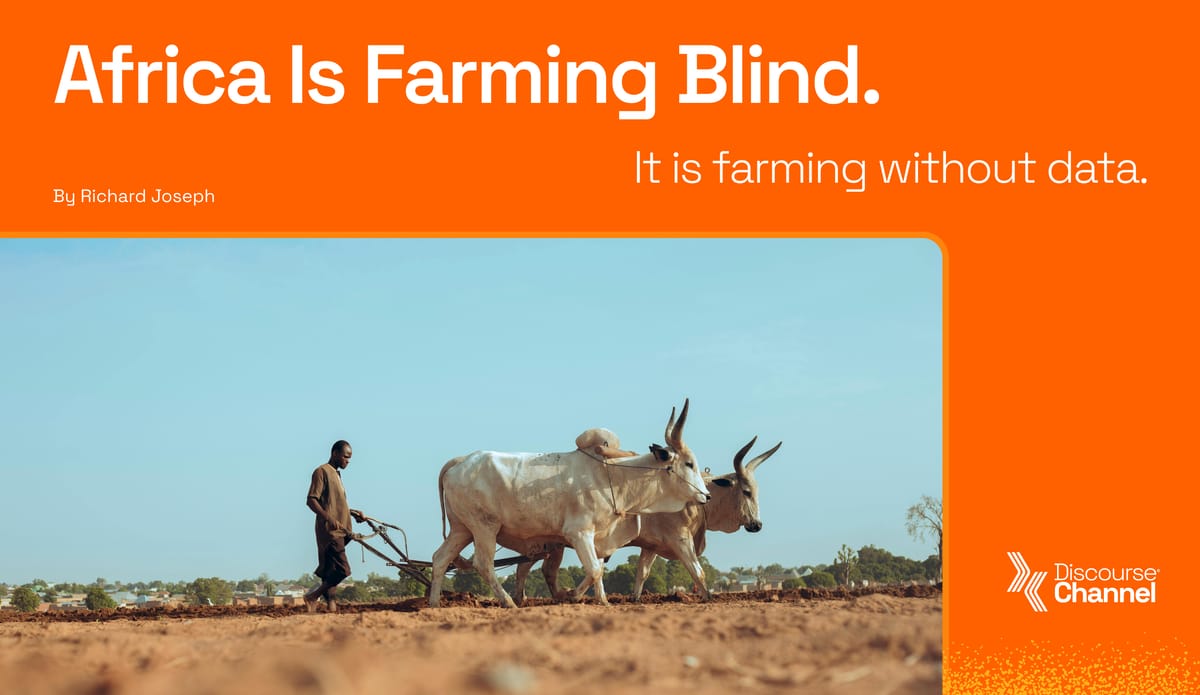
Three out of every four people in Africa's rural communities work the soil every single day. The continent, home to 60% of the world’s uncultivated arable land, is paradoxically dependent on imports for staples it could grow itself.
The continent is not short of farmers or land. It is farming blind — with no continent-wide soil intelligence, no coordinated seasonal mapping, no single data layer that tells an investor in Nairobi, a smallholder in Northern Ghana, or an agri-policymaker in Abuja: this is what your land is built for. This is the season. This is the yield.
At the West Africa Agri Show in Accra, Africa Discourse Channel sat down with Ferdinard Nana Abaka Quaye, DBA — Ghanaian sustainability expert and African Markets Lead at Syntex GmbH — for a conversation that moved from fertilizer chemistry to food sovereignty, from child labour definitions to the political failures quietly draining Africa's agricultural potential. What surfaced was a clear diagnosis of a continent farming on assumption, tradition, and government subsidies too broad to do anything precise.
The deceptively simple question that should keep African policymakers, investors, and agri-entrepreneurs up at night is: what if we actually knew our soil?
The Subsidy Trap: Investment Without Intelligence
Across Africa, governments are not ignoring agriculture. Ghana's Planting for Food and Jobs programme, Nigeria's anchor borrowers scheme, and Ethiopia's agricultural transformation initiatives signal that the continent's governments have poured money, intent, and political capital into farming. Yet intent without precision is a catastrophic waste.
Ferdinard Nana Abaka Quaye, DBA — Ghanaian sustainability expert and African Markets Lead at Syntex GmbH — captured the dilemma:
The investment has to be targeted. It shouldn't be wholesale. The government should know that this soil can be better in soy, this soil in rice. — Ferdinard Nana Abaka Quaye, DBA · African Markets Lead, Syntex GmbH · WAAS West Africa Agri Show, 2025
When a government subsidises fertilizer and seed distribution without knowing what the soil actually needs, it is not investing in agriculture — it is spending money in the direction of agriculture. The two are categorically different. Subsidy without data is waste. And across 54 nations with vastly different soil compositions, rainfall patterns, altitude variations, and microclimatic zones, a one-size-fits-all agricultural policy is not a policy. It is a prayer.
The result is visible in every import terminal from Tema to Lagos: a continent that holds 60% of the world's uncultivated arable land, writing nine-figure cheques — $450 to $550 million for rice from Ghana alone — to import staples it is biologically and geographically equipped to grow.
Imagine the Portal — What Precision Agriculture at Continental Scale Looks Like
Here is the Africa that is possible with the right infrastructure.
Imagine an institution — call it the African States Agriculture Intelligence Body — that commissions systematic soil testing across the continent's farming regions. Not a one-time survey, but a living dataset, updated seasonally, cross-referenced with rainfall data, historical yield records, temperature gradients, and market demand projections. A portal — open-access and publicly funded — that any farmer, investor, cooperative, or government ministry can consult before planting a single seed.
A continental agricultural data portal — showing farmers where to plant what crop, in what season, with what inputs, for what yield — built on real soil intelligence. Not an assumption. Not tradition. Not wholesale government mandates. Data. Africa has the land. What it needs is the map.
The portal does not just tell a farmer in the Volta Region that their soil is potassium-rich. It connects that intelligence to an investor dashboard showing where commercial-scale cassava production is viable, underinvested, and closest to functional logistics corridors. It links to a government planning interface that shows which districts can pivot to rice production and eliminate import dependency within three growing seasons. It surfaces seasonal windows to agri-exporters looking to lock in forward contracts before harvest.
This is not speculative technology. The Netherlands has done versions of this at a national scale for decades — soil mapping, precision farming, digital agriculture infrastructure — and turned a country smaller than West Virginia into the world's second-largest agricultural exporter. The technology exists. The agronomic expertise exists. What has not existed, until now, is the political and institutional will to build it on a continental scale in Africa.
The Organic-Inorganic Debate — And Why Data Resolves It
One of the sharpest tensions in African agriculture today is the one between organic and inorganic fertilisation. On one side: soil scientists and sustainability advocates warning that heavy inorganic fertiliser use — particularly without rotation or soil testing — degrades soil health over time, reducing long-term productivity even as it boosts short-term yield. On the other: the commercial reality is that organic fertilisers cannot yet be produced at the scale Africa's farming sector requires.
Quaye does not dismiss the organic argument. He makes it. But he pairs it with arithmetic: "An organic fertiliser can give you 100 bags of yield. An inorganic fertiliser — I can get double the productivity based on applications." For a continent where food security is not an abstract policy goal but a daily, household-level urgency, that yield gap matters enormously.
The Fertiliser Gap — What Africa's Farmers Are Navigating
- Organic fertilisers improve soil health long-term, but cannot currently be produced at continental scale
- Inorganic fertilisers double yield but risk gradual soil degradation without proper rotation and testing
- GMO seed adoption increases input dependency — potentially compounding soil stress over time
- The right blend is soil-specific — which means it cannot be prescribed without soil data
- Smallholder farmers cannot afford to experiment. They need precise guidance, not general advice
The correct answer — what to apply, in what ratio, in what soil, in what season — is not a universal prescription. It is a data output. A soil intelligence portal resolves this debate not by picking a winner between organic and inorganic, but by giving every farmer and every region the specific information needed to make the right call for their ground. The debate ends when the data arrives.
Youth and Technology: Unlocking the Future
Africa's agricultural labour force is ageing. The youth who should be stepping into farming see it — fairly or not — as the work of those without options. That perception is changing, but slowly, and not fast enough for a continent that needs to double food production in the next fifteen years to keep pace with its own population growth.
Quaye offered a provocation at the Agri Show that landed hard:
"Ghana has a youthful population, and we are tech-savvy. Why doesn't the government channel the tech-savviness of its youth into agriculture?"
It is not a rhetorical question. Africa's young population — the largest and fastest-growing youth cohort on earth — is not allergic to agriculture. It is allergic to analogue agriculture. Give them drone-assisted crop monitoring, soil sensor networks, satellite yield mapping, AI-assisted planting calendars, and agri-fintech platforms that de-risk smallholder investment — and the pipeline changes.
The data portal is not just a planning tool. It is a gateway for a generation that will not go to the farm without a phone signal and a reason to believe the sector can reward them. Precision agriculture is, at its core, a tech problem. And Africa has 400 million people under the age of 25 who know how to solve tech problems.
Politics vs. Citizens: Breaking the Cycle
Here is where the conversation gets honest in a way that most agricultural policy discussions avoid. Quaye was asked for his five-year political outlook on Africa's agricultural transformation. His answer was blunt: "I don't see anything better changing in the short term. We are repeating the same mistakes."
He is not wrong. Agricultural policy cycles in Africa are too often tied to election cycles. Long-term soil investment has a ten-year return horizon that sits uncomfortably against a four-year electoral calendar. Institutions change with administrations. Programmes that work get defunded when political alliances shift. The continent has seen this loop enough times to be sceptical of top-down salvation.
But Quaye's conclusion was not despair. It was a downward delegation to citizens and communities. "Forget the leaders. Let us grow. The citizens should get back on the ground." There is something important in that framing. The data portal, the soil intelligence infrastructure, the continental agricultural mapping — these do not need to wait for a pan-African political consensus that may never come. They can begin as civil society projects, regional economic community mandates, development finance institution priorities, and private sector infrastructure plays. They can grow from the bottom of the value chain upward.
Forget the leaders. Let us grow. Once we are not hungry, crime rate will reduce. Everyone will be comfortable. — Ferdinard Nana Abaka Quaye, DBA
The continent that writes a $450 to $550 million import cheque for a single crop — rice, in a single country — cannot afford to keep farming on assumption. The soil is here. The farmers are here. The youth are here. The technology is available. What remains is the architecture of intelligence that turns all of it into food sovereignty.
Tested soil. Seasonal maps. A portal. Targeted investment. It is not a utopian vision. It is engineering. Africa has everything it needs to build it — except, so far, the decision to start.
That decision belongs to all of us.
Watch the full conversation
with Ferdinard Nana Abaka Quaye, DBA at the WAAS West Africa Agri Show →