A Deal Signed in Lomé: What Africa's Biggest Trade Pact Means When It Meets Concrete and Steel
The AfCFTA-Rendeavour partnership moves Africa's continental trade ambitions off paper and into bricks, roads, and economic zones, but the questions of who benefits, who decides, and who bears the risk remain very much open.
Walk into any market in Africa today and you will find tomato products from the Netherlands, rice from Asia, and fabrics from China. The observation that African markets are filled with imports from Europe, Asia, and the Americas while lacking finished goods from neighboring African nations is starkly confirmed by the UNCTAD Economic Development in Africa Report 2024. The data reveals that intra-African trade accounts for only 16% of the continent's total trade, with the vast majority of economic exchange directed outward to global partners rather than inward to neighbors
The AfCFTA-Rendeavour partnership moves Africa's continental trade ambitions off paper and into bricks, roads, and economic zones, but the questions of who benefits, who decides, and who bears the risk remain very much open.
The Facts: What Was Agreed and Where
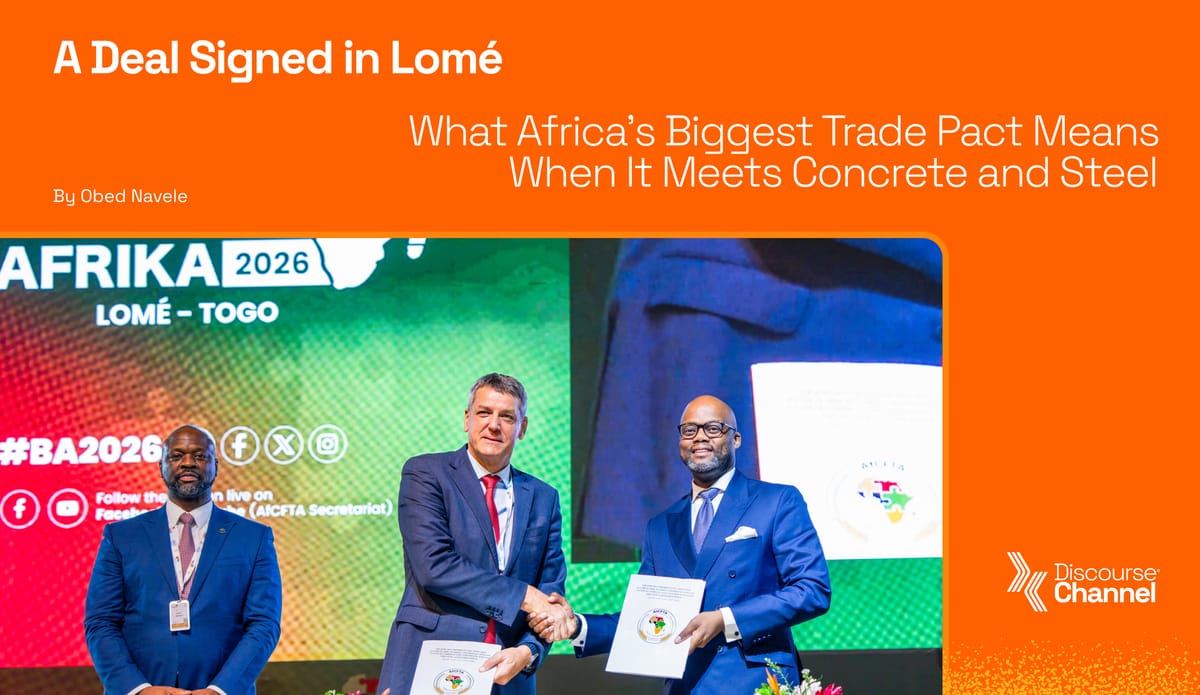
On the margins of Biashara Afrika 2026 in Lomé, Togo, the African Continental Free Trade Area Secretariat formalised a partnership with Rendeavour, a private city development company operating across Kenya, Ghana, Nigeria, Zambia, Democratic Republic of Congo, and Tanzania. The agreement targets three pillars: expanding Special Economic Zones (SEZs) as engines of industrialisation, mobilising private capital for trade-enabling infrastructure, and building trade and industrial corridors linked to master-planned urban developments.
The AfCFTA is the largest trade agreement in the world by participating countries 54 African Union member states with a combined GDP exceeding USD 3.4 trillion. Projections suggest it could add USD 450 billion in continental income by 2035. Yet the gap between projection and reality is stark: intra-African trade today accounts for only 14 percent of the continent's total trade. By contrast, intra-European trade runs above 60 percent, and intra-Asian trade above 55 percent. Africa, in essence, trades far more with the rest of the world than with itself.
Part of the structural explanation lies in infrastructure. Africa hosts approximately 230 Special Economic Zones roughly 4 percent of the more than 5,400 that exist globally. SEZs are the physical anchors of industrial trade: they aggregate logistics, provide reliable utilities, and offer regulatory environments designed to attract manufacturing and processing investment. Without them, goods cannot move efficiently, and value chains cannot form.
The Cause: Why the Gap Exists
Africa's low intra-continental trade is not primarily a policy failure, at least not in recent decades. The deeper causes are structural and historical. Colonial-era rail and road networks were built to extract raw materials outward to ports, not to connect African countries to one another. That legacy infrastructure still shapes trade patterns today. A lorry travelling between Nairobi and Kampala crosses borders more easily than one moving from Accra to Abidjan, two cities in the same economic bloc. Cross-border customs procedures, inconsistent tariff regimes, non-tariff barriers, and currency fragmentation each add cost and time to every transaction.
The industrial deficit compounds the problem. Most African economies export primary commodities oil, cocoa, copper, cotton and import manufactured goods. There is comparatively little manufactured or semi-processed output to trade between African countries. For intra-African trade to grow, Africa must first build the industrial capacity to produce goods its neighbours want to buy. That is precisely what SEZs are designed to enable.
Who It Involves: Sectors and People
Farmers and agro-processors stand to gain the most from functioning trade corridors. Africa produces enough food to feed itself, yet hundreds of millions face food insecurity partly because produce cannot move efficiently from surplus regions to deficit ones. Industrial zones equipped with cold storage, processing facilities, and reliable road links could transform subsistence farming into export agriculture adding value on the continent before goods leave it.
Manufacturers and small businesses in urban centres depend on reliable utilities, logistics, and access to regional markets. An SEZ that operates its own power grid and bonded warehouse network removes two of the largest operating costs African manufacturers face: power outages and customs delays. For small and medium enterprises, proximity to such zones, even without operating inside them reduces input costs and opens export channels.
Workers and communities near planned developments are perhaps the most directly affected, for better or worse. Industrial zones create formal employment, but their track record on wages, labour standards, and local procurement varies widely. The distinction between an SEZ that integrates with surrounding communities and one that operates as a fenced enclave is not a minor detail; it determines whether local residents participate in the growth or merely observe it.
Governments and regulators will be asked to create legal and policy frameworks enabling these zones. That requires institutional capacity, transparent land administration, and the political will to enforce standards. Where those conditions are weak, the risk of elite capture zones that benefit a narrow class of investors and connected insiders is real.
Where Experts Clash
- Rendeavour is a commercial business and It investors expect returns. When a private company builds the infrastructure that trade depends on, it sets the terms of access and those terms are designed to be profitable. Critics raise a legitimate concern: that zones built and managed for commercial return may price out the informal traders, small-scale manufacturers, and micro-enterprises that make up the majority of economic activity across the continent. A city built for investors is not automatically a city that works for the people who live near it.
- The USD 450 billion income projection by 2035 originates from modelling that assumes significant policy harmonisation, border infrastructure upgrades, and private investment materialising at scale all simultaneously. Such projections are useful as a ceiling, not a forecast. Past continental trade frameworks, including COMESA and ECOWAS protocols, have underdelivered relative to their headline numbers. Scepticism about implementation timelines is not pessimism; it is evidence-based caution.
- There is a legitimate debate about whether SEZ-led growth is the right model for African industrialisation at all. Some economists argue that Africa's structural transformation requires broad-based investment in public education, health, and infrastructure, not geographically concentrated enclaves. The SEZ model, they contend, may produce growth islands surrounded by unchanged hinterlands, deepening spatial inequality rather than reducing it.
Notable Outcomes to Watch
If the partnership executes on its stated goals, the most consequential outcome would be a visible reduction in the cost of cross-border trade measured in time, money, and regulatory friction. A secondary outcome would be demonstrable growth in manufacturing output from SEZ-linked facilities, showing that Africa can add value to its own raw materials before export.
The less visible but equally important outcome is governance quality: whether the zones are administered with transparency, whether surrounding communities are included in economic benefits, and whether labour standards are enforced rather than waived as an incentive to attract investors.
What Can Be Done
First, African governments participating in the AfCFTA must accelerate the ratification and domestic implementation of agreed protocols particularly on rules of origin and tariff schedules. The agreement exists; the bottleneck is translation into national law and customs practice.
Second, the SEZ model needs to be adapted to African contexts, not imported wholesale. Successful zones must be connected to surrounding economies through local content requirements, training mandates, and procurement rules that actively channel business to domestic suppliers and workers.
Third, civil society, labour unions, and local communities must be formal stakeholders in zone governance, not afterthoughts. Infrastructure built without community input has a long history of generating conflict and displacement rather than development.
Finally, the data deficit must be addressed. Africa's customs and trade statistics remain fragmented and often delayed by years. Without reliable, real-time data on what is being traded, where bottlenecks persist, and which interventions are working, policymakers are navigating by guesswork. Investment in trade data infrastructure is as important as investment in roads.
The deal signed in Lomé is significant, but it is an agreement, not an achievement. The measure of its value will be written in the years ahead in factories operating, goods moving, and workers earning not in the press release that announced it.