Whose Values, Whose Laws? The Paradox of Codifying 'African Family Values'
A continent that built its post-independence political vocabulary around self-determination is now attempting to codify that self-determination through a legal instrument whose genealogy runs directly to a 2022 gathering in Utah, organised by the US-based Family Watch International.
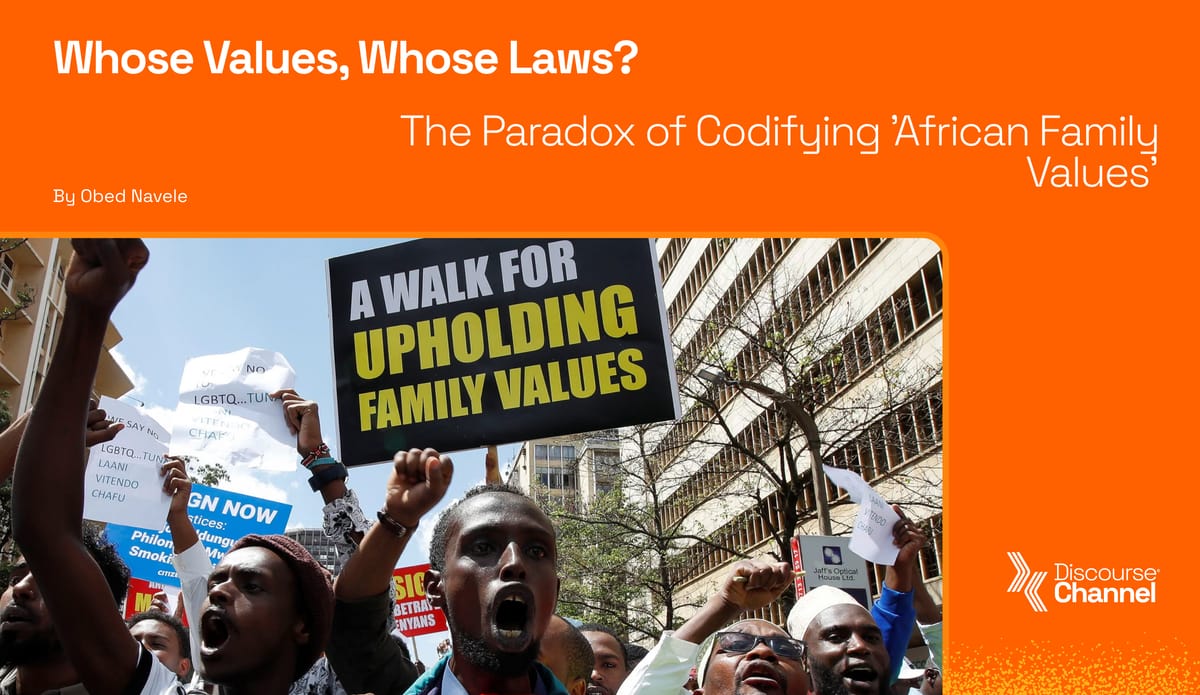
The Paradox
Earlier this month, parliamentarians from twenty African nations gathered in Accra and adopted the draft African Charter on Family, Sovereignty and Values. The document defines the family as a union exclusively between a man and a woman, calls on governments to legislate accordingly, and describes the project as a defence of African society against foreign interference. South Africa and Mozambique declined to sign however the other twenty endorsed it.
The scene carries a particular irony. A continent that built its post-independence political vocabulary around self-determination is now attempting to codify that self-determination through a legal instrument whose genealogy runs directly to a 2022 gathering in Utah, organised by the US-based Family Watch International. The conference has since migrated to Uganda and Ghana, but its origins abroad are not in dispute. What is in dispute is the larger question the Charter raises: when African legislatures define 'family values' by statute, are they exercising sovereignty, or are they handing that sovereignty to a different set of foreign interests while pointing the finger at another?The real conflict here is not a cultural battle between Africa and the West. Instead, the true danger is that politicians are passing rigid, ideology-driven laws instead of using scientific research and facts to guide public policy. While African leaders claim they are protecting their sovereignty from foreign interference, they are actually adopting legal frameworks designed by outside political groups. Ultimately, this replaces objective evidence with rigid dogma, leaving no room for fact-based lawmaking.
The Case for Codification
The proponents of these laws argue from a position that deserves to be taken seriously, not caricatured. They point to a real pattern: development finance increasingly arrives with social conditionalities. International financial institutions and bilateral donors have, at various points, tied disbursements to policy changes on family law, sexual rights, and gender recognition. For governments already operating under structural adjustment constraints, this reads as yet another iteration of the same old story: aid as leverage, sovereignty as negotiable. From this vantage point, the Charter and laws like Uganda's Anti-Homosexuality Act are instruments of epistemic sovereignty that attempt to insist that African polities determine their own normative frameworks rather than importing them from Geneva or Washington. Uganda's Hon. Sarah Opendi, a founding chair of the inter-parliamentary conference, has framed the exercise explicitly in these terms: Africa must define itself. That framing has traction because the grievance beneath it is legitimate.
There is also a genuine majoritarian argument. Public opinion surveys across sub-Saharan Africa consistently show socially conservative attitudes on family structure and sexual norms. Legislators who claim a popular mandate for these laws are not, in most cases, inventing that mandate. The laws reflect something real in the electorate dismissing the entire project as elite manipulation misreads the sociology on the ground. The argument, at its strongest, is this: African parliaments have the right and perhaps the obligation to construct legal frameworks that reflect the values of their constituents, not the funding priorities of external actors. Law as an expression of collective identity is not a fringe position; it is Jurisprudence 101.
What the Data Says
The case for codification collapses, however, the moment it is held against empirical evidence. And that is where a research culture attitude becomes not just an academic preference but a public health necessity. Start with Uganda, which offers the most documented case study. After the Anti-Homosexuality Act was signed in 2023, the Uganda National Council for Science and Technology issued a circular stating that research confidentiality could be waived to report criminal offences to authorities. The practical consequence was immediate: physician-scientists conducting epidemiological work with at-risk populations were placed in an impossible position, caught between the Hippocratic obligation to protect patients and a statutory duty to report them. The chilling effect on data collection was not hypothetical, It was documented.
The public health mathematics here is blunt. Research published in peer-reviewed journals has found that across ten sub-Saharan African countries, states that criminalised certain sexual behaviours had HIV prevalence rates five times higher than non-criminalised settings not because of the behaviour, but because criminalisation drives people away from testing, treatment, and contact tracing. Populations that cannot access health systems without risk of prosecution do not access health systems. That is not a right argument. It is an epidemiological one.
The same logic applies beyond sexual health. Any law that contains a 'duty to report' provision where healthcare workers, teachers, or social workers must flag non-conforming behaviour to the state degrades the data infrastructure on which public health depends. Maternal health workers in highly policed communities produce incomplete case files. Social workers conducting welfare assessments in households that fear surveillance produce sanitised reports. The statistical picture governments receive is not a picture of their population; it is a picture of what their population is willing to show.
Beyond health, the economic risks of a legally narrow family definition are structural. African kinship systems extended families, child fostering networks, matrilineal inheritance arrangements, polygynous households do not map onto a nuclear model. When property law, inheritance regulation, and social welfare entitlements are written around a binary conjugal definition of family, they create a gap between legal reality and social reality that falls hardest on women and children. Nigeria's customary land tenure systems, for instance, already create inheritance insecurity for millions of women in households that formal law does not recognise. Narrowing the statutory definition further compounds that insecurity.
Whose Values, Historically Speaking?
The historical critique of these laws is perhaps the most corrosive to the sovereignty argument, because it strikes at the premise. The punitive family and sexuality codes that today's legislators are defending or extending are not pre-colonial African law. They are, with few exceptions, Victorian-era penal codes imported directly from British colonial administration Section 377 variants that criminalised 'unnatural offences' across British-administered territories.
Pre-colonial African kinship systems were considerably more varied. Among the Igbo of present-day Nigeria, the institution of female husbandry where a woman could, under specific circumstances, contract a form of marriage with another woman to secure lineage continuity was a recognised social arrangement, not a transgression. Matrilineal inheritance systems across some central and southern Africa tribes produced family structures that bore little resemblance to the patrilineal nuclear household now being legislatively enshrined as authentically African. It is colonial law, not pre-colonial tradition, that introduced rigid binary family structures into African legal codes. The legislators who invoke African tradition in defence of these statutes are, knowingly or not, invoking a tradition that was itself a colonial imposition. That is not a rhetorical flourish. It is recorded legal history.
The religious dimension compounds this. Much of the ideological scaffolding behind the Charter and similar legislation is evangelical Christian, a faith tradition whose African mass expansion is largely a product of nineteenth and twentieth century missionary activity. To defend Victorian penal codes through evangelical Christianity as a form of indigenous cultural preservation requires a historical amnesia that the evidence does not permit.
Toward an Evidence-Based Pan-Africanism
None of this means that African legislatures have no role in shaping the normative frameworks of their societies. They do. The question is whether that role is best exercised through surveillance statutes and criminal penalties, or through investment in the research infrastructure that would actually tell governments what their societies look like, how they function, and what they need.
The Accra Charter passed in a conference atmosphere, not a committee room. There was no accompanying sociological impact assessment, No public health modelling of how duty-to-report provisions affect data collection, No economic analysis of how a narrow family definition interacts with existing inheritance law in signatory states. The document was adopted on the strength of political consensus among a group of parliamentarians, some of whom were flown in for a multi-day conference with an agenda set, in part, by an organisation based in the United States.
This is the procedural failure that a research culture would prevent. Law made without data is not sovereignty. It is improvisation with coercive power. The continent's public health researchers, sociologists, legal scholars, and economists are producing serious work on African family structures, kinship networks, and social welfare. That work is not being consulted in the drafting of instruments like this Charter. If it were, the Charter would look very different or would not exist in its current form.
True epistemic sovereignty means African states building their policies on African research. It means funding local sociologists to study what African households actually look like, not what a charter drafted with foreign assistance says they should. It means public health systems that can collect honest data from every population segment, without those segments having legal reason to hide. It means inheritance and welfare law calibrated to the extended kinship networks that African families have always actually used.
The twenty nations that endorsed the Charter framed their decision as a stand against external pressure. The more accurate description is that they replaced one form of external influence with another, while foreclosing the internal intellectual reckoning that genuine sovereignty would require. Africa does not need foreign definitions of the family. It does not need colonial penal codes rebranded as tradition. What it needs is the political will to ask its own researchers what its own societies are, and to legislate accordingly.