Africa's Love Affair with Money: Culture, Celebration, and Status
Across Africa, a banknote has never been just currency, it is pride placed on a graduate's chest, a community woven into a wedding floor, a recognition pressed into a performer's palm. Now governments across African States want it back intact. The negotiation between law and love affair has begun.
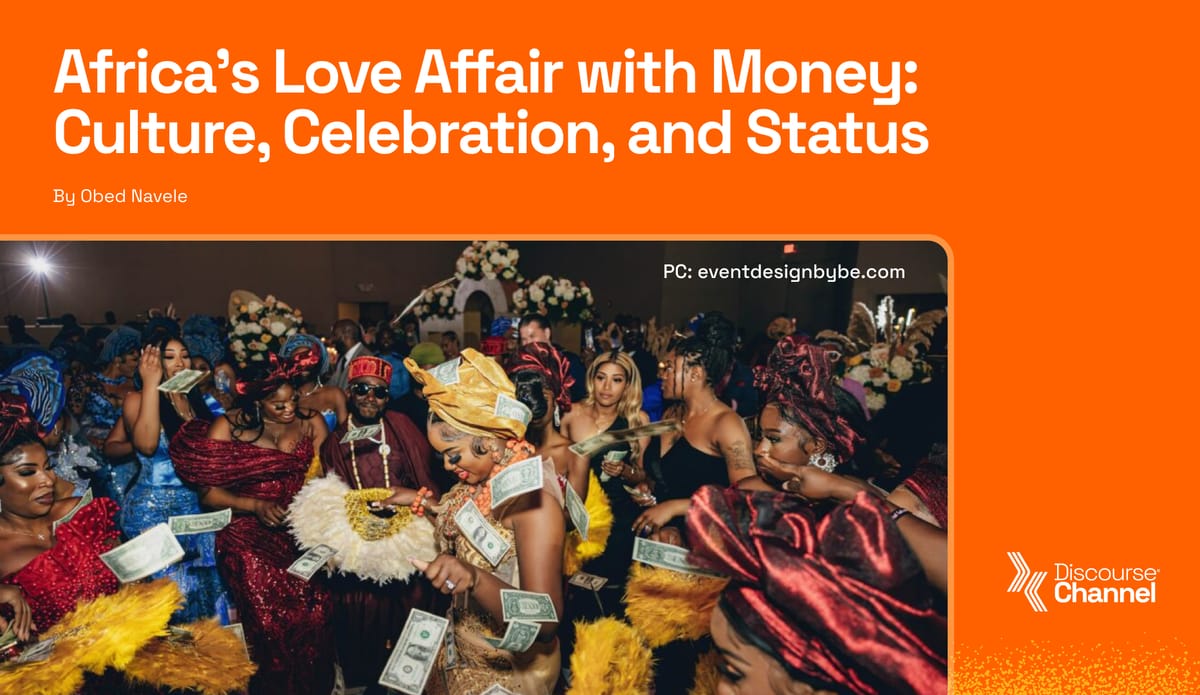
Money, often a medium of exchange, a store of value, and a unit of account. Economists define it through its functions, governments regulate it through monetary policies, and financial institutions safeguard its circulation. Yet across Africa, money has long carried meanings that extend far beyond economics. It is woven into celebrations, social relationships, cultural identity, and public expressions of love, honour, and success; whether at weddings in Nigeria and Ghana, naming ceremonies in Sierra Leone, graduation celebrations in Kenya, or festivals across the continent, the presence of money often symbolises something far deeper than mere financial wealth. Banknotes become messages; a note placed on a bride’s forehead, handed to a graduate, or presented to a performer communicates pride, appreciation, encouragement, and communal support.
This emotional connection has shaped what can be described as Africa’s unique love affair with money, one where it functions not only as an economic instrument but also as a cultural language. Today, however, that relationship is facing increasing scrutiny. Ghana, Nigeria, Zimbabwe, and other governments and central banks have introduced stricter measures against practices that damage or misuse national currencies. Activities such as spraying money, stepping on banknotes, writing on currency, or intentionally mutilating notes have attracted fines and, in some cases, criminal prosecution.
Authorities argue that national currencies are public assets whose integrity must be protected because replacing damaged notes costs taxpayers millions of dollars every year. This has sparked an important debate.

Behind every 'soft life' post lies a story of sacrifice, self-discovery, and the courage to defy expectations.
Can governments protect their currencies without disconnecting from the cultural traditions that have defined celebrations for generations?
The answer is far more complex than choosing between law and culture. For many Africans, the act of giving money publicly isn't necessarily about extravagance. Parents reward academic success with cash not merely because of its purchasing power, but because it symbolises confidence in a child’s future. Friends contribute money at weddings to help couples begin married life. Guests honour musicians, comedians, and dancers by presenting banknotes during performances, acknowledging artistic excellence in a way that words sometimes cannot.
These gestures reinforce collective identity and public displays of generosity. In many African communities, success is rarely celebrated as an individual achievement; it belongs to families, neighbourhoods, and entire communities, communicating that no one succeeds alone. Money, therefore, becomes a visible expression of social capital.
Across the continent, social life often revolves around reciprocity. Individuals are expected to contribute to weddings, funerals, festivals, religious ceremonies, and community projects. The amount one gives may reflect economic capacity, but the act itself signals belonging, which explains why financial gifts are often displayed publicly rather than exchanged privately.
Visibility creates unintended consequences.
Over time, what was once an expression of communal support has increasingly become associated with social status and prestige. Weddings compete to showcase wealth, and graduation ceremonies become stages for public displays of financial success. Social media amplifies these moments, transforming cultural practices into performances for wider audiences.
This shift has been widespread across Africa. In Nigeria, wedding clothes predominantly showed unity; now they show who has the most money, turning parties into expensive contests for social media likes and following. In Ghana, graduation ceremonies became so focused on showing off luxury gifts that the government had to stop them in 2026. In Kenya and South Africa, traditional marriage payments are no longer just symbols of respect; they are now used to prove how rich a family is. Social media makes this worse by encouraging people to care more about looking successful online than about celebrating with their community.
In this environment, a nation's currency represents not only appreciation but also social ranking. The pressure to “show up” financially has become particularly noticeable among younger generations. Some families feel compelled to spend beyond their means to meet societal expectations during celebrations. Others measure the success of events by the amount of money displayed rather than the significance of the occasion itself. The symbolism of generosity gradually shifts toward the symbolism of affluence. This transformation raises an uncomfortable question. Are people celebrating one another, or are they increasingly celebrating wealth itself?
Governments focus on a different concern.
Producing banknotes is expensive. Every damaged or mutilated note must eventually be replaced using public resources. Central banks invest heavily in designing secure currencies with advanced anti-counterfeit features, specialised materials, and durable printing technologies. When notes are torn, trampled, soaked, or intentionally damaged during celebrations, the financial burden ultimately falls on taxpayers. From this perspective, protecting a state's currency is not simply about preserving national symbols. It is also about protecting public resources.
In another dimension, national currencies embody sovereignty. Every banknote reflects a country’s history, institutions, heroes, and national identity. Just as flags are protected from deliberate desecration, governments argue that currencies deserve similar respect because they represent the nation itself. Seen through this lens, regulations against currency abuse are understandable. However, public acceptance of these laws often depends less on the regulations themselves than on how they are communicated and enforced. When governments criminalise long-standing cultural practices without providing alternative ways for people to express generosity, the laws risk being perceived as attacks on tradition rather than efforts to protect national assets. This is where policy must become more culturally intelligent.
Policy Intelligence
Successful public policy rarely succeeds by replacing culture overnight. Instead, it works by understanding why cultural practices exist before attempting to reshape them. Rather than focusing solely on punishment, governments could invest more in public education that explains the economic cost of replacing damaged banknotes. Communities are often willing to adapt when they understand the broader public interest behind new regulations. At the same time, cultural leaders, event organisers, traditional authorities, musicians, and religious institutions all have important roles to play in redefining acceptable ways of celebrating.
Innovation offers another opportunity
Africa is already leading parts of the world in digital financial inclusion. Mobile money services, digital wallets, QR-code payments, and instant bank transfers have become everyday realities across many African countries. Younger generations increasingly exchange gifts electronically, while crowdfunding platforms now support weddings, funerals, educational fundraising, and community development projects. These innovations suggest that expressions of generosity are evolving. The central tension pivots toward how Africans will choose to give, rather than whether they'll continue the long-lived tradition of giving. Future celebrations may rely less on physically handling banknotes and more on digital transfers projected onto screens, symbolic presentations, or creative alternatives that preserve the spirit of generosity without damaging national currencies.
Changes need not diminish existing traditions
Culture has never been static. African societies have continuously adapted to new technologies, political systems, religions, and economic realities while preserving the values that define them. The transition from cash-centred celebrations to digitally enabled generosity may simply represent another chapter in that ongoing evolution.
Ultimately, this conversation extends beyond money itself. It reflects the broader challenge facing many African societies today: balancing heritage with modernisation. Whether discussing digital governance, artificial intelligence, urbanisation, education, or financial systems, African countries are increasingly confronted with decisions that require protecting tradition while embracing change. The debate over a nation's currency is simply one example of a much larger policy question.
How can modernisation respect culture instead of replacing it?
Recognising that laws and traditions should not exist in opposition may provide a way forward. Governments have legitimate reasons to preserve the integrity of national currencies, just as communities have legitimate reasons to protect cultural expressions that strengthen social bonds. Neither objective should come at the complete expense of the other.
Africa’s relationship with money reflects more than spending; it showcases identity, celebration, gratitude, recognition, and belonging. Those meanings should not disappear simply because economies become more digital or regulations become more stringent.
The challenge for policymakers is not to end the continent’s love affair with money. It is to guide that relationship into forms that honour both cultural heritage and national responsibility.
If Africa can achieve that balance, then the continent will demonstrate something far more valuable than well-preserved banknotes. It will show that progress does not require abandoning tradition; it requires allowing tradition to evolve.“This isn’t just about Ghana learning from Ivory Coast or vice versa,” Sonia Toro reminded the room. “It’s about recognising each country’s unique path and asking, ‘What can we do together that we cannot do alone?
Digital Assets Summit Africa
Theme: From Policy to Prosperity: Scaling Digital Assets for Investment, Jobs & Economic Growth
16th - 17th Sept, 2026 | Kempinski Hotel, Accra, Ghana