UK-Ghana Green Growth Deal Targets Agricultural Infrastructure and Cold-Chain Expansion
A milestone UK–Ghana Growth Partnership agreement was signed in London, with a portion of a £215 million package directed toward agricultural transformation projects in Ghana.
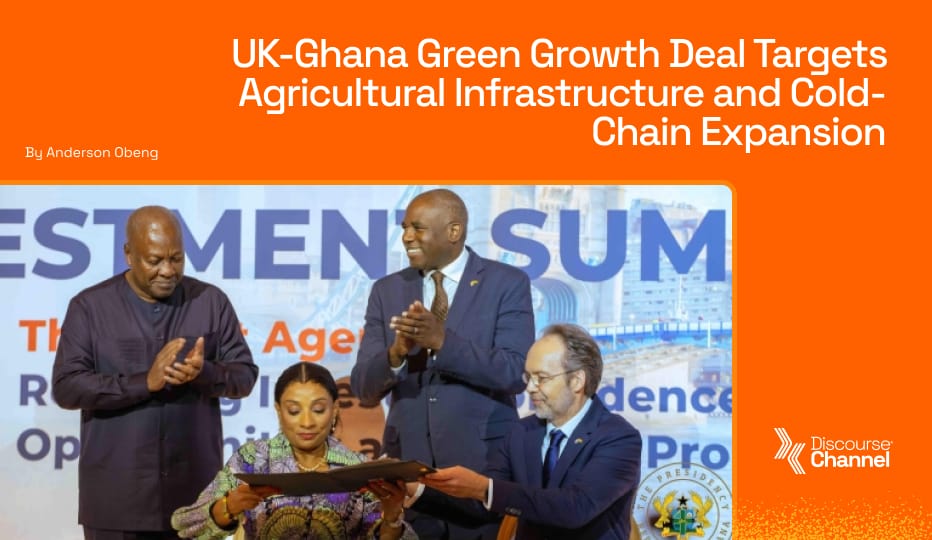
Food systems in Africa are increasingly being shaped less by farming alone and more by the infrastructure that connects production to markets. Cold storage, logistics, financing, and climate resilience are now central to whether agricultural output translates into real economic value. This week, a new UK–Ghana agreement signaled a stronger push in that direction.
The deal focuses on scaling commercial agricultural infrastructure, strengthening cold-chain logistics, and supporting modern farming systems designed for emerging agritech operators, particularly young farmers and agricultural entrepreneurs.
A key emphasis of the agreement is reducing post-harvest losses through improved storage and transport systems, an area that continues to limit agricultural productivity across many African markets. By investing in cold-chain infrastructure, the partnership aims to improve market efficiency and increase the shelf-life of perishable goods, enabling farmers to access broader and more stable markets.
The agreement also reflects a growing shift toward commercial-scale agriculture rather than purely subsistence-based support models. This includes integrating technology-driven farming methods, improved supply chain coordination, and investment in agribusiness ecosystems that can support long-term food security and export competitiveness.
What we are watching:
- Ghana’s Ministry of Food and Agriculture clarified that the previously reported concerns over agricultural funding were inaccurate, confirming that the GH¢1.67 billion 2026 agriculture budget allocation remains fully intact and committed to national food security programs.
- Regional assessments in Ghana’s Upper East region have raised concerns over rapidly declining grasslands, driven by worsening climate conditions.
The developments this week highlight the increasing link between agriculture, climate resilience, and infrastructure investment.
While funding commitments like the UK–Ghana deal aim to modernize agricultural systems, local climate pressures and resource constraints continue to challenge productivity at the ground level. The direction of policy and investment is increasingly shifting toward integrated food systems that combine infrastructure, climate adaptation, and commercial agriculture development.