AI Outsourcing Shift Reshapes Africa’s Tech Workforce
Reports surfaced this week pointing to a significant transition across segments of Africa’s tech and digital outsourcing workforce. Emerging AI automation agents are increasingly handling tasks such as content moderation, remote data entry, basic customer support...
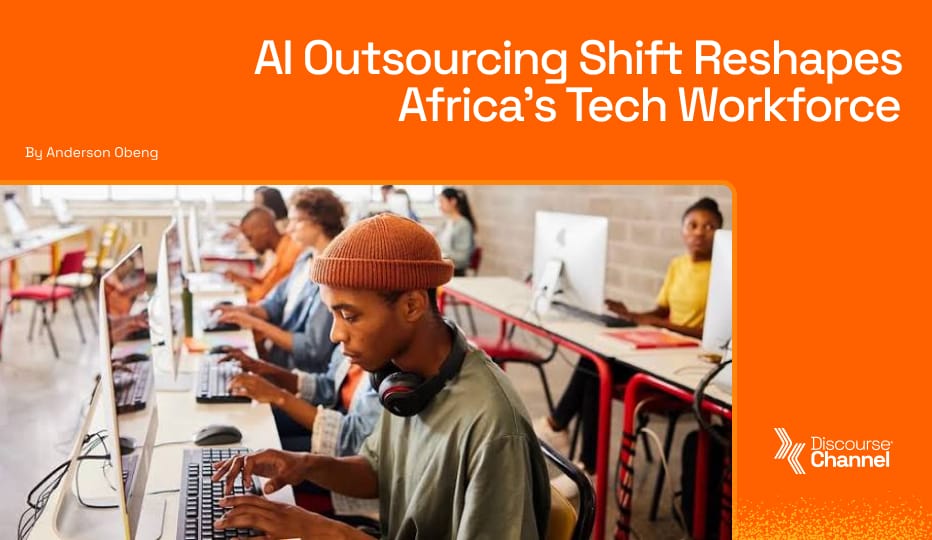
AI is no longer just changing how work is done in Africa’s digital economy, it is beginning to redefine who does the work in the first place. Entry-level digital tasks that once formed the backbone of online employment are increasingly being automated, forcing a rapid rethink of how the tech workforce is structured and trained.
Reports surfaced this week pointing to a significant transition across segments of Africa’s tech and digital outsourcing workforce. Emerging AI automation agents are increasingly handling tasks such as content moderation, remote data entry, basic customer support, and routine digital operations roles that previously absorbed large numbers of entry-level workers.
The shift is accelerating pressure on the traditional outsourcing model, particularly in markets where online gig work and digital support roles formed a key entry point into the global tech economy. As automation systems become more capable, companies are beginning to restructure operations around AI-first workflows, reducing reliance on human-led repetitive tasks.
At the same time, a more complex development is emerging globally. Several major technology companies are reportedly reassessing the cost-efficiency of large-scale AI deployment, with internal evaluations suggesting that in certain operational contexts, AI systems are becoming more expensive than human labour while delivering limited productivity gains. This has led to early-stage recalibration in some firms, particularly around scaling automation beyond pilot environments.
The combined effect is creating a dual pressure point: automation is displacing routine digital work at the entry level, while strategic reconsideration of AI economics is slowing full-scale replacement in some enterprise environments. The result is not a clean transition, but a restructuring phase where both human labour and AI systems are being recalibrated in real time.
This has immediate implications for Africa’s digital workforce, where many young professionals historically entered the tech ecosystem through outsourced digital services. The shift is now accelerating demand for advanced technical skills, particularly in AI engineering, data science, systems integration, and cloud infrastructure management.
What we are watching:
- African tech startups collectively reached an estimated $1.3 billion in venture capital funding in the first half of the year, according to industry trackers.
- Telkom released its fiscal 2026 impact report, highlighting the training of 1,524 unemployed youth through high-intensity ICT learnership programs.
The current shift suggests that Africa’s digital labour market is entering a transition phase defined by both disruption and re-skilling.
While AI systems are reducing demand for routine digital tasks, they are simultaneously increasing demand for higher-level technical expertise. At the same time, global reassessments of AI’s cost-effectiveness suggest that full automation may not progress as quickly or uniformly as once expected.
For Africa’s tech workforce, the next phase will likely be defined less by entry-level digital outsourcing and more by advanced technical capability, infrastructure development, and AI system integration.