Ghana’s New Test for State-Owned Enterprises
Ghana’s State Ownership Policy already provides for entity-specific key performance indicators covering areas such as financial performance, efficiency, productivity, service delivery and public-policy objectives. It also provides for remuneration to be linked to agreed KPIs.
For years, Ghana’s State-Owned Enterprises have faced a difficult question: how can institutions entrusted with public assets deliver better results without repeatedly becoming a financial burden on the state?
The government is now putting a different question to their leadership: what should happen when performance falls short?
A new push to link executive and board remuneration to measurable institutional performance is putting accountability at the centre of the debate. Under the 2026 Budget, the government says it has developed a performance-linked remuneration framework for public boards, while the Public Services Commission is working to connect public-sector pay more closely to productivity and measurable results.
For SOEs, the principle is straightforward: leadership should be assessed against agreed targets, with performance influencing remuneration and continued tenure.
But making that principle work will depend on something more difficult than setting targets, measuring performance fairly and enforcing the consequences.
More Than Profit
State-owned enterprises do not all exist for the same reason. Some are expected to operate commercially, while others provide essential services or pursue strategic public objectives. That means judging every SOE simply by whether it makes a profit would give an incomplete picture.
Ghana’s State Ownership Policy already provides for entity-specific key performance indicators covering areas such as financial performance, efficiency, productivity, service delivery and public-policy objectives. It also provides for remuneration to be linked to agreed KPIs.
The current push is therefore less about inventing performance measurement and more about making it consequential. A target that exists only on paper changes little. A target that determines whether an executive receives additional remuneration, remains in office or faces corrective action carries considerably more weight.
From Targets to Consequences
That is where the government’s current position becomes significant.
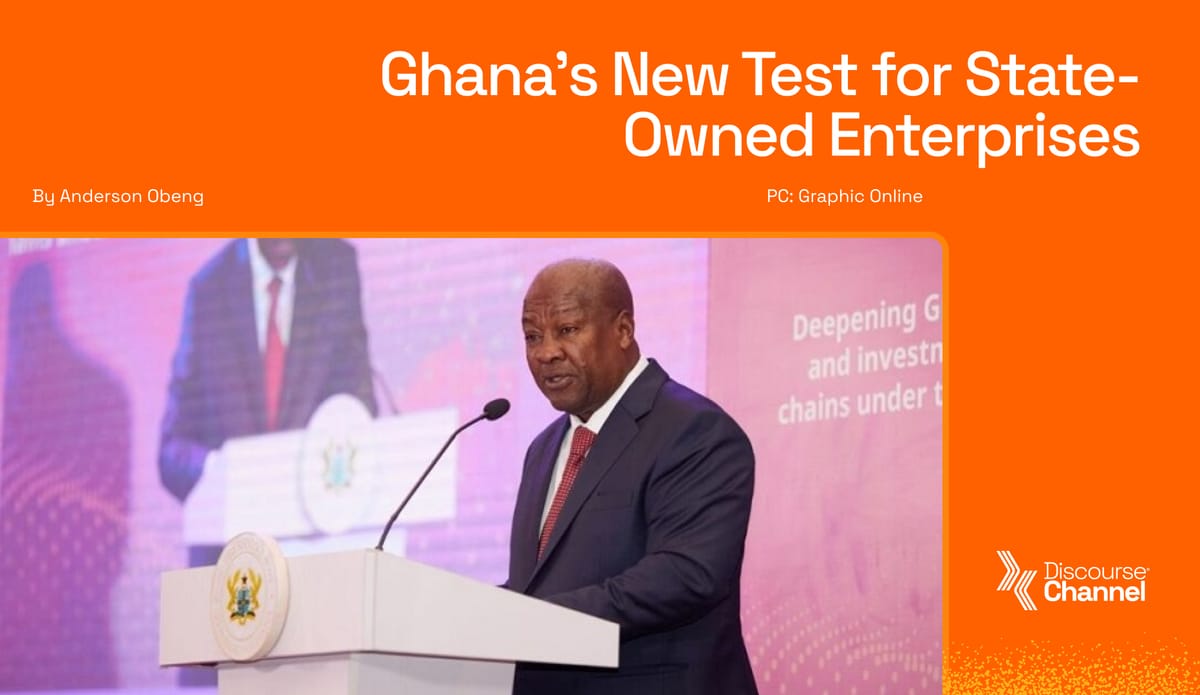
President John Dramani Mahama has said persistent SOE underperformance could lead to corrective measures, including changes to boards and chief executives. He has also argued that commercial SOEs should not continue to rely on government support as a permanent solution to poor performance.
The intended model is simple: Set targets. Measure results. Reward delivery. Address persistent failure.
The challenge is ensuring that the process is consistent.
If one institution is held strictly to its targets while another is given repeated exemptions, performance-based remuneration could become another administrative exercise rather than an accountability mechanism.
The Right KPIs Matter
The choice of indicators may ultimately determine whether the reform succeeds.
An SOE could increase revenue while allowing service quality to deteriorate. Another could reduce expenditure by cutting essential investment. A company might meet a short-term financial target while creating larger problems for itself several years later.
That is why performance cannot be reduced to one number.
The OECD’s guidelines on SOE governance caution against remuneration structures that encourage executives to prioritise short-term results at the expense of an enterprise’s long-term interests.
For Ghana, this means KPIs have to reflect the actual responsibilities of each enterprise.
Financial sustainability may be crucial for a commercial entity. Service reliability may matter more for a public utility. Productivity, governance, compliance and customer outcomes may also need to form part of the assessment.
The objective should be to measure whether an institution is actually fulfilling its mandate, not simply whether it has found a way to satisfy a narrow target.

The Future of Education isn't the Classroom, Here's Why?In this episode of Discourse Brief, we sit down with Professor Karen Ferreira-Meyers of the University of Eswatini's Institute of Distance Education at eLearning Africa 2026. She's spent over two decades building distance-learning infrastructure across Southern Africa; work that meant her institute was ready for COVID-19 fifteen years before it happened, while other universities scrambled for months.
Where Boards Fit In
Executive accountability also depends on clear lines between boards and management. Boards are responsible for oversight and strategic direction. Executives are responsible for managing the organisation.
That separation matters when performance is assessed.
If an SOE misses its targets, there needs to be a clear record of who was responsible for setting the strategy, who implemented it and who was responsible for oversight. Otherwise, performance-based pay could create another problem: accountability without clearly defined responsibility.
Why the Financial Pressure Matters
The debate is also taking place against continuing concerns about the financial position of some SOEs.
The IMF’s September 2026 assessment identified SOE liabilities as a continuing fiscal concern and pointed to losses in parts of the energy and commodity sectors as sources of pressure on public finances.
This is why SOE reform extends beyond executive salaries. When a state-owned enterprise consistently performs poorly and requires government support, the cost can ultimately fall on public finances.
But the answer cannot simply be to demand that every SOE maximise profit.
Some enterprises have public-service obligations that may not produce commercial returns but still serve an important public purpose. The real question is whether the cost of those obligations is understood, measured and transparently accounted for.
Transparency Is the Missing Link
If an executive receives a bonus, the public should be able to understand which targets were achieved. If an institution is classified as underperforming, there should be evidence showing why.
SIGA already publishes State Ownership Reports covering the financial and operational performance of state entities, including its 2025 report released in August 2026.
That reporting becomes even more important when remuneration and leadership decisions are tied to performance. Without transparent data, the system risks becoming another internal government process that the public cannot independently understand.
The Real Test
Linking public-sector pay to performance is easy to announce.
The harder task is creating a system in which targets are realistic, measurements are credible, responsibilities are clear and consequences are applied consistently. If that happens, the reform could change the relationship between public ownership and executive accountability.
If it does not, KPIs could become little more than numbers on a document. For Ghana’s SOEs, the bigger question is therefore not simply whether executives should be paid according to performance.
It is whether the country can build a system in which public institutions are measured honestly, poor performance has consequences and public assets deliver demonstrable value to the people they ultimately belong to.