Why UNEP Says the Next Climate Battle Is About Limiting the Overshoot
UNEP’s September 2026 Limiting Overshoot report says global warming is likely to exceed 1.5°C above pre-industrial levels within the next few years. But it does not describe that threshold as a point beyond which climate action becomes pointless.
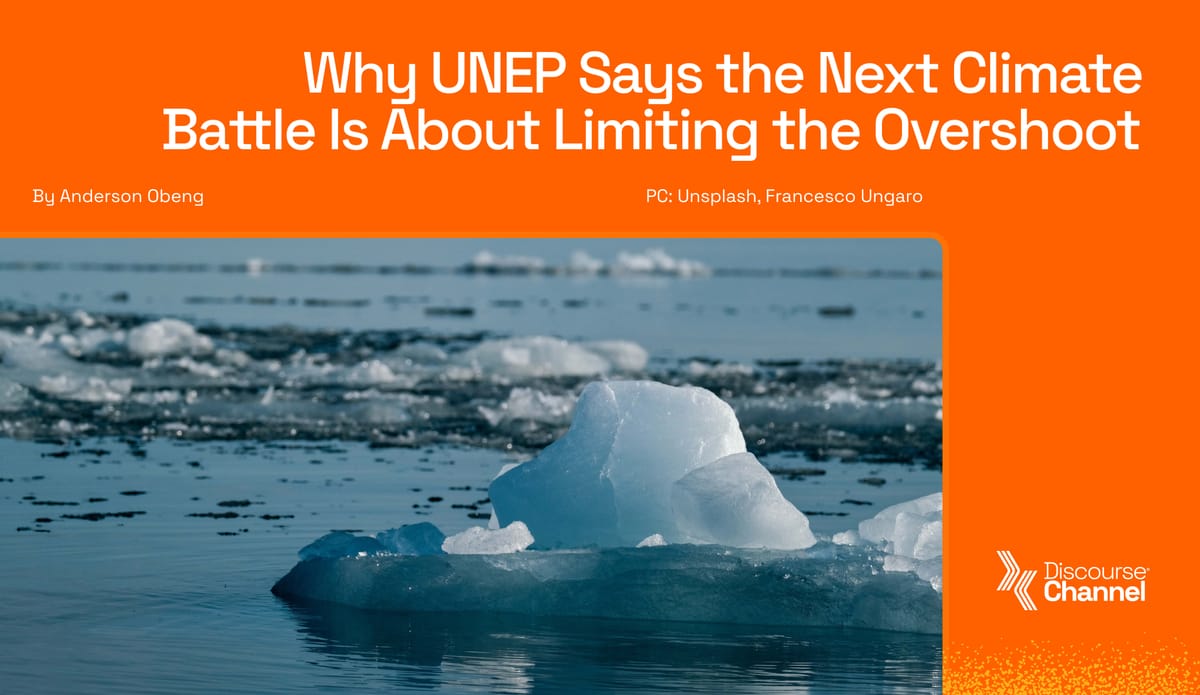
For years, 1.5°C has been treated as a line the world must avoid crossing. A new United Nations Environment Programme report suggests the climate debate now needs to confront a harder reality: the world is likely to cross that line, but what happens afterwards is still being decided.
UNEP’s September 2026 Limiting Overshoot report says global warming is likely to exceed 1.5°C above pre-industrial levels within the next few years. But it does not describe that threshold as a point beyond which climate action becomes pointless.
Instead, it introduces a different challenge: keep the temperature rise above 1.5°C as small and short-lived as possible, reach a peak, and eventually bring global temperatures back down. The distinction matters.
Crossing 1.5°C does not mean the world suddenly moves into an entirely different climate. It means that risks that are already increasing become more severe as warming continues, while the possibility of reversing some of that warming becomes more difficult.
1.5°C Is a Long-Term Threshold, Not a Single Hot Year
One important distinction is often lost in discussions about the 1.5°C target. The Paris Agreement goal concerns long-term global warming, rather than whether a single calendar year happens to be above 1.5°C.
The world experienced its first calendar year above 1.5°C in 2024. UNEP’s new report says the longer-term warming level is now likely to cross the threshold within the coming years. That means the significance of the latest report is not simply that the planet recorded a particularly hot year. It is that the underlying warming trend is moving the world towards a sustained period above the Paris temperature goal.
The Overshoot Problem
UNEP describes the future as an “overshoot, peak and decline” pathway.
Under this approach, temperatures would first exceed 1.5°C, eventually reach a peak and then decline as greenhouse-gas concentrations are reduced.
The size of that peak matters.
UNEP says the most optimistic scenario in its assessment would see a warming peak at around 1.8°C. Other scenarios produce higher peaks. So 1.8°C should not be understood as a forecast that the world is guaranteed to reach.
It represents the peak under the most optimistic pathway examined by the report. That distinction is important because the trajectory is not fixed. The emissions cuts made over the next decade will influence how high warming rises and how long it remains elevated.
Every Fraction of a Degree Matters
The central message of the report is that crossing 1.5°C does not make the difference between 1.6°C, 1.8°C and higher levels irrelevant.
UNEP says climate impacts intensify with every additional fraction of a degree and with every year spent at higher temperatures. These risks include worsening extreme weather, ecosystem losses, pressure on food and water systems, health impacts and damage to infrastructure and economies.
The report also highlights concerns about climate tipping points, including risks involving major ice sheets, the Amazon rainforest and the Atlantic Meridional Overturning Circulation.
The science around individual tipping points contains significant uncertainty, but the basic principle is clear: greater and longer-lasting warming increases exposure to potentially irreversible changes. This is why the report does not treat 1.5°C as a simple pass-or-fail target.
A world at 1.6°C is not equivalent to one at 1.9°C.
Returning Below 1.5°C Will Be Much Harder
The more difficult part of UNEP’s message is what happens after temperatures peak.
Reaching net-zero emissions can eventually stop additional warming, but returning global temperatures below 1.5°C would require net-negative emissions, removing more greenhouse gases from the atmosphere than are being emitted. This is where carbon dioxide removal enters the discussion.
Carbon dioxide removal can involve approaches such as reforestation and other methods of extracting carbon dioxide from the atmosphere and storing it.
But UNEP does not present carbon removal as a substitute for cutting emissions.
That is because relying too heavily on future carbon removal creates another risk: assuming technologies will be able to remove enormous quantities of carbon later to compensate for emissions that are not reduced today.

The Future of Education isn't the Classroom, Here's Why?In this episode of Discourse Brief, we sit down with Professor Karen Ferreira-Meyers of the University of Eswatini's Institute of Distance Education at eLearning Africa 2026. She's spent over two decades building distance-learning infrastructure across Southern Africa; work that meant her institute was ready for COVID-19 fifteen years before it happened, while other universities scrambled for months.
Adaptation Cannot Wait for the Temperature to Come Down
Even if the world eventually returns below 1.5°C, some consequences of the period above the threshold will not simply disappear.
UNEP warns that some losses and changes will be irreversible, meaning communities will have to adapt to conditions that cannot easily be restored to what they were before.
That makes adaptation just as important as emissions reduction.
Cities need to prepare for extreme heat and flooding. Agricultural systems need to become more resilient. Water infrastructure must withstand changing rainfall patterns. Coastal communities face increasing exposure to sea-level rise.
The report therefore argues that mitigation and adaptation cannot be treated as separate climate agendas.
Both have to accelerate at the same time.
The Cost Will Not Be Shared Equally
The consequences of overshoot also raise a question of climate justice. Countries and communities that have contributed relatively little to historical greenhouse-gas emissions can still face some of the most severe consequences of warming.
For vulnerable countries, higher temperatures can translate into agricultural losses, water stress, extreme heat, displacement and pressure on already limited public resources.
UNEP’s report therefore connects overshoot with questions of equity, governance and finance. It argues that countries with greater historical responsibility have a greater role in climate action and that substantially more finance will be required to help vulnerable societies adapt.
The debate is therefore not only about how quickly global emissions can fall.
It is also about who pays for adaptation and who bears the consequences when adaptation reaches its limits.
The Window Is Narrowing, Not Closing
UNEP’s message is serious, but it is not that the 1.5°C goal has become meaningless. In fact, the report argues the opposite.
Every fraction of a degree avoided can reduce climate damage. Every year by which the period of overshoot is shortened reduces the time people and ecosystems are exposed to higher temperatures.
That means the world’s choices still matter even if 1.5°C is temporarily exceeded. The question has changed from “Can we avoid overshoot completely?” to “How high will the overshoot be, how long will it last, and can we bring temperatures back down?”
The Bigger Question
The 1.5°C threshold was never a promise that temperatures below it would be safe. It was a political and scientific goal intended to limit the severity of climate change.
UNEP’s latest report suggests the world is approaching a period in which that goal may temporarily be exceeded. But it also makes clear that the consequences will depend heavily on what happens next. A peak of 1.8°C followed by a sustained decline is a very different pathway from continued warming beyond 2°C.
That is why the report’s central message is not that the climate battle has been lost. It is that the cost of delay is becoming increasingly difficult to reverse.
The world may be approaching an era above 1.5°C. The remaining question is whether governments can act quickly enough to ensure that the overshoot is as low and as brief as possible and eventually bring global temperatures back down.