Building Ghana’s Next Power Hub: Inside the Green Digital City Plan
In Accra, Ghana, traffic gridlock is estimated to cost the Ghanaian economy about GH¢4.5 billion every year. This stark macroeconomic reality represents an invisible, ongoing tax on the working population, collected daily in lost hours, depleted incomes and diminished productivity.
In Accra, Ghana, traffic gridlock is estimated to cost the Ghanaian economy about GH¢4.5 billion every year. This stark macroeconomic reality represents an invisible, ongoing tax on the working population, collected daily in lost hours, depleted incomes and diminished productivity, and it directly compromises the competitiveness of the capital itself.
The gridlock is a symptom. Greater Accra carries the political, commercial, administrative and cultural functions of the state within a single coastal conurbation, a concentration built by decades of uncoordinated growth and weak spatial planning. The national projected population for Ghana in 2026 is 34,378,768 according to the Ghana Statistical Service, while total national estimates stand around 35.7 million, and the pressure is visible in perennial flooding, expanding slums, unmanaged waste and an overcrowded central business district. When every ministry, market and financial institution competes for the same narrow corridors, urban stress ceases to be a municipal inconvenience. It becomes a national structural liability.
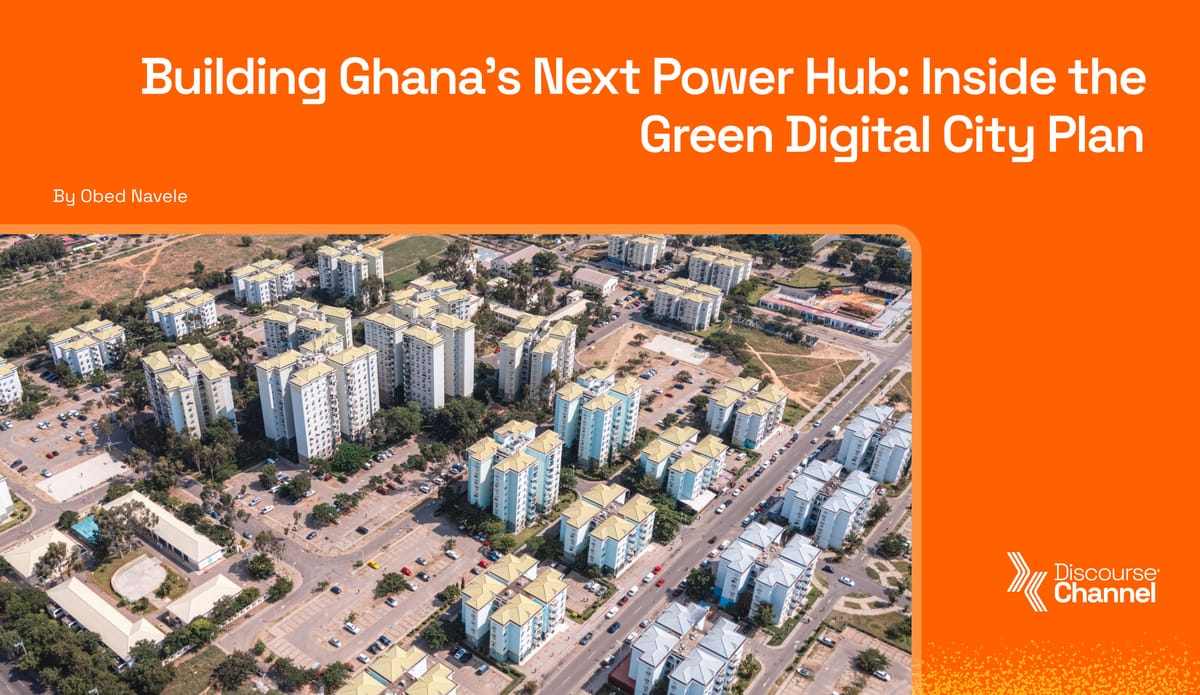
Precisely, this pressure hovered over the Dodowa durbar of May 2025, where President John Dramani Mahama declared that Accra is overstretched and a long-term solution was due. The proposal he outlined was not a replacement capital. It was a Green Digital City on the Accra Plains, a secondary administrative and commercial hub to receive selected ministries, departments, agencies and financial institutions, while Accra remains the capital. In July 2026, the President confirmed that he had received the procurement report to begin consultancy and feasibility work. The plan has therefore moved from campaign proposition to institutional process, and the real scrutiny begins now.
Ghana's Path Through Decongestion, Design and Distribution
To grasp the systemic weight of the moment, one requires an unblinking, rigorous deconstruction of the project's three core pillars.
Decongestion: This is the foundational concept. The city is intended to relieve Accra by relocating a portion of state functions to a site stretching from the Dawa Industrial Zone, through the Saglemi Housing Estate and the Bundase Military Range, into the Eastern and Volta regions, linked to Accra by an expressway and a railway line. Yet relocation alone does not decongest anything. If workers, services and informal commerce continue to orbit the old centre, the traffic merely changes direction. True decongestion demands that the new city generate its own economic gravity, with residents who live, work and spend there rather than commute from Accra.
Design: If we must talk about design, we must answer the question: can a city be engineered correctly from the first day? The President has promised modern drainage, good sanitation and distinct enclaves for industry, residences, offices, commerce and finance. For a capital that floods routinely, a master-planned drainage network is a decisive advantage over retrofitting a dense existing city. However, the same promise that there will be no kiosks and containers carries a quiet tension. The informal economy sustains a large share of Ghanaian livelihoods, and a city designed without a place for it is designed for someone other than the majority.
Distribution: This is the national scaling mechanism. A project spanning three regions is not only an Accra story. It can redistribute administrative activity, investment and employment toward the Eastern and Volta regions, or it can simply relocate privileges a few kilometres inland. The measure of the project will be who is able to live in it, work in it, and afford to move around in it.
What this means for Africa: Ghana's pillars mirror a continental pattern. Across the continent, one primate city absorbs every national function, and the burden it carries is a design inheritance rather than a local accident.
Balancing Urban Opportunity and Structural Risk
The possibilities of a planned second centre are undeniable. A new growth pole can create construction and service employment, modernise public administration and relieve the central business district of functions it was never built to hold. Land on the Accra Plains is available, and the Volta region offers abundant water.
Yet, as a matter of rigorous economic honesty, these possibilities must be violently contrasted with the record. A study of Africa's new capital projects, including Abuja, Dodoma, Gaborone and Lilongwe, found them expensive, overwhelmed by rapid urbanisation, socially exclusionary and short on public participation, with informal settlements and businesses disrupted along the way. Egypt's New Administrative Capital, built at an estimated $45 billion, is accused by critics of being a city financed by borrowing for the benefit of the rich. In its early years, officials faced commutes of around two hours each way while the rail link remained unfinished. Earlier research on Cairo's satellite cities showed a recurring outcome: many stayed reliant on the parent city or were eventually absorbed by it.
The plan carries its own exposures. It is a 20-year project, while electoral mandates last four years. The feasibility study, which should determine whether the city is viable, is only now beginning. Much of the financing is expected to come from the private sector and public-private partnerships. This is the Enclave Trap. A city designed for investors and civil servants, priced beyond ordinary citizens, risks reproducing the exclusions of the old capital under a greener label.
What this means for Africa: Ghana's decision will be read as a test case. If it produces an inclusive city, it strengthens the argument for planned expansion. If it produces an enclave, it adds one more cautionary tale.
Frontier Planning: Redefining Ghana's Role from Managing Crowded Coastlines to Authoring Planned Corridors
To break the cycle of reactive urban management, Ghana must evolve from a custodian of congestion into the architect of its own geography. This requires the new city to be planned as a corridor instead of a destination, connected on day one to the systems that make cities work.
The Rail and Expressway Nexus: The promised railway and expressway are not accessories. They are the difference between a functioning second centre and a remote office park. Transport must be operational before relocation begins, priced for ordinary commuters and integrated with the existing mobility of Accra, so that civil servants are not stranded between two cities.
The Housing and Informality Nexus: The city must absorb the realities that Accra already manages: informal trade, affordable rental housing and the livelihoods of low-income workers. Planning that accommodates the informal economy from the outset is cheaper and more durable than evicting it later.
The Collective Accountability Framework
Real success can no longer be measured by hollow metrics like ground breaking ceremonies, artists' impressions and announced masterplans. It must be verified through hard structural outcomes: reduced commuting hours, genuine job creation beyond the construction phase, affordable housing actually occupied, and a measurable easing of pressure on Accra. Achieving this requires coordinated execution across the societal matrix.
Government and Policymakers: Publish the feasibility study, cost projections, and land-acquisition plans for public scrutiny. Anchor the project in legislation that survives changes of government, and sequence transport infrastructure ahead of relocation.
Developers and Investors: Move beyond the logic of prestige real estate. Commit to affordable housing quotas, transparent contracts, and long-term stewardship over short-term returns.
Planners and Traditional Authorities: Protect landholding communities in the Greater Accra, Eastern and Volta regions through fair consultation and compensation, and ensure that chiefs and local assemblies have a voice in shaping the city.
Citizens and Civil Society: Demand disclosure, monitor budgets and insist that the city serve the whole country, not an insulated minority.
Ghana has long been a country of ambitious declarations, and the history of such projects across the continent is sobering. Whether the Green Digital City becomes a functioning second centre or a well-phrased promise is a question only the coming years can answer. The test is not whether Accra needs relief. It plainly does. The test is whether the planning failures that overloaded Accra are corrected before they are inherited by the city built to rescue it. Action, not rhetoric, will prove whether this time is different.