Africa Continues to Fight for Security Until It Has a Say in Its Own Peace
At the 81st UN General Assembly, African leaders made an argument repeated at every session for years. The continent sits in the Security Council's agenda yet it has no permanent place at its table.
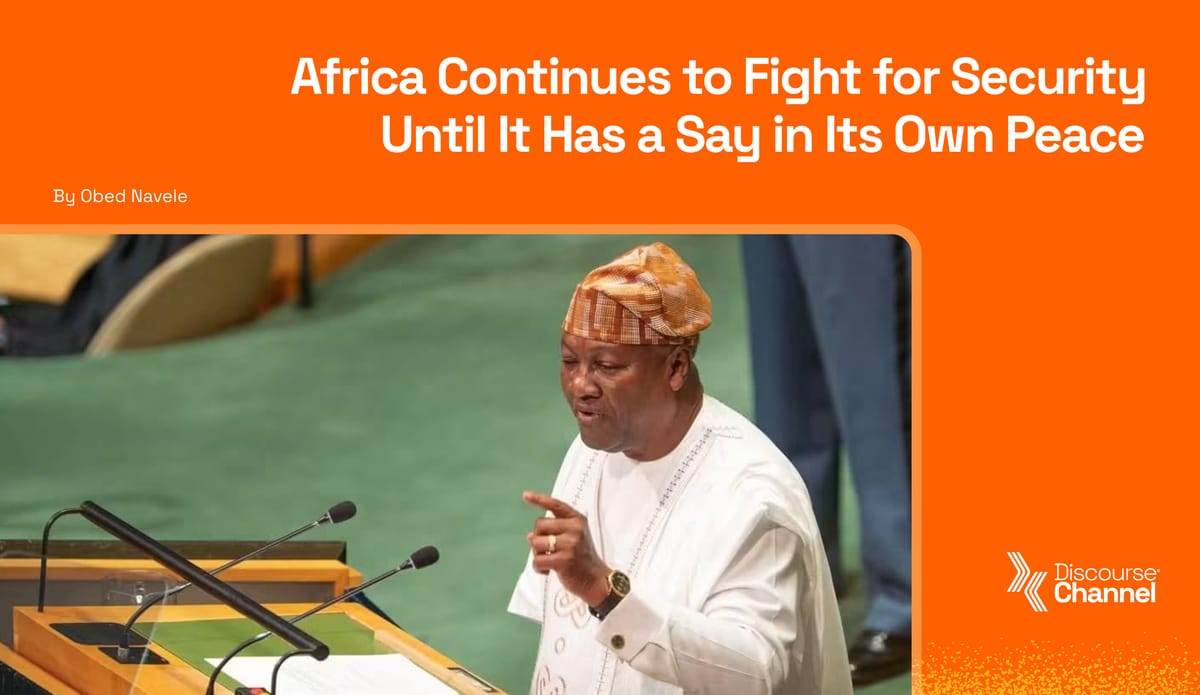
At the 81st UN General Assembly, African leaders made an argument repeated at every session for years. The continent sits in the Security Council's agenda yet it has no permanent place at its table. The speeches were however sharper this time, and the unity among African delegations was palpable. The fixed rules of the Council, and the empty accounts of the institutions Africa has built to secure itself were left unchanged.
This is the real tension behind the headlines. Africa is fighting on two fronts at once: for influence in a global system built in 1945, and for the capacity to lead at home. Winning the first without the second would give Africa a seat and not much else.
The Global Conversation: The UNSC Reform Imperative
African nations currently supply nearly half of all military personnel serving in United Nations peacekeeping operations worldwide and host approximately 80 percent of all deployed peacekeepers globally, yet the continent possesses no permanent representation on the UN Security Council. This structural anomaly was a central point of contention during the 81st United Nations General Assembly (UNGA 81), where African leaders articulated a renewed demand to dismantle a global security architecture established in 1945 without African input. The continent's unified position, articulated in the 2005 Ezulwini Consensus and Sirte Declaration, explicitly demands at least two permanent seats on the Security Council featuring full veto prerogatives, alongside five non-permanent seats reserved for African states. Although major global powers routinely offer rhetoric in support of African representation, their proposals are routinely hindered by geopolitical self-interest. Washington’s backing for permanent African seats explicitly excludes veto authority, London and Paris condition reform on broader enlargement models opposed by competing international factions, and Beijing aligns its endorsement with wider diplomatic realignments. Consequently, the international body charged with making decisions on African crises continues to operate without permanent, structural decision-making authority from the continent itself.
Africa’s Security Reality: Interconnected Threats and Regional Fractures
This push for global institutional reform is driven by an increasingly fragile security reality across sub-Saharan Africa, where security threats cross national boundaries with increasing speed. The rise of non-state armed groups, violent extremism, and unconstitutional changes of government has tested existing regional security mechanisms. In West Africa for instance, the security framework has experienced severe fragmentation following military coups. The decision by Burkina Faso, Mali, and Niger to withdraw from the Economic Community of West African States (ECOWAS) and establish the Alliance of Sahel States (AES) has broken decades of regional integration. This institutional divide severely limits intelligence sharing and joint counterterrorism initiatives at a moment when insurgencies threaten to expand into coastal West African territories.
In Central and Southern Africa, the crisis in the eastern Democratic Republic of the Congo (DRC) exposes similar challenges with regional deployments. The resurgence of the March 23 Movement (M23) and its seizure of strategic urban hubs highlighted the operational limitations of regional forces. The rapid exit of the East African Community Regional Force (EACRF) in late 2023, followed by the deployment of the Southern African Development Community Mission in the DRC (SAMIDRC), demonstrated how differing political mandates among neighboring states hinder collective defense. Hobbled by state fragility, resource limitations, and unresolved regional rivalries involving neighboring states, these deployments illustrate that military interventions lacking unified political agreement cannot deliver enduring peace.
The Power and Resource Question: The Stagnation of Resolution 2719
The main challenge facing African security self-determination remains the gap between operational responsibility and financial independence. Historically, international donors have funded over two-thirds of the AU’s peace and security activities, granting external actors significant leverage over continental policy decisions. To address this challenge, the UN Security Council unanimously adopted Resolution 2719 in December 2023, creating a formal framework for UN-assessed contributions to cover up to 75 percent of the costs for AU-led peace support operations. Designed to pair UN funding stability with African operational responsiveness, the resolution was initially seen as a landmark step forward in international peace architecture.
However, two years after its adoption, Resolution 2719 remains largely unimplemented, bogged down by administrative obstacles and political resistance. To date, no African mission has successfully accessed UN funds through this mechanism. A key obstacle is the requirement for African states to mobilize the remaining 25 percent of mission costs, which places a heavy burden on the AU Peace Fund. Additionally, political opposition in donor capitals has created further complications, as shown by legislative efforts in the United States Senate to limit the use of assessed contributions for successor missions like the African Union Support and Stabilisation Mission in Somalia (AUSSOM). Combined with strict UN compliance guidelines regarding human rights monitoring and financial auditing, these institutional barriers risk converting a key reform framework into an unfulfilled promise.
Beyond the Seat: Translating Representation into Genuine Influence
None of this means the fight for representation is misplaced. A Council that decides the fate of a continent without its permanent voice will ultimately contend with a legitimacy problem, and Africa is right to point that out. But a seat is a platform, not a strategy. Without the means to back its positions, a permanent African member could find itself speaking from the table while others still control the funding, the logistics and the pen holding.
Meaningful influence would need several things working together. It would need a clear, agreed AU position on which countries hold the seats and how they answer to the continent. It would need predictable financing, whether through a working Resolution 2719, a better-funded Peace Fund or larger national contributions. It would need regional mechanisms that coordinate. And it would need African leadership of the Council's own work on African files, from drafting resolutions to leading missions.
There is a case for treating the two fights as one. Every time an African-led mission runs out of money, it strengthens the argument that Africa lacks the capacity to lead, which in turn weakens the claim to a permanent seat. Every time Africa funds and sustains its own operations, the claim gets stronger.
UNGA 81 will pass into the record as another session in which African leaders spoke with one voice. The test is what happens after the delegations leave New York: whether the extraordinary financing session in November produces real commitments, and whether the continent can show that its demand for a say in its own peace is backed by the ability to deliver it.