Africa's Talent Pipeline: the deficit, the diagnosis, and the skills that decide what comes next.
Every ten years, Africa adds roughly the equivalent of Germany's entire population to its youth workforce. However, the continent currently creates only enough formal jobs for about a quarter of them.

From the Desk of The Bureau
Let's start with the number that refuses to move: roughly 20. That is Africa's median age, according to recent UN estimates, so half the continent is younger than that. Each year, an estimated 10 to 12 million young Africans enter the labour market. Around three million formal jobs are created to meet them.
For a decade, this has been told as a windfall. In 2015, the IMF projected that by 2035, more sub-Saharan Africans will reach working age than the rest of the world combined. But a dividend is not a gift of demography. It is a decision, and the clock on that decision is already running.
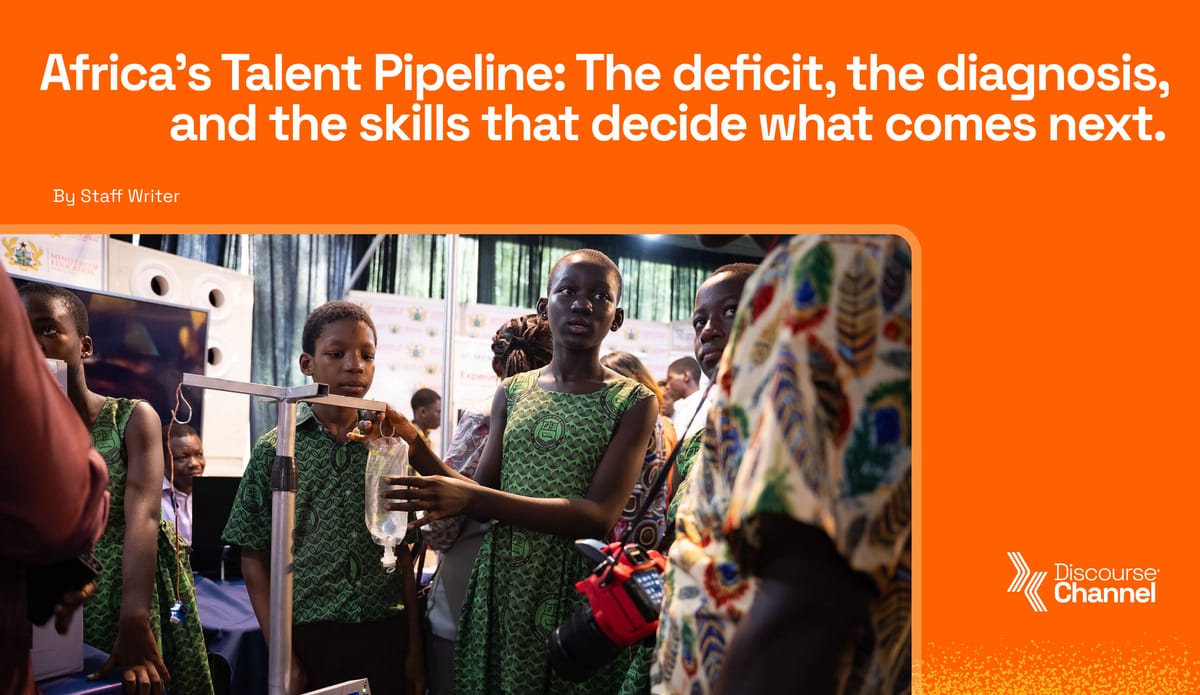
In Accra this June, eLearning Africa convened its 19th edition under a theme that doubled as a verdict: Africa's Time, Africa's Terms. Across three days, the conversations kept circling the same questions. Does what young people learn match what employers hire for? Who builds, owns and governs the platforms, data systems and AI tools now entering the classroom? How far can technical and vocational training stretch when the formal economy is this narrow? Ghana's Education Minister set the tone at the opening, urging African countries to build and deploy their own digital solutions.
The Bureau's read from the floor: the debate has moved. Access to devices and connectivity still matters, but the sharper question is now alignment and ownership. Skills that don't lead to work are a cost. Systems Africa doesn't shape will end up shaping Africa.
What follows is our attempt to measure the deficit, diagnose the gap, and ask what digital education, training and skills development can do about it, on the continent's terms.
This report is written for the people who will decide whether Africa's talent pipeline becomes a dividend or a deficit: policymakers and education ministries shaping national skills strategy, investors and development finance institutions looking for where capital meets real learner and employer demand, edtech founders and training providers building for scale rather than pilots, and employers and industry leaders who need job-ready talent on the continent. If you are making decisions about Africa's next phase of digital education, training and skills development, this is your brief.
Download The Wager today and help build the continent's future on the continent's terms.